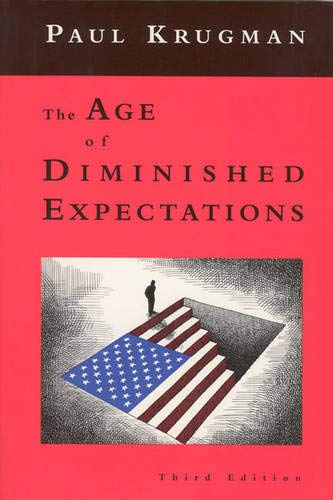

The age of diminished expectations : U.S. economic policy in the 1990s / Paul Krugman.
Detalles de publicación: Cambridge, Mass. : MIT Press, 1997.Edición: 3rd edDescripción: xii, 232 p. : ill. ; 24 cmTipo de contenido:- 0262112248
- 23 330.0112 K943a3
- HC106.8 .K78 1997
| Imagen de cubierta | Tipo de ítem | Biblioteca actual | Biblioteca de origen | Colección | Ubicación en estantería | Signatura topográfica | Materiales especificados | Info Vol | URL | Copia número | Estado | Notas | Fecha de vencimiento | Código de barras | Reserva de ítems | Prioridad de la cola de reserva de ejemplar | Reservas para cursos | |
|---|---|---|---|---|---|---|---|---|---|---|---|---|---|---|---|---|---|---|
| Libro | Biblioteca Encarnación Valdés Colección General bev | 330.0112 K943a3 (Navegar estantería(Abre debajo)) | Disponible | 80000002184086 |
Descripciones mejoradas de Syndetics:
Paul Krugman's popular guide to the economic landscape of the 1990s has been revised and updated to take into account economic developments of the years from 1994 - 1997. New material in the third edition includes: A new chapter--complete with colorful examples from Llyod's of London and Sumitomo Metals--on how risky behavior can lead to disaster in private markets. An evaluation of the Federal Reserve's role in reining in economic growth to prevent inflation, and the debate over whether its targets are too low. A look at the collapse of the Mexican peso and the burst of Japan's "bubble" economy. A revised discussion of the federal budget deficit, including the growth concern that Social Security and Medicare payments to retiring baby boomers will threaten the solvency of the government. Finally, in the updated concluding section, the author provides three possible scenarios for the American economy over the next decade. He warns us that we live in age of diminished expectations, in which the voting public is willing to settle for policy drift--but with the first baby boomers turning 65 in 2011, the economy will not be able to drift indefinitely.
Includes index.
Notas de autor provistas por Syndetics
Paul Krugman was born on February 28, 1953. He received a B.S. in economics from Yale University in 1974 and a Ph.D from MIT in 1977. From 1982 to 1983, he worked at the Reagan White House as a member of the Council of Economic Advisers. He taught at numerous universities including Yale University, MIT, UC Berkeley, the London School of Economics, and Stanford University before becoming a professor of economics and international affairs at Princeton University in 2000. He has written over 200 scholarly papers and 20 books including Peddling Prosperity; International Economics: Theory and Policy; The Great Unraveling; and The Conscience of a Liberal. Since 2000, he has written a twice-weekly column for The New York Times. He received the 1991 John Bates Clark Medal and the 2008 Nobel Memorial Prize in Economic Sciences. His title End This Depression Now! made The New York Times Best Seller List for 2012.(Bowker Author Biography)