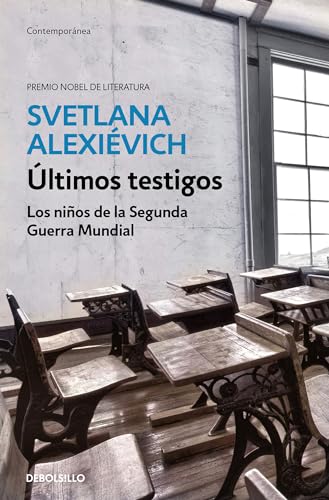

Ultimos testigos : los niños de la Segunda Guerra Mundial / Svetlana Alexiévich ; traducción de Yulia Dobrovolskaia y Zahara García González.
Barcelona : Penguin Random House Grupo Editorial, 2017Descripción: 334 páginas ; 19 cmTipo de contenido:- 9788466341486
- 940.534709253 A384pE
| Imagen de cubierta | Tipo de ítem | Biblioteca actual | Biblioteca de origen | Colección | Ubicación en estantería | Signatura topográfica | Materiales especificados | Info Vol | URL | Copia número | Estado | Notas | Fecha de vencimiento | Código de barras | Reserva de ítems | Prioridad de la cola de reserva de ejemplar | Reservas para cursos | |
|---|---|---|---|---|---|---|---|---|---|---|---|---|---|---|---|---|---|---|
| Libro | Biblioteca Mons. Iñaki Mallona (Arecibo) Colección General ab | 940.534709253 A384p E (Navegar estantería(Abre debajo)) | 1 | Disponible | 60000010165782 |
Descripciones mejoradas de Syndetics:
Uno de los mejores libros del Siglo XXI según el New York Times
De la Premio Nobel de Literatura 2015, una obra maestra inédita hasta ahora que recoge el recuerdo de los niños que sobrevivieron a la segunda guerra mundial.
Un tema de gran interés desde una perspectiva totalmente distinta. La Segunda Guerra Mundial dejó casi trece millones de niños muertos y, en 1945, solo en Bielorrusia, vivían en los orfanatos unos veintisiete mil huérfanos, resultado de la devastación producida por la guerra en la población de ese país. A finales de los años ochenta la Premio Nobel Svetlana Alexiévich entrevistó a aquellos huérfanos y compuso con sus testimonios un emocionante relato de una de las mayores tragedias de la historia.
Esta obra maestra inédita constituye un retrato personal y profundamente conmovedor del conflicto en el que la propia autora no interviene más allá del prólogo: son sus protagonistas los que hablan conformando con sus palabras una especie de memoria coral de la guerra, original, auténtica y fascinante.
«[...] por su escritura polifónica, que es un monumento al valor y al sufrimiento en nuestro tiempo.», palabras del Jurado de la Academia Sueca al otorgar a la autora el Premio Nobel de Literatura 2015. «Me dedico a la historia omitida, las huellas imperceptibles de nuestro paso por la tierra y por el tiempo. Recojo la cotidianidad de los sentimientos, los pensamientos y las palabras. Intento captar la vida cotidiana del alma.»
Svetlana Alexiévich
ENGLISH DESCRIPTION
One of the New York Times 's 100 Best Books of the 21st Century
NAMED ONE OF THE TEN BEST BOOKS OF THE YEAR BY THE WASHINGTON POST AND PUBLISHERS WEEKLY
LOS ANGELES TIMES BOOK PRIZE WINNER NAMED ONE OF THE BEST BOOKS OF THE YEAR BY
* The New York Times
* The Washington Post
* The Boston Globe
* The Wall Street Journal
* NPR
* Financial Times
* Kirkus Reviews
When the Swedish Academy awarded Svetlana Alexievich the Nobel Prize, it cited her for inventing "a new kind of literary genre," describing her work as "a history of emotions--a history of the soul." Alexievich's distinctive documentary style, combining extended individual monologues with a collage of voices, records the stories of ordinary women and men who are rarely given the opportunity to speak, whose experiences are often lost in the official histories of the nation.
In Secondhand Time, Alexievich chronicles the demise of communism. Everyday Russian citizens recount the past thirty years, showing us what life was like during the fall of the Soviet Union and what it's like to live in the new Russia left in its wake. Through interviews spanning 1991 to 2012, Alexievich takes us behind the propaganda and contrived media accounts, giving us a panoramic portrait of contemporary Russia and Russians who still carry memories of oppression, terror, famine, massacres--but also of pride in their country, hope for the future, and a belief that everyone was working and fighting together to bring about a utopia. Here is an account of life in the aftermath of an idea so powerful it once dominated a third of the world.
A magnificent tapestry of the sorrows and triumphs of the human spirit woven by a master, Secondhand Time tells the stories that together make up the true history of a nation. "Through the voices of those who confided in her," The Nation writes, "Alexievich tells us about human nature, about our dreams, our choices, about good and evil--in a word, about ourselves."
Notas de autor provistas por Syndetics
Svetlana Alexievich was born in Stanislav, Ukraine, Soviet Union on May 31, 1948. She became a journalist and wrote narratives from interviews with witnesses to events such as World War II, the Soviet-Afghan war, the fall of the Soviet Union, and the Chernobyl disaster. Her books include Zinky Boys: Soviet Voices from the Afghanistan War and War's Unwomanly Face. She won the National Book Critics Circle Award in 2005 for Voices from Chernobyl: The Oral History of a Nuclear Disaster and the 2015 Nobel Prize in Literature.(Bowker Author Biography)