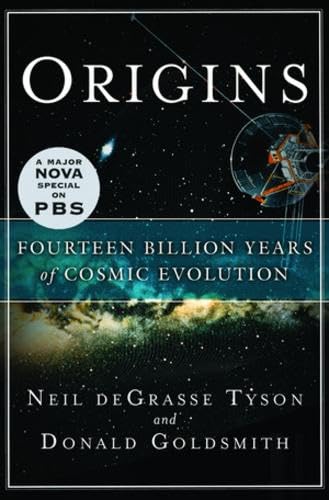
Imagen de portada de Amazon
Imagen de Amazon.com
Imagen de cubierta Syndetics
Portada de Syndetics
Imagen de OpenLibrary

Origins : fourteen billion years of cosmic evolution / Neil deGrasse Tyson and Donald Goldsmith.

Por: Colaborador(es): Detalles de publicación: New York : W.W. Norton & Co., c2004.Edición: First editionDescripción: 345 pages, [32] pages of plates : color illustrations ; 25 cmTipo de contenido:
  • text
Tipo de medio:
  • unmediated
Tipo de soporte:
  • volume
ISBN:
  • 0393059928
Tema(s): Clasificación CDD:
  • 523.1 22
Clasificación LoC:
  • QB981 .T96 2004
Contenidos:
Part I: The Origin of the Universe -- CHAPTER 1. In the Beginning -- CHAPTER 2. Antimatter Matters -- CHAPTER 3. Let There Be Light -- CHAPTER 4. Let There Be Dark -- CHAPTER 5. Let There Be More Dark -- CHAPTER 6. One Universe or Many? -- Part II: The Origin of Galaxies and Cosmic Structure -- CHAPTER 7. Discovering Galaxies -- CHAPTER 8. The Origin of Structure -- Part III: The Origin of Stars -- CHAPTER 9. Dust to Dust -- CHAPTER 10. The Elemental Zoo -- Part IV: The Origin of Planets -- CHAPTER 11. When Worlds Were Young -- CHAPTER 12 Between the Planets -- CHAPTER 13. Worlds Unnumbered: Planets Beyond the Solar System -- Part V: The Origin of Life -- CHAPTER 14. Life in the Universe -- CHAPTER 15. The Origin of Life on Earth -- CHAPTER 16. Searching for Life in the Solar System -- CHAPTER 17. Searching for Life in the Milky Way Galaxy -- CODA. The Search for Ourselves in the Cosmos -- Glossary of Selected Terms -- Further Reading -- Image Credits -- Index.
Resumen: Our true origins are not just human, or even terrestrial, but in fact cosmic. Drawing on recent scientific breakthroughs and the current cross-pollination among geology, biology, astrophysics, and cosmology, ?Origins? explains the soul-stirring leaps in our understanding of the cosmos. From the first image of a galaxy birth to Spirit Rover's exploration of Mars, to the discovery of water on one of Jupiter's moons, coauthors Neil deGrasse Tyson and Donald Goldsmith conduct a galvanizing tour of the cosmos with clarity and exuberance. 32 pages of color illustrations
Valoración
    Valoración media: 0.0 (0 votos)
Existencias
Imagen de cubierta Tipo de ítem Biblioteca actual Biblioteca de origen Colección Ubicación en estantería Signatura topográfica Materiales especificados Info Vol URL Copia número Estado Notas Fecha de vencimiento Código de barras Reserva de ítems Prioridad de la cola de reserva de ejemplar Reservas para cursos
Libro Biblioteca de Mayagüez Colección General mb QB981 .T96 2004 (Navegar estantería(Abre debajo)) c. 1 Disponible 50000003276184
Total de reservas: 0

Descripciones mejoradas de Syndetics:

An exploration of new theories about the formation and evolution of the universe traces from the big bang, through the first three billion years on Earth, to today's search for life on other planets.

Includes bibliographical references (p. 323-325) and index.

Part I: The Origin of the Universe -- CHAPTER 1. In the Beginning -- CHAPTER 2. Antimatter Matters -- CHAPTER 3. Let There Be Light -- CHAPTER 4. Let There Be Dark -- CHAPTER 5. Let There Be More Dark -- CHAPTER 6. One Universe or Many? -- Part II: The Origin of Galaxies and Cosmic Structure -- CHAPTER 7. Discovering Galaxies -- CHAPTER 8. The Origin of Structure -- Part III: The Origin of Stars -- CHAPTER 9. Dust to Dust -- CHAPTER 10. The Elemental Zoo -- Part IV: The Origin of Planets -- CHAPTER 11. When Worlds Were Young -- CHAPTER 12 Between the Planets -- CHAPTER 13. Worlds Unnumbered: Planets Beyond the Solar System -- Part V: The Origin of Life -- CHAPTER 14. Life in the Universe -- CHAPTER 15. The Origin of Life on Earth -- CHAPTER 16. Searching for Life in the Solar System -- CHAPTER 17. Searching for Life in the Milky Way Galaxy -- CODA. The Search for Ourselves in the Cosmos -- Glossary of Selected Terms -- Further Reading -- Image Credits -- Index.

Our true origins are not just human, or even terrestrial, but in fact cosmic. Drawing on recent scientific breakthroughs and the current cross-pollination among geology, biology, astrophysics, and cosmology, ?Origins? explains the soul-stirring leaps in our understanding of the cosmos. From the first image of a galaxy birth to Spirit Rover's exploration of Mars, to the discovery of water on one of Jupiter's moons, coauthors Neil deGrasse Tyson and Donald Goldsmith conduct a galvanizing tour of the cosmos with clarity and exuberance. 32 pages of color illustrations

Tabla de contenidos provista por Syndetics

  • Acknowledgments(p. 11)
  • Preface: A Meditation on the Origins of Science and the Science of Origins(p. 15)
  • Overture: The Greatest Story Ever Told(p. 25)
  • Part I The Origin of the Universe
  • Chapter 1 In the Beginning(p. 33)
  • Chapter 2 Antimatter Matters(p. 46)
  • Chapter 3 Let There Be Light(p. 53)
  • Chapter 4 Let There Be Dark(p. 64)
  • Chapter 5 Let There Be More Dark(p. 78)
  • Chapter 6 One Universe or Many?(p. 98)
  • Part II The Origin of Galaxies and Cosmic Structure
  • Chapter 7 Discovering Galaxies(p. 111)
  • Chapter 8 The Origin of Structure(p. 122)
  • Part III The Origin of Stars
  • Chapter 9 Dust to Dust(p. 147)
  • Chapter 10 The Elemental Zoo(p. 167)
  • Part IV The Origin of Planets
  • Chapter 11 When Worlds Were Young(p. 183)
  • Chapter 12 Between the Planets(p. 194)
  • Chapter 13 Worlds Unnumbered: Planets Beyond the Solar System(p. 204)
  • Part V The Origin of Life
  • Chapter 14 Life in the Universe(p. 225)
  • Chapter 15 The Origin of Life on Earth(p. 233)
  • Chapter 16 Searching for Life in the Solar System(p. 250)
  • Chapter 17 Searching for Life in the Milky Way Galaxy(p. 274)
  • Coda: The Search for Ourselves in the Cosmos(p. 291)
  • Glossary of Selected Terms(p. 297)
  • Further Reading(p. 323)
  • Image Credits(p. 327)
  • Index(p. 329)

Reseñas proporcionadas por Syndetics

Library Journal Review

Scientists are achieving a new understanding about the origins of our universe as the disciplines of geology, biology, and astrophysics bleed into one another. Astrophysicist Tyson is the director of New York City's Hayden Planetarium; Goldsmith is an astronomy writer with more than 20 books to his credit. Together, they have crafted a terrific historical perspective on humanity's pursuit of answers that offers insights into the recent findings that have both expanded our knowledge and raised even more intriguing questions. Amateur astronomersAin fact, any reader who enjoys popular scienceAwill find fascinating information presented in clear but never patronizing language. The mysteries of the cosmos have wide appeal, and this reader-friendly title, timed to coincide with the four-part Nova series on PBS in late September, is highly recommended for small academic and all public libraries.ADenise Hamilton, Heritage Christian Sch., Ridge, NH (c) Copyright 2010. Library Journals LLC, a wholly owned subsidiary of Media Source, Inc. No redistribution permitted.

Publishers Weekly Review

This is the most informative, congenial and accessible general look at cosmology to come along since Carl Sagan's Cosmos 27 years ago-and, like Cosmos, it's a companion to a PBS series, in this case a Nova special (to air on September 28 and 29). But Tyson (The Sky Is Not the Limit, etc.), who's director of Manhattan's Hayden Planetarium, and Goldsmith (Connecting with the Cosmos, etc.) are no Sagan clones; they bring a distinct point of view and tone to this title. The point of view surfaces right away, both with their concerted effort to draw in numerous branches of science to explain the story of cosmic evolution, and with the statement that "science depends on organized skepticism." The authors continually refer to the reach and limits of science, explaining, as they offer a chronological tour of cosmic history, just what they think science can tell us and what it can't (as they end the journey, focusing on the possibility of extraterrestrial life, they deliver several sharp blows to true believers of UFOs). The tone is informational, aimed at high clarity, and laced with giddy humor: "A hundred billion years from now... all but the closest galaxies will have vanished over our horizon of visibility. Enjoy the view while you can." Beginning at the beginning, Tyson and Goldsmith tackle the origin of the universe and its nature-from antimatter to dark matter and dark energy to the possibility of multiverses; how the universe became organized; the origin of stars; a fascinating look at the periodic table; the origin of planets, including a vivid discuss of planets outside our solar system; and the origin of life. Much of this material will necessarily be familiar to regular readers of popular science, but even they will benefit from Tyson and Goldsmith's incorporation of the latest cosmological developments, from string theory to recent thinking on dark energy; and if this book breaks out, as it has real potential to do, general readers of every stripe will benefit from the authors' sophisticated, deeply knowledgeable presentation. If the casual book buyer purchases one science book this year, this should be the one. (Oct.) (c) Copyright PWxyz, LLC. All rights reserved

CHOICE Review

Tyson, an astrophysicist and director of New York City's Hayden Planetarium, was the narrator for the recent PBS Nova series with the same title, and the book, like the TV series, is successful in conveying abstract concepts in a manner that is often breezy and whimsical but always authoritative. The book explores five different "origins": of the universe, of galaxies and cosmic structure, of stars, of planets, and of life. Tyson and Goldsmith, a writer, are particularly authoritative when discussing the first three fields, and they write about them with an insider's perspective. A typically wry and insightful comment: "... if no one knew in advance that stars exist, front-line research would offer plenty of convincing reasons why stars could never form." This is an unusually good introduction to the interconnectedness of these diverse cutting-edge fields. ^BSumming Up: Highly recommended. General readers; lower-division undergraduates. T. Barker Wheaton College (MA)

Booklist Review

Since Carl Sagan's book-and-television package Cosmos0 (1980), astrophysicists have discovered that the universe will probably expand for eternity and have found planets orbiting neighboring stars. That's reason enough to update and redo the Sagan concept. Tyson and Goldsmith's book is allied with their four-hour PBS Nova0 special, which will air September 28 and 29. This book's popularity is thus ensured and, in effect, introduces the vibrant general-interest literature about individual post-Sagan advances in astronomy and cosmology, which includes Goldsmith's Worlds Unnumbered 0 (1997). The authors adopt a colloquial, even conversational style suited to readers new to the ideas and vocabulary of big-bang cosmology; they make comprehensible the connections between subatomic physics and the structure of the universe. With that as background, the authors then flit between the epoch of infinite density and temperature and the contemporary eon of galaxies, and they sign off with ruminations on extraterrestrial life, though they look askance at UFO devotees. Aiming for mass appeal, Tyson and Goldsmith cover the whole celestial block. --Gilbert Taylor Copyright 2004 Booklist

Notas de autor provistas por Syndetics

Neil deGrasse Tyson is an astrophysicist and director of New York City's Hayden Planetarium.
Compartir
logopucpr-y-vive

Contáctanos

¡Queremos saber de ti!

Tel. 787.841.2000 Ext. 1801

bibliotecavaldes@pucpr.edu

⁣Búscanos en las redes

© 2026 Desarrollado por Ignite Online • All Rights Reserved • Powered by Koha.