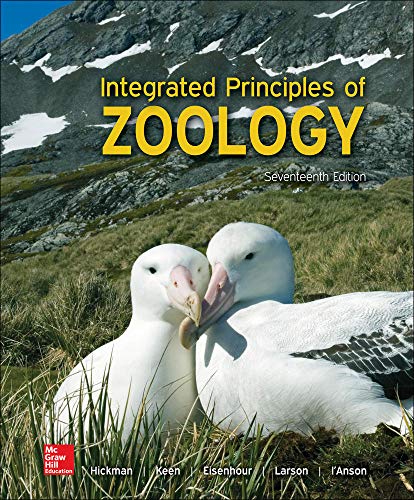

Integrated principles of zoology / Cleveland P. Hickman, Jr., Washington and Lee University, Susan L. Keen, University of California-Davis, David J. Eisenhour, Morehead State University, Allan Larson, Washington University, Helen I. Anson, Washington and Lee University ; original artwork by William C. Ober, M.D. Washington and Lee University, and Claire W. Ober,, B.A., Washington and Lee University.
Detalles de publicación: New York : Mc-Graw Hill, 2016.Edición: Seventeenth editionDescripción: 834 pages (loose leaves) : illustrations ; 30 cm. + 1 Laboratory StudiesTipo de contenido:- text
- unmediated
- volume
- 9781259562310 (alk. paper)
- 590 23
- QL47.2 .H54 2016
| Imagen de cubierta | Tipo de ítem | Biblioteca actual | Biblioteca de origen | Colección | Ubicación en estantería | Signatura topográfica | Materiales especificados | Info Vol | URL | Copia número | Estado | Notas | Fecha de vencimiento | Código de barras | Reserva de ítems | Prioridad de la cola de reserva de ejemplar | Reservas para cursos | |
|---|---|---|---|---|---|---|---|---|---|---|---|---|---|---|---|---|---|---|
| Libro | Biblioteca de Mayagüez Colección General mb | QL47.2 .H54 2016 (Navegar estantería(Abre debajo)) | Lab c. 1 | Disponible | 50000003275863 | |||||||||||||
| Libro | Biblioteca de Mayagüez Colección General mb | QL47.2 .H54 2016 (Navegar estantería(Abre debajo)) | c. 1 | Disponible | 50000003275947 |
Descripciones mejoradas de Syndetics:
Overview Emphasizing the central role of evolution in generating diversity, this best-selling text describes animal life and the fascinating adaptations that enable animals to inhabit so many ecological niches. Featuring high quality illustrations and photographs set within an engaging narrative, Integrated Principles of Zoology is considered the standard by which other texts are measured. With its comprehensive coverage of biological and zoological principles, mechanisms of evolution, diversity, physiology, and ecology, organized into five parts for easy access, this text is suitable for one- or two-semester introductory courses.
Includes bibliographical references and index.
PART ONE. Introduction to Living Animals -- 1. Life: Biological Principles and the Science of Zoology -- 2. The Origin and Chemistry of Life -- 3. Cells as Units of Life -- 4. Cellular Metabolism -- PART TWO. Continuity and Evolution of Animal Life -- 5. Genetics: A Review -- 6. Organic Evolution -- 7. The Reproductive Process -- 8. Principles of Development -- PART THREE. Diversity of Animal Life -- 9. Architectural Pattern of an Animal -- 10. Taxonomy and Phylogeny of Animals -- 11. Unicellular Eukaryotes -- 12. Sponges and Placozoans -- 13. Radiate Animals -- 14. Acoelomorpha, Platyzoa, and Mesozoa -- 15. Polyzoa and Kryptrochozoa -- 16. Molluscs -- 17. Annelids and Allied Taxa -- 18. Smaller Ecdysozoans -- 19. Trilobites, Chelicerates, and Myriapods -- 20. Crustaceans -- 21. Hexapods -- 22. Chaetognaths, Echinoderms, and Hemichordates -- 23. Chordates -- 24. Fishes -- 25. Early Tetrapods and Modern Amphibians -- 26. Amniote Origins and Nonavian Reptiles -- 27. Birds -- 28. Mammals -- PART FOUR. Activity of Life -- 29. Support, Protection, and Movement -- 30. Homeostasis: Osmotic Regulation, Excretion, and Temperature Regulation -- 31. Homeostasis: Internal Fluids and Respiration -- 32. Digestion and Nutrition -- 33. Nervous Coordination: Nervous System and Sense Organs -- 34. Chemical Coordination: Endocrine System -- 35. Immunity -- 36. Animal Behavior -- PART FIVE. Animals and Their Environments -- 37. Animal Distributions -- 38. Animal Ecology -- Glossary -- Credits -- Index
Emphasizing the central role of evolution in generating diversity, this best-selling text describes animal life and the fascinating adaptations that enable animals to inhabit so many ecological niches. Featuring high quality illustrations and photographs set within an engaging narrative,Integrated Principles of Zoology is considered the standard by which other texts are measured. With its comprehensive coverage of biological and zoological principles, mechanisms of evolution, diversity, physiology, and ecology, organized into five parts for easy access, this text is suitable for one- or two-semester introductory courses.