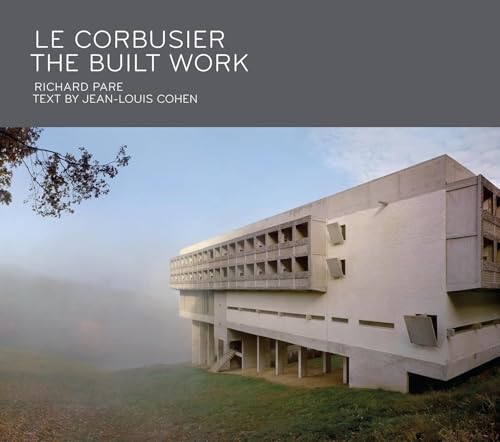
Imagen de portada de Amazon
Imagen de Amazon.com
Imagen de cubierta Syndetics
Portada de Syndetics
Imagen de OpenLibrary

Le Corbusier : the built work / Richard Pare ; text by Jean-Louis Cohen.

Por: Colaborador(es): Editor: New York, New York : The Monacelli Press, 2018Fecha de copyright: ♭2018Descripción: 480 p. : ill.; col. ; 27 cmTipo de contenido:
  • text
  • still image
Tipo de medio:
  • unmediated
Tipo de soporte:
  • volume
ISBN:
  • 9781580934718
  • 1580934714
Títulos uniformes: Tema(s): Género/Forma: Clasificación LoC:
  • NA1053.J4 P37 2018
Resumen: "The most thoroughgoing survey of nearly all of Le Corbusier's extant projects, beautifully photographed and authoritatively detailed. Le Corbusier is widely acknowledged as the most influential architect of the twentieth century. As extensively researched and documented as his works are, however, they have never been exhaustively surveyed in photographs until now. Photographer Richard Pare has crossed the globe for years to document the extant works of Le Corbusier--from his first villas in Switzerland to his mid-career works in his role as the first global architect in locations as far-flung as Argentina and Russia, and his late works, including his sole North American project, at Harvard University, and an extensive civic plan for Chandigarh, India."--
Valoración
    Valoración media: 0.0 (0 votos)
Existencias
Imagen de cubierta Tipo de ítem Biblioteca actual Biblioteca de origen Colección Ubicación en estantería Signatura topográfica Materiales especificados Info Vol URL Copia número Estado Notas Fecha de vencimiento Código de barras Reserva de ítems Prioridad de la cola de reserva de ejemplar Reservas para cursos
Libro CARIBET Biblioteca Arquitectura Colección General CARIBET General NA1053.J4 P37 2018 (Navegar estantería(Abre debajo)) 1 Disponible 91000000058800
Total de reservas: 0

Descripciones mejoradas de Syndetics:

The most thoroughgoing survey of nearly all of Le Corbusier's extant projects, beautifully photographed and authoritatively detailed

Le Corbusier is widely acknowledged as the most influential architect of the twentieth century. As extensively researched and documented as his works are, however, they have never been exhaustively surveyed in photographs until now.

Photographer Richard Pare has crossed the globe for years to document the extant works of Le Corbusier - from his first villas in Switzerland to his mid-career works in his role as the first global architect in locations as far-flung as Argentina and Russia, and his late works, including his sole North American project, at Harvard University, and an extensive civic plan for Chandigarh, India.

Le Corbusier: The Built Work provides numerous views of each project to bring a fuller understanding of the architect's command of space, sometimes surprising use of materials and color, and the almost ineffable qualities that only result from a commanding synthesis of all aspects of design.

With an authoritative text by scholar and curator Jean-Louis Cohen, Le Corbusier: The Built Work is a groundbreaking opportunity to appreciate the master's work anew.

Includes bibliographical references (pages 470-471).

"The most thoroughgoing survey of nearly all of Le Corbusier's extant projects, beautifully photographed and authoritatively detailed. Le Corbusier is widely acknowledged as the most influential architect of the twentieth century. As extensively researched and documented as his works are, however, they have never been exhaustively surveyed in photographs until now. Photographer Richard Pare has crossed the globe for years to document the extant works of Le Corbusier--from his first villas in Switzerland to his mid-career works in his role as the first global architect in locations as far-flung as Argentina and Russia, and his late works, including his sole North American project, at Harvard University, and an extensive civic plan for Chandigarh, India."--

Extracto provisto por Syndetics

Attempting to take Le Corbusier's entire work into account in a single publication is not without precedent. As early as the 1920s, he himself was already committed to publicizing his projects and buildings in a serial and systematic fashion. The first of such publications were the seven collections of plates published between 1927 and 1933 under the aegis of L'Architecture vivante and Jean Badovici's editorship. These publications were subsequently followed up by the concept of an OEuvre complète , initially suggested by Christian Zervos, the founder of the review Cahiers d'Art, and undertaken by the young architects Willy Boesiger and Oscar Stonorov, released in 1930. The publication of OEuvre complète was set in motion by the Zurich publisher Hans Girsberger, and eight volumes covered his works from 1910 to 1968. Long after Le Corbusier's death in 1965, the drawings held by the Fondation Le Corbusier, which had been established during his lifetime, would be addressed in a systematic manner in thirty-two volumes published by Garland in New York. With the digital revolution, another comparable enterprise was completed at the beginning of the twenty-first century in the form of sixteen DVDs that included high-resolution color reproductions of the same documents, accompanied by historical captions that were, for the most part, extremely rigorous.    But if the drawings by Le Corbusier, his associates, and his employees can be accounted for accurately and completely, can the same hold equally true of his buildings? These were copiously photographed as soon as they were completed, sometimes even during the course of construction, and their images were reproduced in reviews and publications under Le Corbusier's strict and vigilant control. His close attention to the choice of views, including the framing and lighting of the shots, is well known; his relations with photographers were narrow and demanding, as his correspondence and the recollections of Lucien Hervé and René Burri clearly attest. One can legitimately claim that he practiced a veritable architecture of photography, interacting with the photographers sent out to shoot his buildings and discussing intensely the images they brought back. This aspect of his work has in fact been the subject of numerous interpretations, and the 2012 exhibition in La Chaux-de-Fonds, along with the scholarly conference organized around it, marked a benchmark moment in that process.    In addition to the analysis of Le Corbusier's relation to photography and to photographers, the buildings themselves have never ceased to draw the attention of contemporary photographers, who have produced a wide range of images. One has only to compare the mysterious blurriness of Hiroshi Sugimoto's photographs of the Villa Savoye and Ronchamp with the icy mechanical dullness of Cemal Emden's more recent reproductions of the same projects in order to apprehend the spectrum of possible ways of seeing them. It was certainly not by chance that the latter's views were chosen to illustrate the dossier of buildings proposed for inclusion in the list of UNESCO's world heritage sites and adopted in 2016. A decision of that scope was unprecedented in the history of the organization, which had never agreed to include so many works located in so many countries, and it is a gauge of the extent of the recognition of Le Corbusier's built work, fifty years after his death. Yet none of these efforts should ossify the understanding of his work into a fixed frame of documentation that would render the work almost academic. Although it is necessarily a partial and fragmentary view, the pages of this book give us a glimpse into Richard Pare's very different project--to indicate what a vision informed by the history of photography and imbued with an authentic empathy for the architecture can reveal about modern buildings that have so often already been reproduced, yielding in this particular case the most comprehensive panorama ever assembled of the architect's built oeuvre. Excerpted from Le Corbusier: the Built Work by Richard Pare, Jean-Louis Cohen All rights reserved by the original copyright owners. Excerpts are provided for display purposes only and may not be reproduced, reprinted or distributed without the written permission of the publisher.

Reseñas proporcionadas por Syndetics

CHOICE Review

Le Corbusier: The Built Work offers 600 of architectural photographer Richard Pare's splendid color photographs of Le Corbusier's works. Each photograph is accompanied by an essay by Jean-Louis Cohen, a distinguished authority on Le Corbusier and on the modern movement in architecture broadly. Together Pare and Cohen have created a monumental work in which Pare's images, which range from full elevations (some covering two pages) to interior studies and details, and Cohen's narrative offer an immersive experience that approaches actual site visitation. Cohen's essays meld description, documentation, anecdote, and observations on individual site conditions in a style that enhances the near-experiential possibilities of the photographs. Also included are endnotes and an afterword by Pare, in which he describes his processes and experiences in photographing some of the sites included in the book. Both Pare and Cohen acknowledge the vast amount of assistance from archivists, site directors, and building owners necessary to make this global undertaking possible. Summing Up: Essential. All readers. --Jack Quinan, emeritus, independent scholar

Notas de autor provistas por Syndetics

Jean-Louis Cohen is an architect & historian. He is a professor at the Institute of Fine Arts at New York University & the director of the Institute Francais d'Architecture. He specializes in the twentieth-century architecture & urbanism of Europe & the United States.

(Bowker Author Biography)

Compartir
logopucpr-y-vive

Contáctanos

¡Queremos saber de ti!

Tel. 787.841.2000 Ext. 1801

bibliotecavaldes@pucpr.edu

⁣Búscanos en las redes

© 2026 Desarrollado por Ignite Online • All Rights Reserved • Powered by Koha.