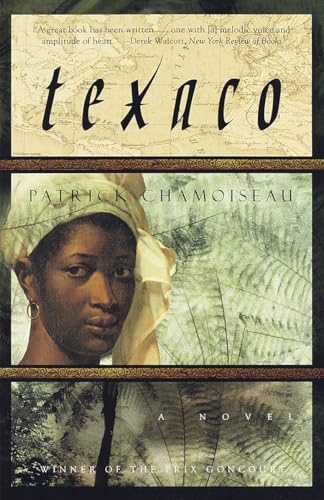

Texaco : a novel / Patrick Chamoiseau ; translated from the french and creole by Rose-Myriam Rǰouis and Val Vinokurov.
Series New York Random House 1997Descripción: 401 pag. ; 21 cmTipo de contenido:- text
- unmediaded
- volume
- 9780679751755
- 0679432353
- 843.91 C41t4 19
- PQ39492.2.C45 T4913 1997
- Winner of the Prix Concourt
| Imagen de cubierta | Tipo de ítem | Biblioteca actual | Biblioteca de origen | Colección | Ubicación en estantería | Signatura topográfica | Materiales especificados | Info Vol | URL | Copia número | Estado | Notas | Fecha de vencimiento | Código de barras | Reserva de ítems | Prioridad de la cola de reserva de ejemplar | Reservas para cursos | |
|---|---|---|---|---|---|---|---|---|---|---|---|---|---|---|---|---|---|---|
| Libro | CARIBET Biblioteca Arquitectura Colección General CARIBET | General PQ3949.2.C45 T4913 1997 (Navegar estantería(Abre debajo)) | 1 | Disponible | 91000000057448 |
Descripciones mejoradas de Syndetics:
"Chamoiseau is a writer who has the sophistication of the modern novelist, and it is from that position (as an heir of Joyce and Kafka) that he holds out his hand to the oral prehistory of literature."
--Milan Kundera
Of black Martinican provenance, Patrick Chamoiseau gives us Texaco (winner of the Prix Goncourt, France's most prestigious literary prize), an international literary achievement, tracing one hundred and fifty years of post-slavery Caribbean history: a novel that is as much about self-affirmation engendered by memory as it is about a quest for the adequacy of its own form.
In a narrative composed of short sequences, each recounting episodes or developments of moment, and interspersed with extracts from fictive notebooks and from statements by an urban planner, Marie-Sophie Laborieux, the saucy, aging daughter of a slave affranchised by his master, tells the story of the tormented foundation of her people's identity. The shantytown established by Marie-Sophie is menaced from without by hostile landowners and from within by the volatility of its own provisional state. Hers is a brilliant polyphonic rendering of individual stories informed by rhythmic orality and subversive humor that shape a collective experience.
A joyous affirmation of literature that brings to mind Boccaccio, La Fontaine, Lewis Carroll, Montaigne, Rabelais, and Joyce, Texaco is a work of rare power and ambition, a masterpiece.
Glosario : p.397-401.
MILESTONES IN OUR ATTEMPTS TO CONQUER THE CITY -- THE ANNUNCIATION (in which the urban planner who comes to raze the insalubrious Texaco Quarter instead finds himself in a Creole circus and faces a matadora's word) -- The Christ's coming according to Irene -- The Christ's coming according to Sonore -- The Christ's coming according to Marie-Clemente -- The Christ's encounter with the old blackman of the Doum -- The Christ's encounter with myself -- THE SERMON OF MARIE-SOPHIE LABORIEUX (not on the mount, but over some dark rum) -- AROUND SAINT-PIERRE (in which the slave Esternome, having embarked on the conquest of City, brings back nothing but the horror of a barbecued love) -- THE AGE OF STRAW (1823-1920) -- Grandpapa of the dungeon -- Grandmama laundress -- The conquest of the Big Hutch -- The Mentoh and the carpenter -- The descent into City -- Oselia's cream -- The libertied and the affranchis -- A woman's blow -- Building City -- Shoeless blackman -- Sweet Ninon so sweet -- The mean chabin -- The Word of the Mentohs -- Ninon's illusion -- Headwork and troubles -- The Nouteka of the Hills -- Doctor of Hutches -- Factory charms -- An infernal serenade -- Barbecued love -- AROUND FORT-DE-FRANCE (in which Esternome's daughter, bearer of a secret name, pursues the work of conquest and imposes Texaco) -- THE AGE OF CRATE WOOD (1903-1945) -- The Flying One -- A quick look at Idomenee's musings -- Tears of light -- Last love bites -- The Word Scratcher to the Source -- Musicians with hungry eyes -- City people -- The Made-in-France dresses and the four books -- Basile at heart -- The muscles of civilization -- The lonely watergrass -- Other City people -- THE AGE OF ASBESTOS (1946-1960) -- Mad Season -- The dream of leaving -- Morne Abelard's Laws -- Law 35 -- Sweet painful bride -- The last Mentoh -- Words of the old blackman of the Doum -- The secret name -- Foundation stricken -- Time biding its time -- Christmas down here -- THE AGE OF CONCRETE (1961-1980) -- Free soil -- Writing-dying -- The Word Scratcher to the Source -- The drifter -- Roman goose -- The lawyerly mulatto -- The sailors with visions -- The Cesaire effect -- The drifter's death -- Writing-torn -- The beke's swan song -- Medicine-poem -- Hoping for the Messiah -- The toll -- The last shark catcher -- Christ's arrival -- The secret name -- RESURRECTION (not in Easter's splendor but in the shameful society of the Word Scratcher who tries to write life)
A novel of Martinique through the eyes of its people. Narrated by a black woman activist, the story spans 150 years, describing the end of slavery, the collapse of the sugar plantations, the coming of the oil companies and the new relations with France, of which the island is a department. By the author of Creole Folktales.
In a narrative composed of short sequences, each recounting episodes or developments of moment, and interspersed with extracts from fictive notebooks and from statements by an urban planner, Marie-Sophie Laborieux, the saucy, aging daughter of a slave affranchised by his master, tells the story of the tormented foundation of her people's identity. The shantytown established by Marie-Sophie is menaced from without by hostile landowners and from within by the volatility of its own provisional state. Hers is a brilliant polyphonic rendering of individual stories informed by rhythmic orality and subversive humor that shape a collective experience--From product description.
Winner of the Prix Concourt