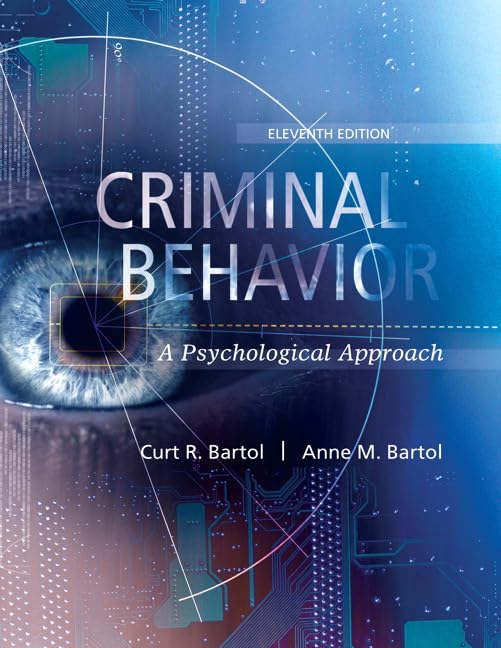

Criminal behavior : a psychological approach / Curt R. Bartol, PhD, Anne M. Bartol, PhD.
Editor: Boston : Pearson, [2017]Edición: Eleventh editionDescripción: xxi, 644 pages ; 28 cmTipo de contenido:- text
- unmediated
- volume
- 9780134163741 (alk. paper)
- 0134163745 (alk. paper)
- 364.3 23
- HV6080 .B37 2017
| Imagen de cubierta | Tipo de ítem | Biblioteca actual | Biblioteca de origen | Colección | Ubicación en estantería | Signatura topográfica | Materiales especificados | Info Vol | URL | Copia número | Estado | Notas | Fecha de vencimiento | Código de barras | Reserva de ítems | Prioridad de la cola de reserva de ejemplar | Reservas para cursos | |
|---|---|---|---|---|---|---|---|---|---|---|---|---|---|---|---|---|---|---|
| Libro | Biblioteca de Mayagüez Colección General mb | HV6080 .B37 2017 (Navegar estantería(Abre debajo)) | c. 1 | Disponible | 50000003273439 |
Descripciones mejoradas de Syndetics:
A comprehensive psychological approach to criminal and antisocial behavior.
Building on a tradition of excellence, Criminal Behavior: A Psychological Approachis accurate, well-researched, contemporary, and comprehensive. It offers a detailed look at crime, what may lead to it, and how criminal behavior may be prevented -- all from a psychological perspective. With a focus on serious crimes, particularly those involving violence, this text offers an all-inclusive look at a very complex field through effective and engaging material that has been classroom-tested for more than thirty years.
Now in the Eleventh Edition, you'll find crucial updates relating to crime definitions and DSM-5 categories, as well as the most current statistics and recently proposed models and theories. Numerous topics -- such as intimate partner violence, juvenile sex offending, terrorist recruitment, elderly abuse, and sexual burglary -- now receive more extensive coverage than ever before.
Includes bibliographical references (pages 515-608) and indexes.
Chapter 1. Introduction to Criminal Behavior -- Chapter 2. Origins of Criminal Behavior: Developmental Risk Factors -- Chapter 3. Origins of Criminal Behavior: Biological Factors -- Chapter 4. Origins of Criminal Behavior: Learning and Situational Factors -- Chapter 5. Human Aggression and Violence -- Chapter 6. Juvenile Delinquency -- Chapter 7. Psychopathy -- Chapter 8. Crime and Mental Disorders -- Chapter 9. Homicide, Assault, and Intimate Partner and Family Violence -- Chapter 10. Multiple Murder, School and Workplace Violence -- Chapter 11. Psychology of Modern Terrorism -- Chapter 12. Sexual Assault -- Chapter 13. Sexual Abuse of Children and Youth -- Chapter 14. Burglary, Home Invasions, Thefts, and “White-Collar” Offenses -- Chapter 15. Violent Economic Crime, Cybercrime, and Crimes of Intimidation -- Chapter 16. Substance Abuse and Crime -- Glossary -- Cases Cited -- References -- Author Index -- Subject Index.
Building on a tradition of excellence, Criminal Behavior: A Psychological Approachis accurate, well-researched, contemporary, and comprehensive. It offers a detailed look at crime, what may lead to it, and how criminal behavior may be prevented — all from a psychological perspective. With a focus on serious crimes, particularly those involving violence, this text offers an all-inclusive look at a very complex field through effective and engaging material that has been classroom-tested for more than thirty years. Now in the Eleventh Edition, you’ll find crucial updates relating to crime definitions and DSM-5 categories, as well as the most current statistics and recently proposed models and theories. Numerous topics — such as intimate partner violence, juvenile sex offending, terrorist recruitment, elderly abuse, and sexual burglary — now receive more extensive coverage than ever before.
Notas de autor provistas por Syndetics
Curt Bartol earned a PhD in Personality/Social Psychology from Northern Illinois University. He was then a psychology professor for over 30 years, teaching a wide array of both graduate and undergraduate courses, including Criminal Behavior, Biopsychology, Social Psychology, Introduction to Forensic Psychology, Juvenile Delinquency, and Psychology and Law. He was instrumental in creating and launching a Master's Program in Forensic Psychology at Castleton State College (now Castleton University) and served as its director for six years. He is a licensed clinical psychologist who has offered psychological services to local, state, and federal law enforcement agencies and public safety offices for over 35 years. He was editor of the scholarly journal Criminal Justice and Behavior for 17 years.
Anne Bartol earned an M.A. in Journalism from the University of Wisconsin-Madison and an M.A. and PhD in Criminal Justice from the State University of New York at Albany. Over a 20-year college teaching career she taught criminal justice, sociology, and journalism courses, including Criminology, Juvenile Justice, Corrections, Women and Criminal Justice, Occupational Crime, and Media Law. She was managing editor of Criminal Justice and Behavior and has worked as a news reporter and a social worker in family and child protective services.
In addition to individual published articles in journals and encyclopedias, the Bartols have collaborated on and co-authored five books through multiple editions--with each subsequent edition carefully updated to reflect changes in data, research findings, theories, and law. Besides Criminal Behavior in its Eleventh Edition, they have written: Juvenile Delinquency (Third Edition, 2009); Psychology and Law (Third Edition, 2015); Introduction to Forensic Psychology (Fourth Edition, 2015); and Criminal and Behavioral Profiling (First Edition, 2013). They also have co-edited a book of readings, Current Perspectives in Forensic Psychology and Criminal Behavior (Fourth Edition, 2016).