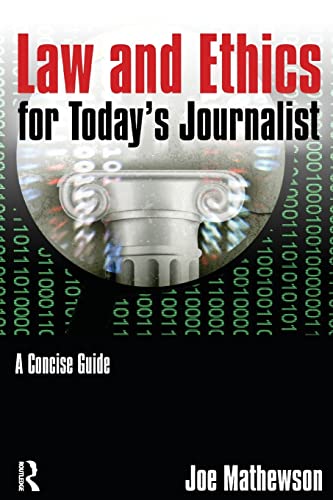

Law and ethics for today's journalist : a concise guide / Joe Mathewson.
Editor: Armonk, New York : M.E. Sharpe, Inc., [2014]Descripción: xv, 222 pages : illustrations ; 24 cmTipo de contenido:- text
- unmediated
- volume
- 9780765640765 (pbk. : alk. paper)
- 343.730998
- KF2750 .M37 2014
| Imagen de cubierta | Tipo de ítem | Biblioteca actual | Biblioteca de origen | Colección | Ubicación en estantería | Signatura topográfica | Materiales especificados | Info Vol | URL | Copia número | Estado | Notas | Fecha de vencimiento | Código de barras | Reserva de ítems | Prioridad de la cola de reserva de ejemplar | Reservas para cursos | |
|---|---|---|---|---|---|---|---|---|---|---|---|---|---|---|---|---|---|---|
| Libro | Biblioteca Encarnación Valdés Colección General bev | 343.730998 M4298L (Navegar estantería(Abre debajo)) | Disponible | 80000002628199 |
Descripciones mejoradas de Syndetics:
Law and Ethics for Today's Journalist offers aspiring and working journalists the practical understanding of law and ethics they must have to succeed at their craft. Instead of covering every nuance of media law for diverse communications majors, Mathewson focuses exclusively on what's relevant for journalists. Even though media law and media ethics are closely linked together in daily journalistic practice, they are usually covered in separate volumes. Mathewson brings them together in a clear and colourful way that practicing journalists will find more useful. Everything a journalist needs to know about legal protections, limitations, and risks inherent in workaday reporting is illustrated with highlights from major court opinions.
Mathewson advises journalists who must often make ethical decisions on the spot with no time for the elaborate, multi-faceted analysis. The book assigns to journalists the hard decisions on ethical questions such as whether to go undercover or otherwise misrepresent themselves in order to get a big story. The ethics chapter precedes the law chapters because ethical standards should underlie a journalist's work at all times. There may be occasions when ethics and law are not parallel, thus calling for the journalist to make a personal judgment. Law and Ethics for Today's Journalist is user-friendly, written in clear, direct, understandable language on issues that really matter to a working journalist. Supplementary reading of the actual court cases is recommended and links to most cases are provided in the text. The text includes a fine (but purposely not exhaustive) bibliography listing important and useful legal cases, including instructive appellate and trial court opinions, state as well as federal.
Includes bibliographical references (pages 199-204) and index.
Courts and the legal system -- Ethics, root and branch -- Prior restraint -- Libel -- Invasion of privacy -- Less common invasion-of-privacy torts -- Fair trial v. free press -- Anonymous sources and the journalist's privilege -- Copyright -- Access to government documents and meetings -- Broadcast regulation -- Citizens United v. Federal Election Commission -- The ethical journalist.
Tabla de contenidos provista por Syndetics
- Preface(p. xi)
- To the Reader: An Introduction(p. xiii)
- 1 Courts and the Legal System(p. 3)
- Sources of American Law(p. 3)
- State and Federal Courts(p. 4)
- Types of Law(p. 6)
- Federal and State Constitutions(p. 6)
- Statutes(p. 6)
- Regulations(p. 7)
- Court Rulings(p. 7)
- Civil Law and Criminal Law(p. 7)
- Anatomy of a Lawsuit(p. 8)
- Court Opinions(p. 10)
- 2 Ethics, Root and Branch(p. 13)
- Opportunities Forfeited(p. 13)
- Success Under a Cloud(p. 14)
- Classical Ethics(p. 15)
- Virtue(p. 16)
- Love(p. 17)
- Rights(p. 18)
- Duty(p. 19)
- Utility(p. 19)
- Professional Codes of Conduct(p. 20)
- Concealment and Confidentiality(p. 22)
- Conflict of Interest(p. 23)
- 3 Prior Restraint(p. 27)
- Seditious Libel(p. 27)
- Declarations of Press Freedom(p. 28)
- Press Freedom Sustained(p. 29)
- Near v. Minnesota(p. 29)
- The Pentagon Papers(p. 30)
- Prior Restraint Isn't Totally Gone(p. 36)
- 4 Libel(p. 39)
- Seditious Libel and Civil Libel(p. 40)
- New York Times v. Sullivan(p. 41)
- Public Figures, Too(p. 43)
- General Walker and Coach Butts(p. 43)
- Misquotation Allowed(p. 45)
- Private Plaintiffs(p. 46)
- Actual Malice Proved(p. 48)
- The Wall Street Journal in Error(p. 48)
- Proof of Libel(p. 50)
- Defenses to Libel(p. 50)
- Product Disparagement(p. 53)
- Internet Libel(p. 55)
- 5 Invasion of Privacy(p. 59)
- American Origins(p. 59)
- Five Privacy Torts(p. 60)
- Intrusion upon Seclusion(p. 61)
- Food Lion v. ABC(p. 66)
- Paparazzo Restricted(p. 67)
- Disclosure of Embarrassing Private Facts(p. 69)
- Highly Offensive(p. 69)
- State Privacy Statutes(p. 70)
- Newsworthiness Defense(p. 74)
- Intercepted Communications(p. 75)
- 6 Less Common Invasion of Privacy Torts(p. 80)
- False Light(p. 80)
- New York's Privacy Statute(p. 80)
- Indefensible Press Conduct(p. 84)
- Intentional Infliction of Emotional Distress(p. 86)
- Again, Actual Malice(p. 86)
- But Private Plaintiffs Can Win(p. 87)
- Orchestrating Police Raids(p. 89)
- Appropriation(p. 92)
- Defenses to Invasion of Privacy Claims(p. 96)
- Newsworthiness(p. 96)
- Fair Report(p. 96)
- Libel Plus Invasion of Privacy(p. 98)
- 7 Fair Trial v. Free Press(p. 102)
- Prejudicial Pretrial Publicity(p. 103)
- Gag Orders(p. 106)
- Closed Courtrooms(p. 109)
- Trials(p. 109)
- Pretrial Hearings(p. 110)
- Access to Court Documents(p. 116)
- Cameras in Court(p. 117)
- Crime Coverage(p. 120)
- 8 Anonymous Sources and the Journalist's Privilege(p. 123)
- Federal Law(p. 125)
- Branzburg v. Hayes(p. 125)
- Civil Cases Are Different(p. 129)
- State Law(p. 136)
- Price v. Time, Inc.(p. 137)
- Who's a Journalist?(p. 138)
- 9 Copyright(p. 143)
- The Copyright Act(p. 143)
- Fair Use(p. 145)
- Gerald Ford's Autobiography(p. 146)
- Is the Use Transformative?(p. 148)
- Digital Millennium Copyright Act(p. 154)
- On Using Fair Use(p. 156)
- 10 Access to Government Documents and Meetings(p. 158)
- Federal Freedom of Information Act (FOIA) of 1966(p. 158)
- "Agency Records"(p. 160)
- Exemptions from the FOIA(p. 162)
- Open Meetings(p. 168)
- Example: Illinois Statute(p. 168)
- Reporters under Siege(p. 169)
- Access to Prisons(p. 171)
- 11 Broadcast Regulation(p. 175)
- Ownership Rules(p. 176)
- Content Regulation(p. 177)
- Indecency(p. 177)
- Political Advertising(p. 180)
- Children's Programming(p. 180)
- Cable and Internet Regulation(p. 181)
- 12 Citizens United v. Federal Election Commission(p. 184)
- Opening Wedge(p. 184)
- Citizens United and Hillary(p. 185)
- PACs(p. 187)
- Super PACs(p. 188)
- Hard Money and Soft Money(p. 189)
- 527s(p. 189)
- "Social Welfare" Organizations(p. 190)
- Follow the Money(p. 191)
- 13 The Ethical Journalist(p. 193)
- Promises, Promises(p. 196)
- No Government Discrimination(p. 196)
- Today's Environment(p. 197)
- Bibliography(p. 199)
- Index(p. 205)
- About the Author(p. 21?)