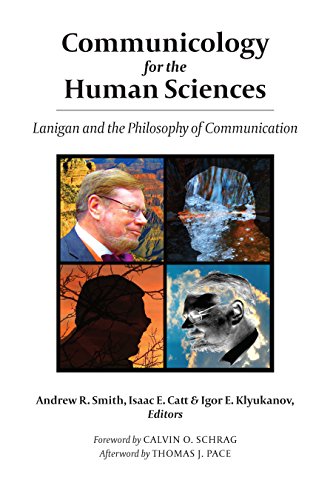

Communicology for the Human Sciences : Lanigan and the Philosophy of Communication / Andrew R. Smith, Isaac E. Catt & Igor E. Kluykanov, editors. [electronic resource]
Editor: New York : Peter Lang, [2018]Descripción: Electronic text (xxxix, 514 pages) : illustrations ; 23 cmTipo de contenido:- text
- computer
- online resource
- 9781433141157 (pbk. : alk. paper)
- 9781433143748 (hardback : alk. paper)
- 302.2/01 23
- P91.25 .C619 2018
| Imagen de cubierta | Tipo de ítem | Biblioteca actual | Biblioteca de origen | Colección | Ubicación en estantería | Signatura topográfica | Materiales especificados | Info Vol | URL | Copia número | Estado | Notas | Fecha de vencimiento | Código de barras | Reserva de ítems | Prioridad de la cola de reserva de ejemplar | Reservas para cursos | |
|---|---|---|---|---|---|---|---|---|---|---|---|---|---|---|---|---|---|---|
| Libro electrónico | Biblioteca de Mayagüez Acceso en línea | P91.25 .C619 2018 (Navegar estantería(Abre debajo)) | Ebook | Disponible | 50000003274114 | |||||||||||||
| Libro electrónico | Biblioteca Mons. Iñaki Mallona (Arecibo) Acceso en línea | EBook | Disponible | 60000010172176 |
Descripciones mejoradas de Syndetics:
Winner of the National Communication Association 2018 Philosophy of Communication Division Top Edited Book Award
This edited volume develops the philosophy of communication inspired by the scholarship of Richard L. Lanigan, with emphasis on communicology as a human science. Lanigan's syntheses of the philosophies of speech, language and discourse stemming from the works of Edmund Husserl, Maurice Merleau-Ponty, Michel Foucault, Julia Kristeva, Charles Sanders Peirce, Roman Jakobson, Umberto Eco, Pierre Bourdieu, Jurgen Reusch and Gregory Bateson, and many others offers a compelling framework for systematic analysis of human communication in all domains of lived experience. His work defines the theory and method of the human sciences in general and the discipline of communicology in particular. The focus in this collection is on the theoretical and methodological foundations for semiotic phenomenology whereby communication is recognized as constitutive of all human conscious experience and social relationships, involving gestural, nonverbal, discursive, performative, artistic, poetic and mass mediated forms.
The volume is divided into five thematic sections: Founding(s) , which marks out primary influences on communicology conceived as a human science; Tropologic(s) , which reveals how abduction, adduction and semiosis are essential for understanding human conduct in multiple forms of expression; Trans/formations , which addresses problems of change in self-other relations advancing an ethical life; Voicing Bodies/Embodied Voices , which elaborates the reversible relations between body and voice, and voice and world; and Horizons of Communicability , which takes up operative intentionalities that typically escape human conscious experience. All chapters are original to this volume, written by leading international scholars in the philosophy of communication who cross several disciplinary boundaries in the human sciences.
Includes bibliographical references and index.
Introduction: Communicology: What’s in a Name? (Isaac E. Catt / Igor E. Klyukanov / Andrew R. Smith) -- Section One: Founding(s) --
Chapter One: Decolonizing Research Praxis: Embodiment, Border Thinking and Theory Construction in the Human Sciences (Andrew R. Smith) -- Chapter Two: Lanigan’s “Encyclopedic Dictionary”: Key Concepts, Insights, and Advances (Corey Anton) -- Chapter Three: Communicability as Ground of Communicology: Impulses and Impediments (Horst Ruthrof) -- Chapter Four: The Human, the Family, and the Vécu of Semiotic Phenomenology: Lanigan’s Communicology in the Context of Life Itself (Frank Macke) -- Section Two: Tropologic(s) -- Chapter Five: Communicational Aspects in Experimental Phenomenological Studies on Cognition: Theory and Methodology (William B. Gomes) -- Chapter Six: The Monstrosity of Adduction (Igor E. Klyukanov) -- Chapter Seven: Is Martin Heidegger’s Fourfold a Semiotic Square? (Alexander Kozin) -- Chapter Eight: Communicology and the Practice of Coding in Qualitative Communication Research (Eric E. Peterson / Kristin M. Langellier) -- Section Three: Trans/formations -- Chapter Nine: Emmanuel Levinas: The Turning of Semioethics (Ronald C. Arnett / Susan Mancino / Hannah Karolak) -- Chapter Ten: Mental Health in the Communication Matrix: A Semiotic Phenomenology of Depression Medicine (Isaac E. Catt) -- Chapter Eleven: Decolonial Phenomenological Practice: Communicology Across the Cultural and Political Borders of the North-South and West-East Divides (Jacqueline M. Martinez) -- Chapter Twelve: In the Context of Communicology: Issues of Technical Risk Communication About Sustainability (Hong Wang) -- Section Four: Voicing Bodies/Embodying Voices -- Chapter Thirteen: Authoring Life Writing as a Technology of the Self: A Communicological Perspective on the Concept of Voice (Deborah Eicher-Catt) -- Chapter Fourteen: Communicative Possibilities in/of a Glance (Pat Arneson) -- Chapter Fifteen: Laban and Lanigan: Shall We Dance? (Maureen Connolly / Tom D. Craig) -- Chapter Sixteen: Lexis Agonistic and Lexis Graphike: Translation from Library Document to Museum Monument (Thaddeus Martin) -- Section Five: Horizons of Communicability -- Chapter Seventeen: The Subject at Hand (Vincent Colapietro) -- Chapter Eighteen: Being in Speech: Inferentialism, Historicism, and Metaphysics of Intentionality (Jason Hannan) -- Chapter Nineteen: The Theory of Perfective Drift (Johan Siebers) -- Afterword: Richard L. Lanigan: A Fifty Year Legacy (Thomas J. Pace, Jr.) -- Appendix A: Richard L. Lanigan’s Biography and Curriculum Vitae -- Appendix B: Richard L. Lanigan’s Publications, Presentations, Thesis and Dissertation Direction -- Index.
This edited volume develops the philosophy of communication inspired by the scholarship of Richard L. Lanigan, with emphasis on communicology as a human science. Lanigan's syntheses of the philosophies of speech, language and discourse stemming from the works of Edmund Husserl, Maurice Merleau-Ponty, Michel Foucault, Julia Kristeva, Charles Sanders Peirce, Roman Jakobson, Umberto Eco, Pierre Bourdieu, Jurgen Reusch and Gregory Bateson, and many others offers a compelling framework for systematic analysis of human communication in all domains of lived experience. His work defines the theory and method of the human sciences in general and the discipline of communicology in particular. The focus in this collection is on the theoretical and methodological foundations for semiotic phenomenology whereby communication is recognized as constitutive of all human conscious experience and social relationships, involving gestural, nonverbal, discursive, performative, artistic, poetic and mass mediated forms. The volume is divided into five thematic sections: Founding(s), which marks out primary influences on communicology conceived as a human science; Tropologic(s), which reveals how abduction, adduction and semiosis are essential for understanding human conduct in multiple forms of expression; Trans/formations, which addresses problems of change in self-other relations advancing an ethical life; Voicing Bodies/Embodied Voices, which elaborates the reversible relations between body and voice, and voice and world; and Horizons of Communicability, which takes up operative intentionalities that typically escape human conscious experience. All chapters are original to this volume, written by leading international scholars in the philosophy of communication who cross several disciplinary boundaries in the human sciences.
Tabla de contenidos provista por Syndetics
- List of Tables and Figures(p. xv)
- Foreword: Speaking and Semiotics(p. xvii)
- Acknowledgements(p. xxi)
- Introduction: Communicology: What's in a Name?(p. 1)
- Section 1 Founding(s)
- Chapter 1 Decolonizing Research Praxis: Embodiment, Border Thinking and Theory Construction in the Human Sciences(p. 23)
- Chapter 2 Lanigan's "Encyclopedic Dictionary": Key Concepts, Insights, and Advances(p. 49)
- Chapter 3 Communicability as Ground of Communicology: Impulses and Impediments(p. 71)
- Chapter 4 The Human, the Family, and the Vécu of Semiotic Phenomenology: Lanigan's Communicology in the Context of Life Itself(p. 93)
- Section 2 Tropologic(s)
- Chapter 5 Communicational Aspects in Experimental Phenomenological Studies on Cognition: Theory and Methodology(p. 111)
- Chapter 6 The Monstrosity of Adduction(p. 133)
- Chapter 7 Is Martin Heidegger's Fourfold a Semiotic Square?(p. 147)
- Chapter 8 Communicology and the Practice of Coding in Qualitative Communication Research(p. 159)
- Section 3 Trans/formations
- Chapter 9 Emmanuel Levinas: The Turning of Semioethics(p. 179)
- Chapter 10 Mental Health in the Communication Matrix: A Semiotic Phenomenology of Depression Medicine(p. 201)
- Chapter 11 Decolonial Phenomenological Practice: Communicology Across the Cultural and Political Borders of the North-South and West-East Divides(p. 221)
- Chapter 12 In the Context of Communicology: Issues of Technical Risk Communication About Sustainability(p. 243)
- Section 4 Voicing Bodies/Embodying Voices
- Chapter 13 Authoring Life Writing as a Technology of the Self: A Communicological Perspective on the Concept of Voice(p. 267)
- Chapter 14 Communicative Possibilities in/of a Glance(p. 283)
- Chapter 15 Laban and Lanigan: Shall We Dance?(p. 299)
- Chapter 16 Lexis Agonistic and Lexis Graphike: Translation from Library Document to Museum Monument(p. 313)
- Section 5 Horizons of Communicability
- Chapter 17 The Subject at Hand(p. 327)
- Chapter 18 Being in Speech: Inferentialism, Historicism, and Metaphysics of Intentionality(p. 351)
- Chapter 19 The Theory of Perfective Drift(p. 369)
- Afterword: Richard L. Lanigan: A Fifty Year Legacy(p. 391)
- Appendix A Richard L. Lanigan's Biography and Curriculum Vitae(p. 397)
- Appendix B Richard L. Lanigan's Publications, Presentations, Thesis and Dissertation Direction(p. 427)
- Index(p. 493)