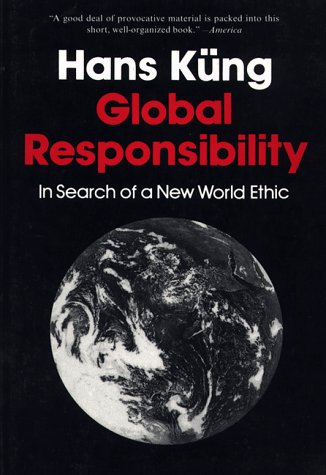

Global responsibility : in search of a new world ethic / Hans Küng ; translation : John Bowden.
Idioma: Inglés Lenguaje original: Alemán New York : Continuum, 1993Descripción: xix, 158 pages : illustrations ; 23 cmTipo de contenido:- 0826406238 (pbk. : alk. paper) :
- 170.44
- BJ1125 .K8613 1993
| Imagen de cubierta | Tipo de ítem | Biblioteca actual | Biblioteca de origen | Colección | Ubicación en estantería | Signatura topográfica | Materiales especificados | Info Vol | URL | Copia número | Estado | Notas | Fecha de vencimiento | Código de barras | Reserva de ítems | Prioridad de la cola de reserva de ejemplar | Reservas para cursos | |
|---|---|---|---|---|---|---|---|---|---|---|---|---|---|---|---|---|---|---|
| Libro | Biblioteca Encarnación Valdés Colección General bev | 170.44 K689p I (Navegar estantería(Abre debajo)) | Disponible | 80000002606203 |
Descripciones mejoradas de Syndetics:
Highly intelligent... It is understandable while being scholarly and should be read by anyone seeking an overview of ethical history as it relates to the present. -- Church and Synagogue Library Association
Includes bibliographical references (p. 139-158).
Reseñas proporcionadas por Syndetics
CHOICE Review
A noted scholar on ecumenism and inter-religious dialogue, Hans K"ung in this brief volume makes and supports three assertions: there will be no survivival of humanity unless there is a world ethos; there will be no peace among nations unless there is peace among the religions; there will be no peace among the religions unless there is genuine dialogue among them. K"ung states that a new constellation of values is needed one that stresses human rights and the rights of nature. He expects that such an ethos could be accepted by both religious and nonreligious people. He notes that religion sometimes contributes to world conflicts and sometimes helps to resolve them. Religions can work together for humanization, and dialogue should take place at many levels. K"ung believes it is necessary to develop a theology regarding other religions; he has been working on such a theology as evidenced in his other books. This very readable book presents a clear challenge on issues that will face the world in the next millenium. It has no bibliography but does have extensive footnotes.-P. J. Bock, Doane CollegeNotas de autor provistas por Syndetics
Hans Kung is Swiss and was born into a middle-class family. He studied in Rome for seven years, obtaining his licentiate in philosophy and theology from the Gregorian University there, and then receiving his doctorate in theology from the Catholic Institute in Paris. Since 1960 he has been a professor at Tubingen University, where he taught dogmatic and ecumenical theology until his permission to teach Catholic theology was removed as a consequence of statements judged to be contrary to official doctrine. Since 1980 he has taught at the University of Chicago and the University of Michigan, and occasionally in Europe as well.His difficulties with the church began with the publication The Church (1967) and became very hot with the publication of Infallible? An Inquiry (1971). More recently, his On Being Christian (1977) has raised the question of whether his theology is not simply rational Protestant theology of the turn of the century. Official inquiries were held, statements were exchanged between Kung and the Conference of German Bishops, and the Rome-based Congregation for the Doctrine of the Faith, but no agreement was to be had. Kung continues to declare himself a loyal member of the Roman Catholic church and seems unlikely to leave its priesthood or to be excommunicated.
(Bowker Author Biography)