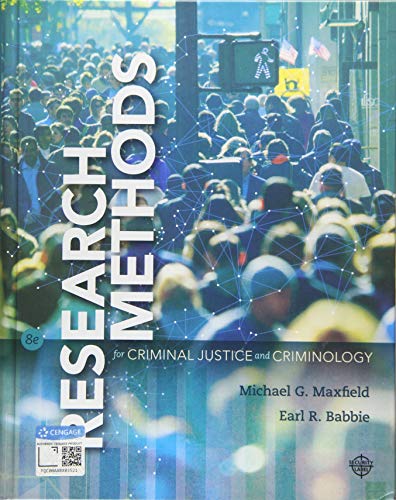

Research methods for criminal justice and criminology / Michael G. Maxfield, John Jay College of Criminal Justice, City University of New York, Earl R. Babbie, Chapman University.
Editor: Australia : Cengage Learning, ©2018Edición: Eighth edition, Student editionDescripción: xvi, 479 pages : illustrations ; 26 cmTipo de contenido:- text
- unmediated
- volume
- 1337091820
- 9781337091824
- HV7419.5 .M38 2018
| Imagen de cubierta | Tipo de ítem | Biblioteca actual | Biblioteca de origen | Colección | Ubicación en estantería | Signatura topográfica | Materiales especificados | Info Vol | URL | Copia número | Estado | Notas | Fecha de vencimiento | Código de barras | Reserva de ítems | Prioridad de la cola de reserva de ejemplar | Reservas para cursos | |
|---|---|---|---|---|---|---|---|---|---|---|---|---|---|---|---|---|---|---|
| Libro | Biblioteca Encarnación Valdés Colección General bev | 364.072 M463r8 (Navegar estantería(Abre debajo)) | Disponible | 80000002603739 |
Descripciones mejoradas de Syndetics:
Featuring real-world examples and comprehensive coverage of qualitative methods, the market-leading RESEARCH METHODS FOR CRIMINAL JUSTICE AND CRIMINOLOGY combines the scholarship, accuracy, and conversational tone of Earl Babbie's best-selling THE PRACTICE OF SOCIAL RESEARCH with Mike Maxfield's expertise in criminology and criminal justice. Providing the most comprehensive, authoritative introduction to criminal justice research available today -- and enhanced by new examples (e.g., cannabis cultivation, violence prevention), research, applications, and built-in study tools -- the eighth edition continues its focus on engaging readers like you in DOING research.
Includes bibliographical references (pages 441-457) and indexes.
Crime, criminal justice, and scientific inquiry -- Foundations of criminal justice research -- Ethics and criminal justice research -- General issues in research design -- Concepts, operationalization, and measurement -- Measuring crime -- Experimental and quasi-experimental designs -- Sampling -- Survey reseach -- Qualitative interviewing -- Field observation -- Agency records, content analysis, and secondary data -- Evaluation reseach and problem analysis Interpreting data.