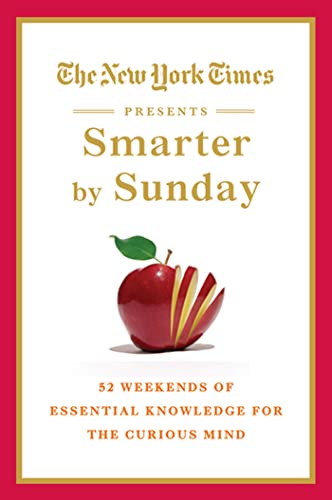

The New York times presents Smarter by Sunday : 52 weekends of essential knowledge for the curious mind.
Detalles de publicación: New York : St. Martin's Press, 2010.Edición: First EditionDescripción: ix, 550 pages ; 22 cmTipo de contenido:- text
- unmediated
- volume
- 9780312571344 (hbk.)
- 0312571348 (hbk.)
- Smarter by Sunday
- 031.02 22
- AG106 .N493 2010
| Imagen de cubierta | Tipo de ítem | Biblioteca actual | Biblioteca de origen | Colección | Ubicación en estantería | Signatura topográfica | Materiales especificados | Info Vol | URL | Copia número | Estado | Notas | Fecha de vencimiento | Código de barras | Reserva de ítems | Prioridad de la cola de reserva de ejemplar | Reservas para cursos | |
|---|---|---|---|---|---|---|---|---|---|---|---|---|---|---|---|---|---|---|
| Libro | Biblioteca de Mayagüez Colección General mb | AG106 .N493 2010 (Navegar estantería(Abre debajo)) | c. 1 | Disponible | 50000003272605 |
Descripciones mejoradas de Syndetics:
Fell asleep during history class in high school when World War II was covered? Learned the table of elements at one time but have forgotten it since? Always wondered who really invented the World Wide Web? Here is the book for you, with all the answers you've been looking for: The New York Times Presents Smarter by Sunday is based on the premise that there is a recognisable group of topics in history, literature, science, art, religion, philosophy, politics, and music that educated people should be familiar with today. Over 100 of these have been identified and arranged in a way that they can be studied over a year's time by spending two hours on a topic every weekend.
Includes index.
This book does exactly what it sets out to do: provide readers with “very basic information in a variety of subjects usually associated with what was once called ‘a well-rounded education.’” Divided into 52 sections—a weekend’s worth of reading for an entire year—the text explores the history of newspapers and magazines, English poetry from Beowulf to the Victorians, the Bible, American fiction, ancient Egypt, the history of computing, radio and television, American cinema, and much, much more. It reads like the kind of textbook you wish you’d had in school: succinct, easily digestible, even stylishly written. It’s also mostly free of political side-taking or editorial commentary; its goal is to inform and provide context but not to make moral or artistic judgments. Adolf Hitler, for example, is discussed in terms of his political and military actions, and the classic films Jaws and Star Wars are described as “action-driven narratives fueled by mechanical and special effects, which became blockbusters that attracted youth audiences and set box-office records.” Readers are left to assign their own moral and artistic values. A very informative, very useful book. --David Pitt