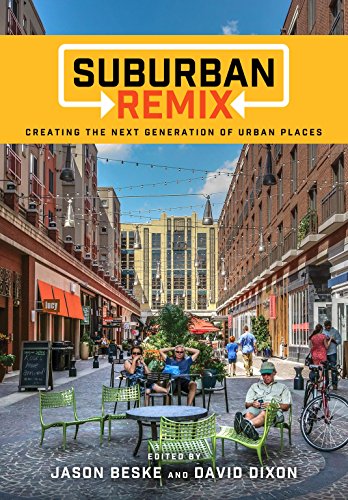

Suburban remix : creating the next generation of urban places. / edited by Jason Beske, David Dixon. txt
Editor: Washington, DC : Island Press , 2018Descripción: 307 p. ill.; col.; maps. 26 cmTipo de contenido:- text
- unmediaded
- volume
- 9781610918626
- 1610918622
- 9781610918633
- 1610918630
- 23 307.74
- HT352.U6 S7995 2018
| Imagen de cubierta | Tipo de ítem | Biblioteca actual | Biblioteca de origen | Colección | Ubicación en estantería | Signatura topográfica | Materiales especificados | Info Vol | URL | Copia número | Estado | Notas | Fecha de vencimiento | Código de barras | Reserva de ítems | Prioridad de la cola de reserva de ejemplar | Reservas para cursos | |
|---|---|---|---|---|---|---|---|---|---|---|---|---|---|---|---|---|---|---|
| Libro | CARIBET Biblioteca Arquitectura Colección General CARIBET | General HT352.U6 S7995 2018 (Navegar estantería(Abre debajo)) | 1 | Disponible | Presupuesto 2017-2018 | 91000000055996 |
Descripciones mejoradas de Syndetics:
The suburban dream of a single-family house with a white picket fence no longer describes how most North Americans want to live. The dynamics that powered sprawl have all but disappeared. Instead, new forces are transforming real estate markets, reinforced by new ideas of what constitutes healthy and environmentally responsible living. Investment has flooded back to cities because dense, walkable, mixed-use urban environments offer choices that support diverse dreams. Auto-oriented, single-use suburbs have a hard time competing.
Suburban Remix brings together experts in planning, urban design, real estate development, and urban policy to demonstrate how suburbs can use growing demand for urban living to renew their appeal as places to live, work, play, and invest. The case studies and analyses show how compact new urban places are already being created in suburbs to produce health, economic, and environmental benefits, and contribute to solving a growing equity crisis.
Above all, Suburban Remix shows that suburbs can evolve and thrive by investing in the methods and approaches used successfully in cities. Whether next-generation suburbs grow from historic village centers (Dublin, Ohio) or emerge de novo in communities with no historic center (Tysons, Virginia), the stage is set for a new chapter of development--suburbs whose proudest feature is not a new mall but a more human-scale feel and form.
Include index
Include Bibliography
Introduction / by David Dixon --
Part I. Setting the stage --
Chapter 1: Urbanizing the suburbs: the major development trend of the next generation / Christopher B. Leinberger --
Chapter 2: From the rise of suburbs to the great reset / David Dixon --
Part II. Suburban markets --
Chapter 3: Housing / Laurie Volk, Todd Zimmerman, and Christopher Volk-Zimmerman --
Chapter 4: Office / Sarah Woodworth --
Chapter 5: Retail / Michael J. Berne --
Part III. Case studies for walkable urban places --
Chapter 6: Blueprint for a better region: Washington, DC / Stewart Schwartz --
Chapter 7: Tysons, Virgina / Linda E. Hollis and Sterling Wheeler --
Chapter 8: From Dayton Mall to Miami Crossing, Ohio / Chris Snyder --
Chapter 9: Shanghai's journey in urbanizing suburbia / Tianyao Sun --
Chapter 10: North York Center: an example of Canada's urbanizing suburbs / Harold Madi and Simon O'Byrne --
Chapter 11: Dublin, Ohio: Bridge Street Corridor / Terry Foegler --
Chapter 12: The Arlington experiment in urbanizing suburbia / Christopher Zimmerman --
Chapter 13: From village to city: Bellevue, Washington / Mark Hinshaw --
Part IV. Bringing it all together --
Chapter 14: Planning / by David Dixon --
Chapter 15: Placemaking / Jason Beske --
Conclusion / Jason Beske and David Dixon --
The suburban dream of a single-family house with a white picket fence no longer describes how most North Americans want to live. The dynamics that powered sprawl have all but disappeared. Instead, new forces are transforming real estate markets, reinforced by new ideas of what constitutes healthy and environmentally responsible living. Investment has flooded back to cities because dense, walkable, mixed-use urban environments offer choices that support diverse dreams. Auto-oriented, single-use suburbs have a hard time competing. Suburban Remix brings together experts in planning, urban design, real estate development, and urban policy to demonstrate how suburbs can use growing demand for urban living to renew their appeal as places to live, work, play, and invest. The case studies and analyses show how compact new urban places are already being created in suburbs to produce health, economic, and environmental benefits, and contribute to solving a growing equity crisis. Above all, Suburban Remix shows that suburbs can evolve and thrive by investing in the methods and approaches used successfully in cities. Whether next-generation suburbs grow from historic village centers (Dublin, Ohio) or emerge de novo in communities with no historic center (Tysons, Virginia), the stage is set for a new chapter of development--suburbs whose proudest feature is not a new mall but a more human-scale feel and form"--Provided by publisher.
Notas de autor provistas por Syndetics
Jason Beske, AICP, is an urban planner and urban designer with public and private experience and a frequent speaker and instructor at planning conferences.David Dixon, FAIA, leads planning and urban design for Stantec's Urban Places, an interdisciplinary team that helps cities and suburbs alike thrive by harnessing the growing demand for urban life.