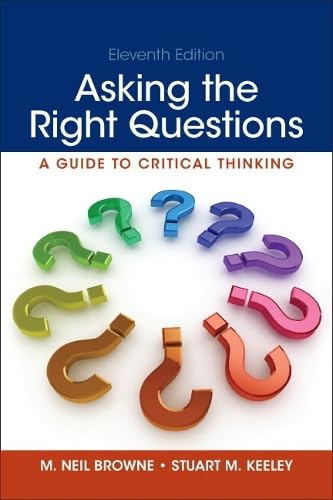
Imagen de Amazon.com

Portada de Syndetics
Imagen de OpenLibrary
Asking the right questions: A guide to critical thinking /
Longman 2015Edición: 11th edISBN:- 9780321907950
| Imagen de cubierta | Tipo de ítem | Biblioteca actual | Biblioteca de origen | Colección | Ubicación en estantería | Signatura topográfica | Materiales especificados | Info Vol | URL | Copia número | Estado | Notas | Fecha de vencimiento | Código de barras | Reserva de ítems | Prioridad de la cola de reserva de ejemplar | Reservas para cursos | |
|---|---|---|---|---|---|---|---|---|---|---|---|---|---|---|---|---|---|---|
| Libro | Biblioteca de Mayagüez Procesos Técnicos | NO PROCESADO (Navegar estantería(Abre debajo)) | 1 | Disponible | NO PROCESADO |
Total de reservas: 0
Descripciones mejoradas de Syndetics:
Used in a variety of courses in various disciplines, Asking the Right Questionsnbsp; helps students bridge the gap between simply memorizing or blindly accepting information, and the greater challenge of critical analysis and synthesis.nbsp; Specifically, this concise text teaches students to think critically bynbsp;exploring the components of arguments--issues, conclusions, reasons, evidence, assumptions, language--and on how to spot fallacies and manipulations and obstacles to critical thinking in both written and visual communication.nbsp; It teaches them to respond to alternative points of view and develop a solid foundation for making personal choices about what to accept and what to reject.nbsp;
Tabla de contenidos provista por Syndetics
- Preface(p. xi)
- Chapter 1 The Benefit and Manner of Asking the Right Questions(p. 1)
- The Noisy, Confused World We Live In(p. 1)
- Experts Cannot Rescue Us, Despite What They Say(p. 3)
- The Necessity Of Relying On Our Mind(p. 4)
- Critical Thinking to the Rescue(p. 4)
- The Sponge and Panning for Gold: Alternative Thinking Styles(p. 5)
- Weak-Sense and Strong-Sense Critical Thinking(p. 7)
- The Importance of Practice(p. 8)
- Critical Thinking and Other People(p. 9)
- Values and Other People(p. 9)
- Primary Values of a Critical Thinker(p. 10)
- Keeping the Conversation Going(p. 11)
- Creating a Friendly Environment for Communication(p. 13)
- Chapter 2 Speed Bumps Interfering with Your Critical Thinking(p. 14)
- The Discomfort of Asking the Right Questions(p. 14)
- Thinking Too Quickly(p. 15)
- Stereotypes(p. 15)
- Mental Habits That Betray Us(p. 16)
- Halo Effect(p. 16)
- Belief Perseverance(p. 17)
- Availability Heuristic(p. 18)
- Answering the Wrong Question(p. 18)
- Egocentrism(p. 19)
- Wishful Thinking: Perhaps the Biggest Single Speed Bump on the Road to Critical Thinking(p. 20)
- Chapter 3 What Are the Issue and the Conclusion?(p. 23)
- Kinds of Issues(p. 24)
- Searching for the Issue(p. 25)
- Searching for the Author's or Speaker's Conclusion(p. 26)
- Using This Critical Question(p. 27)
- Clues to Discovery: How to Find the Conclusion(p. 27)
- Critical Thinking and Your Own Writing and Speaking(p. 28)
- Narrowing Your Issue Prior to Writing(p. 28)
- Cluing Your Reader into Your Conclusion(p. 29)
- Practice Exercises(p. 29)
- Sample Responses(p. 30)
- Chapter 4 What Are the Reasons?(p. 33)
- Initiating the Questioning Process(p. 35)
- Words That Identify Reasons(p. 36)
- Kinds of Reasons(p. 36)
- Keeping the Reasons and Conclusions Straight(p. 37)
- Using This Critical Question(p. 38)
- Reasons First, Then Conclusions(p. 38)
- Critical Thinking and Your Own Writing and Speaking(p. 38)
- Exploring Possible Reasons before Reaching a Conclusion(p. 38)
- Identify Major Publications That Cover Your Issue(p. 39)
- Helping Your Readers Identify Your Reasons(p. 39)
- Practice Exercises(p. 40)
- Sample Responses(p. 41)
- Chapter 5 What Words or Phrases Are Ambiguous?(p. 43)
- The Confusing Flexibility of Words(p. 44)
- Locating Key Terms and Phrases(p. 45)
- Checking for Ambiguity(p. 46)
- Using This Critical Question(p. 47)
- Determining Ambiguity(p. 47)
- Context and Ambiguity(p. 49)
- Using This Critical Question(p. 49)
- Ambiguity, Definitions, and the Dictionary(p. 50)
- Ambiguity and Loaded Language(p. 51)
- Limits of Your Responsibility to Clarify Ambiguity(p. 52)
- Ambiguity and Your Own Writing and Speaking(p. 53)
- Keeping Your Eye Out for Ambiguity(p. 53)
- Practice Exercises(p. 54)
- Sample Responses(p. 55)
- Chapter 6 What Are the Value and Descriptive Assumptions?(p. 58)
- General Guide for Identifying Assumptions(p. 60)
- Value Conflicts and Assumptions(p. 60)
- From Values to Value Assumptions(p. 61)
- Typical Value Conflicts(p. 62)
- The Communicator's Background as a Clue to Value Assumptions(p. 63)
- Consequences as Clues to Value Assumptions(p. 63)
- More Hints for Finding Value Assumptions(p. 64)
- The Value of Knowing the Value Priorities of Others(p. 65)
- Using This Critical Question(p. 66)
- Values and Relativism(p. 66)
- Identifying and Evaluating Descriptive Assumptions(p. 66)
- Illustrating Descriptive Assumptions(p. 67)
- Common Descriptive Assumptions(p. 68)
- Clues for Locating Assumptions(p. 69)
- Avoiding Analysis of Trivial Assumptions(p. 71)
- Assumptions and Your Own Writing and Speaking(p. 71)
- Practice Exercises(p. 73)
- Sample Responses(p. 74)
- Chapter 7 Are There Any Fallacies in the Reasoning?(p. 76)
- A Questioning Approach to Finding Reasoning Fallacies(p. 78)
- Evaluating Assumptions as a Starting Point(p. 78)
- Discovering Other Common Reasoning Fallacies(p. 80)
- Looking for Diversions(p. 85)
- Sleight of Hand: Begging the Question(p. 87)
- Using This Critical Question(p. 87)
- Summary of Reasoning Errors(p. 88)
- Expanding Your Knowledge of Fallacies(p. 88)
- Practice Exercises(p. 88)
- Sample Responses(p. 90)
- Chapter 8 How Good Is the Evidence: Intuition, Personal Experience, Case Examples, Testimonials, and Appeals to Authority?(p. 92)
- The Need for Evidence(p. 93)
- Locating Factual Claims(p. 94)
- Sources of Evidence(p. 95)
- Intuition as Evidence(p. 96)
- Personal Experience as Evidence(p. 97)
- Case Examples as Evidence(p. 98)
- Testimonials as Evidence(p. 99)
- Appeals to Authority as Evidence(p. 100)
- Using This Critical Question(p. 102)
- Your Academic Writing and Evidence(p. 102)
- Practice Exercises(p. 103)
- Sample Responses(p. 104)
- Chapter 9 How Good Is the Evidence: Personal Observation, Research Studies, and Analogies?(p. 106)
- Personal Observation as Evidence(p. 106)
- Research Studies as Evidence(p. 107)
- General Problems with Research Findings(p. 108)
- Generalizing From the Research Sample(p. 112)
- Generalizing From the Research Measures(p. 114)
- Biased Surveys and Questionnaires(p. 115)
- Analogies as Evidence(p. 117)
- Identifying and Comprehending Analogies(p. 117)
- Evaluating Analogies(p. 118)
- When You Can Most Trust Expert Opinion(p. 120)
- Research and the Internet(p. 121)
- Practice Exercises(p. 122)
- Sample Responses(p. 123)
- Chapter 10 Are There Rival Causes?(p. 125)
- When to Look for Rival Causes(p. 126)
- The Pervasiveness of Rival Causes(p. 126)
- Detecting Rival Causes(p. 128)
- The Cause or a Cause(p. 128)
- Multiple Perspectives as a Guide to Rival Causes(p. 129)
- Rival Causes for Differences Between Groups(p. 129)
- Confusing Causation with Association(p. 131)
- Confusing "After This" with "Because of This"(p. 132)
- Explaining Individual Events or Acts(p. 133)
- Evaluating Rival Causes(p. 134)
- Rival Causes and Your Own Communication(p. 134)
- Exploring Potential Causes(p. 135)
- Practice Exercises(p. 136)
- Sample Responses(p. 137)
- Chapter 11 Are the Statistics Deceptive?(p. 139)
- Unknowable and Biased Statistics(p. 140)
- Confusing Averages(p. 141)
- Concluding One Thing, Proving Another(p. 143)
- Deceiving by Omitting Information(p. 144)
- Using Statistics in Your Writing(p. 144)
- Practice Exercises(p. 145)
- Sample Responses(p. 146)
- Chapter 12 What Significant Information Is Omitted?(p. 148)
- The Benefits of Detecting Omitted Information(p. 149)
- The Certainty of Incomplete Reasoning(p. 149)
- Questions That Identify Omitted Information(p. 151)
- But We Need to Know the Numbers(p. 151)
- The Importance of the Negative View(p. 153)
- Omitted Information That Remains Missing(p. 154)
- Using This Critical Question(p. 154)
- Practice Exercises(p. 155)
- Sample Responses(p. 156)
- Chapter 13 What Reasonable Conclusions Are Possible?(p. 158)
- Dichotomous Thinking: Impediment to Considering Multiple Conclusions(p. 159)
- Two Sides or Many?(p. 160)
- Productivity of If-Clauses(p. 161)
- The Liberating Effect of Recognizing Alternative Conclusions(p. 161)
- Summary(p. 162)
- Practice Exercises(p. 163)
- Sample Responses(p. 163)
- Final Word(p. 165)
- Index(p. 166)