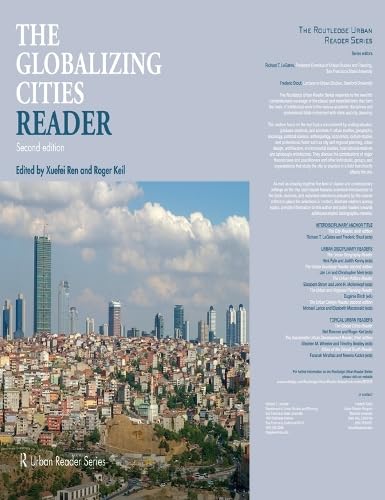

The Globalizing Cities Reader : edited by Xuefei Ren and Roger Keil. txt
Series Routledge urban reader seriesEditor: Abingdon, Oxon ; New York, NY : Routledge, an imprint of the Taylor & Francis Group , 2018Edición: Second editionDescripción: xxix, 481 p. ill. ; 24cmTipo de contenido:- text
- unmediaded
- volume
- 9781317410461
- 1317410467
- 307.76 23
- HT119 G64 2018
| Imagen de cubierta | Tipo de ítem | Biblioteca actual | Biblioteca de origen | Colección | Ubicación en estantería | Signatura topográfica | Materiales especificados | Info Vol | URL | Copia número | Estado | Notas | Fecha de vencimiento | Código de barras | Reserva de ítems | Prioridad de la cola de reserva de ejemplar | Reservas para cursos | |
|---|---|---|---|---|---|---|---|---|---|---|---|---|---|---|---|---|---|---|
| Libro | CARIBET Biblioteca Arquitectura Colección General CARIBET | General HT119 G64 2018 (Navegar estantería(Abre debajo)) | 1 | Disponible | 91000000054882 |
Descripciones mejoradas de Syndetics:
The newly revised Globalizing Cities Reader reflects how the geographies of theory have recently shifted away from the western vantage points from which much of the classic work in this field was developed.
The expanded volume continues to make available many of the original and foundational works that underpin the research field, while expanding coverage to familiarize students with new theoretical and epistemological positions as well as emerging research foci and horizons. It contains 38 new chapters, including key writings on globalizing cities from leading thinkers such as John Friedmann, Michael Peter Smith, Saskia Sassen, Peter Taylor, Manuel Castells, Anthony King, Jennifer Robinson, Ananya Roy, and Fulong Wu. The new Reader reflects the fact that world and global city studies have evolved in exciting and wide-ranging ways, and the very notion of a distinct "global" class of cities has recently been called into question. The sections examine the foundations of the field and processes of urban restructuring and global city formation. A large number of new entries focus on the emerging urban worlds of Asia, Latin America and Africa, including Beijing, Bogota, Cairo, Cape Town, Delhi, Istanbul, Medellin, Mumbai, Phnom Penh, Rio de Janeiro, Sao Paulo, and Shanghai. The book also presents cases off the conventional map of global cities research, such as smaller cities and less known urban regions that are undergoing processes of globalization.
The book is a key resource for students and scholars alike who seek an accessible compendium of the intellectual foundations of global urban studies as well as an overview of the emergent patterns of early 21st century urbanization and associated sociopolitical contestation around the world.
Revised edition of The global cities reader, 2006.
Includes index.
Contents:
List of Plates xv --
List of contributors xvii--
Acknowledgments xxi --
Editors’ introduction: from Global to Globalizing Cities xxiii --
PART 1 FOUNDATIONS 1 --
Introduction to Part One 3 --
1 Prologue: “The metropolitan explosion” Peter Hall 7 --
2 “Divisions of space and time in Europe” Fernand Braudel 9 --
3 “World city formation: an agenda for research and action” John Friedman and Goetz Wolff 16 --
4 “Locating cities on global circuits” Saskia Sassen 25 --
5 “Urban specialization in the world system: an investigation of historical cases” Nestor P Rodriguez and Joe R Feagin 31 --
6 “Accumulation and comparative urban systems” John Walton 41 --
7 “The world system perspective and urbanization” Michael Timberlake 47 --
8 “Global city formation in New York, Chicago and Los Angeles: Janet L Abu Lughod 53 --
9 “Global and world cities: a view from off the map” Jennifer Robinson 60 --
10 “Space in the globalizing city” Peter Marcuse 67 --
PART 2 PATHWAYS 75 --
Introduction to Part Two 77 --
11 Prologue: Istanbul was our past, Istanbul is our future” Hamid Dabashi 81 --
12 “The city as a landscape of power: London and New York as global financial capitals “Sharon Zukin 83 --
13 “Detroit and Houston: two cities in global perspective” Richard Child Hill and Joe Feagin 90 --
14 “The stimulus of a little confusion: a contemporary comparison of Amsterdam and Los Angeles” Edward W. Soja 98 --
15 “Global city Zurich: paradigms of urban development” Christian Schmid 106 --
16 “From ‘state owned’ to ‘City Inc’: the re territorialization of the state in Shanghai” Fulong Wu 116 --
17 “The dream of Delhi as a global city” Veronique Dupont 123 --
18 “’Fourth world’ cities in the global economy: the case of Phnom Penh, Cambodia” Gavin Shatkin 130 --
19 “Medellín and Bogotá: the global cities of the other globalization” Eduardo Mendieta 137 --
PART 3 RELATIONS 143 --
Introduction to Part Three 145 --
20 Prologue: “Specification of the world city network” Peter J. Taylor 147 --
21 “Local and global: cities in network society” Manuel Castells 148 --
22 “Comparing London and Frankfurt as world cities: a relational study of contemporary urban change” Jonathan V. Beaverstock, Michel Hoyler, Kathryn Pain, and Peter J. Taylor 154 --
23 “Global grids of glass: on global cities, telecommunications and planetary urban networks” Stephen Graham 161 --
24 “Global cities and the spread of infectious disease: the case of Severe Acute Respiratory Syndrome (SARS) in Toronto, Canada” S. Harris Ali and Roger Keil 169 --
25 “Flying high (in the competitive sky): conceptualizing the role of airports in global city regions through ‘aero regionalism’” Jean Paul Addie 176 --
26 “One package at a time: the distributive world city” Cynthia Negrey, Jeffery L. Osgood, and Frank Goetzkie 183 --
27 “Global cities between biopolitics and necroppolitics: (in)security and circuits of knowledge in the glogal city network” David Murakami Wood 191 --
28 “The virtual palimpsest of the global city network” Mark Graham 198 --
29 “Relationality territoriality: toward conceptualization of city in the world” Eugene McCann and Kevin Ward 205 --
PART 4 REGULATIONS 211 --
Introduction to Part Four 213 --
30 Prologue: “ The global city as world order” Warren Magnusson 219 --
31 “ Globalization and the rise of city regions “ Allen J Scott 222 --
32 “ Global cities, ‘glocal states’: global city formation and state territorial restructuring in contemporary Europe” Neil Brenner 228 --
33 “ Global cities and developmental states: Tokyo and Seoul” Richard Child Hill and June Woo Kim 236 --
34 “World city information on the Asia Pacific Rim: poverty, ‘everyday’ forms of civil society and environmental management” Mike Douglass 244 --
35 “New globalism, new urbanism: gentrification as global urban strategy” Neil Smith 251 --
36 “Between world history and state formation: new perspective on Africa’s cities” Laurent Fourchard 257 --
37 “The ‘right to the city’: institutional imperatives of a developmental state” Susan Parnell and Edgar Pieterse 264 --
38 “Global cities vs. ‘global cities’: rethinking contemporary urbanism as public ecology” Timothy W. Luke 270 --
PART 5 CONTESTATIONS 277 --
Introduction to Part Five 279 --
39 Prologue: “From Tahrir Square to Emaar Square: Cairo’s private road to a private city” Mohamed Elshahed 283 --
40 “Local actors in global politics” Saskia Sassen 285 --
41 “The right to the city” David Harvey 290 --
42 “Urban social movements in an era of globalization” 295 --
43 “Sao Paulo: the city and its protest” Teresa Caldeira 302 --
44 “Global city building in China and its discontents” Xuefei Ren 307 --
45 “Between ghetto and globe: remaking urban life in Africa” AbdouMaliq Simone 313 --
46 “World cities and union renewal” Steven Tufts 319 --
47 “Blockupy fights back: global city formation in Frankfurt am Main after the financial crisis” Sebastian Schipper, Lucas Pohl, Tino Petzold, Daniel Mullis, and Bernd Belina” 325 --
PART 6 CULTURE 333 --
Introduction to Part Six 335 --
48 Prologue: “High culture and hard labor” Andrew Ross 339 --
49 “World cities: Global? Postcolonial Postimperial? Or just the result of happenstance? Some cultural comments” Anthony D. King 341 --
50 “’Global media cities’: major nodes of globalizing culture and media industries” Stefan Krätke 348 --
51 “Willing the global city: Berlin’s cultural strategies of interurban competition after 1989” Ute Lehrer 355 --
52 “The transitional capitalist class and contemporary architecture in globalizing cities’’ Leslie Sklair 362 --
53 “Shanghai nightscapes and ethnosexual contact zones” James Farrer and Andrew Field 368 --
54 “Graffiti or street art? Negotiating the moral geographies of the creative city’’ Cameron McAuliffe 374 --
55 “Spaces and networks or musical creativity in the city” Allan Watson, Michael Hoyler, and Christoph Mager 380 --
56 “Provincializing the global city: from Bombay to Mumbai” Rashimi Varma 386 --
PART 7 FRONTIERS 391 --
Introduction to Part Seven 393 --
57 Prologue: “World city” Doreen Massey 397 --
58 “The global cities discourse: a return to the master narrative?” Michael Peter Smith 399 --
59 “Provincializing the global city: from Bombay to Mumbai” Peter J. Taylor, Michael Hoyler, and Raf Verbruggen 407 --
60 “Beyond the global city concept and the myth of ‘command and control’” Richard G. Smith 413 --
61 “World cities under conditions of financialized globalization: towards an augmented world city hypothesis” David Bassens and Michiel van Meeteren 419 --
62 “Can the straw man speak? An engagement with postcolonial critiques of ‘global cities research’” Michiel van Meeteren, Ben Derudder, and David Bassens 426 --
63 “Global suburbanization” Roger Keil 433 --
64 “What is urban about critical urban theory? Ananya Roy 441 --
65 “Planetary urbanization” Neil Brenner and Christian Schmid 449 --
66 “New geographies of theorizing the urban: putting comparison to work for global urban studies” Jennifer Robinson 453 --
67 “Governing the informal in globalizing cities: comparing China, India and Brazil” Xuefei Ren 459 --
68 “The urban revolution” Henri Lefebvre 465 --
Index 472 --
Plates:
1 Time Square, New York City 2 --
2 Amsterdam historic canal 33 --
3 The Shard, London, looming 35 --
4 Industrial Age glory in Manchester 36 --
5 One World Trade Center, New York 38 --
6 Vintage skyscrapers, Chicago 55 --
7 Bonaventure Hotel and its neighbors in downtown Los Angeles 56 --
8 Istanbul Financial Center under construction 76 --
9 Global city at street level, New York 85 --
10 Urban redevelopment, Soho, London 87 --
11 Model T in former Ford Piquette Avenue Plant, Detroit 92 --
12 Packard Factory, Detroit 94 --
13 Amsterdam 101 --
14 Street scene, downtown Los Angeles 103 --
15 Shanghai selfie in front of Pudong skyline across Huangpu River 119 --
16 Billboard in 2010 during the Commonwealth Games, Delhi 125 --
17 Gurgaon, Delhi 128 --
18 Toronto aerotropolis 144 --
19 Frankfurt skyline from south of the Main River 156 --
20 London Metabolism 164 --
21 Temperature screening post, Hong Kong Macau border 172 --
22 Chicago aerotropolis 179 --
23 Complexo do Alemao, Rio de Janeiro 179 --
24 Luxury housing, Barrada Tijuca, Rio de Janeiro 193 --
25 Hong Kong, Asia’s world city 196 --
26 Johannesburg, a world class city 212 --
27 Downtown Johannesburg 258 --
28 Demolitions, Shanghai 262 --
29 Sao Paulo 278 --
30 A Starbucks at Xintiandi, Shanghai 304 --
31 Street scene, downtown Johannesburg 310 --
32 Trade union headquarters, London 315 --
33 ECB headquarters 321 --
34 Police in front of the ECB 329 --
35 Police using tear gas 330 --
36 Graffiti covered streets, Sao Paulo 334 --
37 Shopping malls, Bangalore 344 --
38 Construction of Potzdamer Platz 357 --
Electronic reproduction. Ipswich, MA Available via World Wide Web.
Description based on print version record.
Notas de autor provistas por Syndetics
Xuefei Ren is Associate Professor of Sociology and Global Urban Studies at Michigan State University.
Roger Keil is York Research Chair in Global Sub/Urban Studies in the Faculty of Environmental Studies, York University, Toronto.