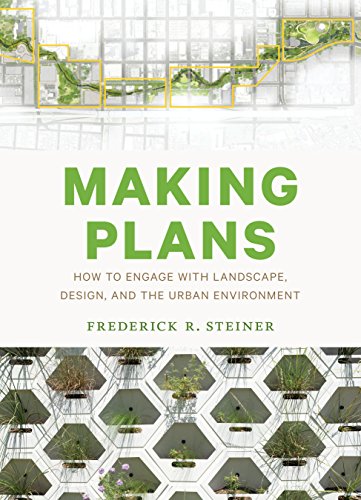

Making Plans : how to engage with landscape, design, and the urban environment. / Frederick R. Steiner. Book
Editor: Austin : University of Texas Press, 2018Edición: First editionDescripción: 195 p. ill. ; 23 cmTipo de contenido:- text
- unmediaded
- volume
- 9781477314302
- 9781477314319
- 307.1/216 23
- HT166 S684 2018
| Imagen de cubierta | Tipo de ítem | Biblioteca actual | Biblioteca de origen | Colección | Ubicación en estantería | Signatura topográfica | Materiales especificados | Info Vol | URL | Copia número | Estado | Notas | Fecha de vencimiento | Código de barras | Reserva de ítems | Prioridad de la cola de reserva de ejemplar | Reservas para cursos | |
|---|---|---|---|---|---|---|---|---|---|---|---|---|---|---|---|---|---|---|
| Libro | CARIBET Biblioteca Arquitectura Colección General CARIBET | General HT166 S684 2018 (Navegar estantería(Abre debajo)) | 1 | Disponible | 2017-2018 | 91000000054908 |
Descripciones mejoradas de Syndetics:
"Community and regional planning involve thinking ahead and formally envisioning the future for ourselves and others," according to Frederick R. Steiner. "Improved plans can lead to healthier, safer, and more beautiful places to live for us and other species. We can also plan for places that are more just and more profitable. Plans can help us not only to sustain what we value but also to transcend sustainability by creating truly regenerative communities, that is, places with the capacity to restore, renew, and revitalize their own sources of energy and materials."
In Making Plans , Steiner offers a primer on the planning process through a lively, firsthand account of developing plans for the city of Austin and the University of Texas campus. As dean of the UT School of Architecture, Steiner served on planning committees that addressed the future growth of the city and the university, growth that inevitably overlapped because of UT's central location in Austin. As he walks readers through the planning processes, Steiner illustrates how large-scale planning requires setting goals and objectives, reading landscapes, determining best uses, designing options, selecting courses for moving forward, taking actions, and adjusting to changes. He also demonstrates that planning is an inherently political, sometimes messy, act, requiring the intelligence and ownership of the affected communities. Both wise and frank, Making Plans is an important philosophical and practical statement on planning by a leader in the field.
Includes bibliographical references and index.
Introduction : a planning species -- Setting goals : a declaration of aspiration -- Reading landscapes : an understanding of human ecology -- Determining suitabilities : a discovery of opportunities and constraints -- Designing options : an exploration of preferred futures -- Selecting a course : a commitment to act -- Taking actions : a live performance -- Adjusting to change : a road to resilience -- Reflections : a clearing in the distance -- Coda.
List of Illustrations and Tables ix --
Introduction: A Planning Species 1 --
1 Setting Goals: A Declaration of Aspiration 7 --
2 Reading Landscapes: An Understanding of Human Ecology 31 --
3 Determining Suitabilities: A Discovery of Opportunities and Constraints 71 --
4 Designing Options: An Exploration of Preferred Futures 87 --
5 Selecting a Course a Commitment to Act 101 --
6 Taking Actions: A Live Performance 113 --
7 Adjusting to Change: A Road to Resilience 133 --
8 Reflections: A Clearing in the Distance 153 --
Coda 169 --
Acknowledgments 173 --
Notes 177 --
References 183 --
Index 189 --
Figures:
Figure 1 Conservation and development zones 36 --
Figure 2 Steiner house 37 --
Figure 3 City of Austin watershed regulation areas 42 --
Figure 4 Central Texas watersheds 44 --
Figure 5 Tree Canopy 46 --
Figure 6 Balcones, Canyonlands Preserve System, Travis County, Texas 48 --
Figure 7 Battle Hall, University of Texas at Austin designed by Cass Gilbert 1909-1910 52 --
Figure 8 Paul Cret plan of the development for the University of Texas at Austin 1933 53 --
Figure 9 Paul Cret’s watercolor perspective of the future development of the University of Texas at Austin 1933 55 --
Figure 10 Organizational mandala 60 --
Figure 11 Historical timeline 61 --
Figure 12 Main campus construction trends 62 --
Figure 13 Campus zones 63 --
Figure 14 Site coverage 64 --
Figure 15 Building density 65 --
Figure 16 Existing floor area ratio by zone 65 --
Figure 17 Tree cover 66 --
Figure 18 Outdoors comfort zones 67 --
Figure 19 Waller Creek 68 --
Figure 20 Plateau region, fundamental site planning determinants 73 --
Figure 21 Travis County Greenprint for Growth: Overall conservation opportunities 75 --
Figure 22 Central Texas Greenprint for Growth: Regional overall conservation opportunities 77 --
Figure 23 Growth concept map 80 --
Figure 24 Campus growth map and chart 84 --
Figure 25 Second Street, a result of the Green Streets Plan 91 --
Figure 26 George W. Bush Presidential Center Park 99 --
Figure 27 Speedway Mall 118 --
Figure 28 Living Wall 127 --
Figure 29 Nancy Rubins, Monochrome for Austin 143 --
Figure 30 Ann Hamilton, ONEEVERYONE Zoë 144 --
Figure 31 Moody College of Communication Bridge 145 --
Figure 32 Walter Creek concept plan 149 --
Figure 33 Rose Kennedy Greenway, Boston 157 --
Figure 34 Klyde Warren Park, Dallas 158 --
Tables:
Table 1 Task force meetings 17 --
Table 2 Individual citizen involvement 17 --
Table 3 Community engagement activities 18 --
Table 4 Future Plans and studies 109 --
Table 5 Imagine Austin building blocks and planning elements 111 --
Table 6 Key features of the Speedway Mall Transformation 119 --
Table 7 Complete communities indicators 139 --
Boxes:
Box 1 Imagine Austin principles and objectives 16 --
Box 2 Confederate Statues Forum guidelines 161 --
Community and regional planning involve thinking ahead and formally envisioning the future for ourselves and others," according to Frederick R. Steiner. "Improved plans can lead to healthier, safer, and more beautiful places to live for us and other species. We can also plan for places that are more just and more profitable. Plans can help us not only to sustain what we value but also to transcend sustainability by creating truly regenerative communities, that is, places with the capacity to restore, renew, and revitalize their own sources of energy and materials." In Making Plans, Steiner offers a primer on the planning process through a lively, firsthand account of developing plans for the city of Austin and the University of Texas campus. As dean of the UT School of Architecture, Steiner served on planning committees that addressed the future growth of the city and the university, growth that inevitably overlapped because of UT's central location in Austin. As he walks readers through the planning processes, Steiner illustrates how large-scale planning requires setting goals and objectives, reading landscapes, determining best uses, designing options, selecting courses for moving forward, taking actions, and adjusting to changes. He also demonstrates that planning is an inherently political, sometimes messy, act, requiring the intelligence and ownership of the affected communities. Both wise and frank, Making Plans is an important philosophical and practical statement on planning by a leader in the field --
Tabla de contenidos provista por Syndetics
- List of Illustrations and Tables(p. ix)
- Introduction: A Planning Species(p. 1)
- 1 Setting Goals: A Declaration of Aspiration(p. 7)
- 2 Reading Landscapes: An Understanding of Human Ecology(p. 31)
- 3 Determining Suitabilities: A Discovery of Opportunities and Constraints(p. 71)
- 4 Designing Options: An Exploration of Preferred Futures(p. 87)
- 5 Selecting a Course: A Commitment to Act(p. 101)
- 6 Taking Actions: A Live Performance(p. 113)
- 7 Adjusting to Change: A Road to Resilience(p. 133)
- 8 Reflections: A Clearing in the Distance(p. 153)
- Coda(p. 169)
- Acknowledgments(p. 173)
- Notes(p. 177)
- References(p. 183)
- Index(p. 189)