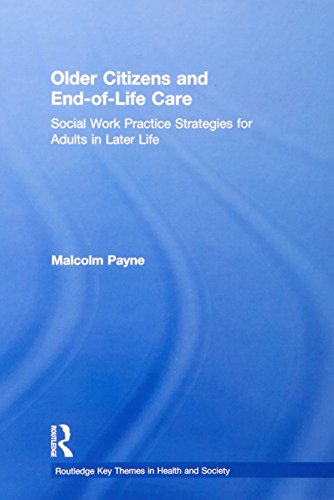

Older citizens and end-of-life care : social work practice strategies for adults in later life / Malcolm Payne.
London ; New York : Routledge, Taylor & Francis Group, 2017Descripción: 187 pages ; 26 cmTipo de contenido:- 9781409440840 (hardback)
- 9781138288720 (pbk.)
- 9781315572161 (ebook)
- 362.175 P346o
- HV1451 .P396 2017
| Imagen de cubierta | Tipo de ítem | Biblioteca actual | Biblioteca de origen | Colección | Ubicación en estantería | Signatura topográfica | Materiales especificados | Info Vol | URL | Copia número | Estado | Notas | Fecha de vencimiento | Código de barras | Reserva de ítems | Prioridad de la cola de reserva de ejemplar | Reservas para cursos | |
|---|---|---|---|---|---|---|---|---|---|---|---|---|---|---|---|---|---|---|
| Libro | Biblioteca Mons. Iñaki Mallona (Arecibo) Colección General ab | 362.175 P346o (Navegar estantería(Abre debajo)) | 1 | Disponible | 60000010160692 |
Descripciones mejoradas de Syndetics:
Older people are, like younger people, citizens in the communities of the nations in which they live. This book sees ageing as a life journey that incorporates a process of citizening, in which people build their identity as part of their family and community. But the social experience of illness, frailty, disability and reaching the end of life may de-citizen older people by devaluing the social identity that comes from continuing social engagement. We de-citizen older people by emphasizing dependence on services and their cost to public expenditure instead of valuing the interdependence of participation and mutual respect. This book argues that older people retain full citizenship for the whole of their lives, up to the moment of death; but what does this mean for health and social care?
In this groundbreaking book, Malcolm Payne argues that social work with older people must build re-citizening practice strategies to value both the common and the special aspects of the citizenship of older people. Current models of social care and social work create dependency, rather than relying on values of participative interdependence. The failure to recognize the end of life as a crucial element in all social care and social work for older people means that the lessons learned in providing palliative and end-of-life care in healthcare have not been transferred to social care, and the priorities of end-of-life care have not been adequately encompassed in social work with older people.
Includes bibliographical references (pages 172-184) and index.
Notas de autor provistas por Syndetics
Malcolm Payne is Emeritus Professor, Manchester Metropolitan University and Honorary Professor, Kingston University; formerly Director of Psychosocial and Spiritual Care, St Christopher's Hospice, London.