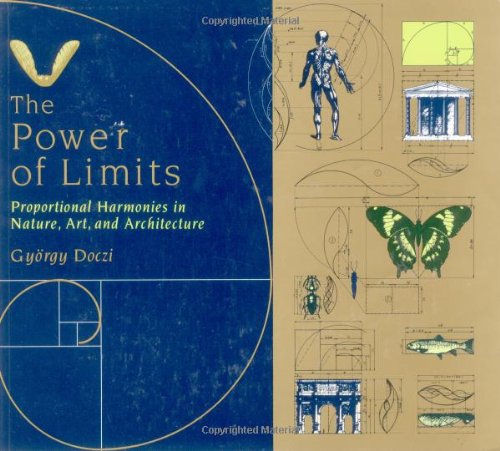

The Power of Limits : proportional harmonies in nature, art, and architecture. / György Doczi. txt
United States of America : Shambhala Boulder , 1981Descripción: 150 p. : ill. ; 25cmTipo de contenido:- text
- unmediaded
- volume
- 9780877731931
- 978159030
- 117 22
- BH301.C84 D62 1981
| Imagen de cubierta | Tipo de ítem | Biblioteca actual | Biblioteca de origen | Colección | Ubicación en estantería | Signatura topográfica | Materiales especificados | Info Vol | URL | Copia número | Estado | Notas | Fecha de vencimiento | Código de barras | Reserva de ítems | Prioridad de la cola de reserva de ejemplar | Reservas para cursos | |
|---|---|---|---|---|---|---|---|---|---|---|---|---|---|---|---|---|---|---|
| Libro | CARIBET Biblioteca Arquitectura Colección General CARIBET | General BH301.C84 D62 1981 (Navegar estantería(Abre debajo)) | 1 | Disponible | Presupuesto 2017-2018 | 91000000053603 |
Descripciones mejoradas de Syndetics:
One of the delights of life is the discovery and rediscovery of patterns of order and beauty in nature--the designs revealed by slicing through a head of cabbage or an orange, the forms of shells and butterfly wings. These images are awesome not just for their beauty alone, but because they suggest an order underlying their growth, a harmony existing in nature. What does it mean that such an order exists; how far does it extend?
The Power of Limits was inspired by those simple discoveries of harmony. The author then went on to investigate and measure hundreds of patterns--ancient and modern, minute and vast. His discovery, vividly illustrated here, is that certain proportions occur over and over again in all these forms. Patterns are also repeated in how things grow and are made--by the dynamic union of opposites--as demonstrated by the spirals which move in opposite directions in the growth of a plant.
The joining of unity and diversity in the discipline of proportional limitations creates forms that are beautiful to us because they embody the principles of the cosmic order of which we are a part; conversely, the limitlessness of that order is revealed by the strictness of its forms. The author shows how we, as humans, are included in the universal harmony of form, and suggests that the union of complementary opposites may be a way to extend that harmony to the psychological and social realms as well.
Originally published: Boulder, Colo. : Shambhala Publications ; [New York] : Distributed in the U.S. by Random House, 1981.
Includes bibliographical references (p. 144-146) and index.
"One of the delights of life is the discovery and rediscovery of patterns of order and beauty in nature -- designs revealed by slicing through a head of cabbage or an orange, the forms of shells and butterfly wings. These images are awesome not just for their beauty alone, but because they suggest an order underlying their growth, a harmony existing in nature. What does it mean that such an order exists; how far does it extend? The Power of Limits was inspired by those simple discoveries of harmony. The author went on to investigate and measure hundreds of patterns--ancient and modern, minute and vast. His discovery, vividly illustrated here, is that certain proportions occur over and over again in all these forms. Patterns are also repeated in how things grow and are made--by the dynamic union of opposites--as demonstrated by the spirals that move in opposite directions in the growth of a plant. The joining of unity and diversity in the discipline of proportional limitations creates forms that are beautiful to us because they embody the principles of the cosmic order of which we are a part; conversely, the limitlessness of that order is revealed by the strictness of its forms. The author shows how we, as humans, are included in the universal harmony of form, and suggests that the union of complementary opposites may be a way to extend that harmony to the psychological and social realms as well " --