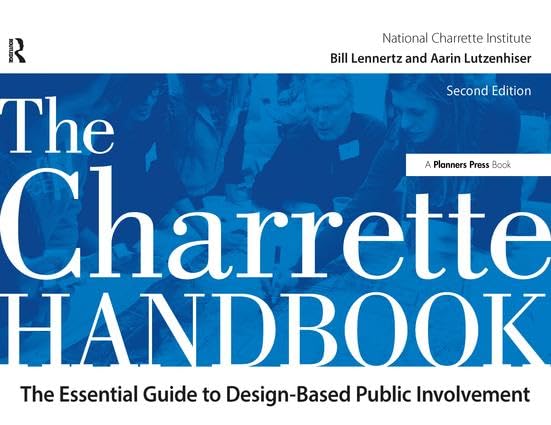

The Charrette Handbook : the essential guide to design-based public involvement. / by the National Charrette Institute ; principal authors Bill Lennertz and Aarin Lutzenhiser, foreword by Andres Duany.
Editor: Chicago, Illinois ; Washington, D.C. : American Planning Association , 2014Edición: Second editionDescripción: xi, 183 p. ill. ; (some color) ; 21 cmTipo de contenido:- text
- unmediaded
- volume
- 1611901472
- 9781611901474
- Charrettes -- United States -- Handbooks, manuals, etc
- City planning -- United States -- Handbooks, manuals, etc
- City planning -- United States -- Citizen participation -- Handbooks, manuals, etc
- Zoning -- United States -- Handbooks, manuals, etc
- Urbanismo -- Estados Unidos -- Manuales
- Urbanismo -- Estados Unidos -- Participación ciudadana
- Zonas urbanas -- Estados Unidos -- Manuales
- 307.1216 22
- HT167 L355 2014
- RPL 661f
| Imagen de cubierta | Tipo de ítem | Biblioteca actual | Biblioteca de origen | Colección | Ubicación en estantería | Signatura topográfica | Materiales especificados | Info Vol | URL | Copia número | Estado | Notas | Fecha de vencimiento | Código de barras | Reserva de ítems | Prioridad de la cola de reserva de ejemplar | Reservas para cursos | |
|---|---|---|---|---|---|---|---|---|---|---|---|---|---|---|---|---|---|---|
| Libro | CARIBET Biblioteca Arquitectura Colección General CARIBET | General HT 167 L355 2014 (Navegar estantería(Abre debajo)) | 1 | Disponible | Pres. 2016 - 2017 | 91000000054072 |
Descripciones mejoradas de Syndetics:
The Charrette Handbook is a step-by-step guide to successful charrettes -- those extended exercises that help citizens envision new possibilities for their communities. Based on a program developed by the National Charrette Institute, the book offers a three-phase approach to project management, describing how to organize for a charrette, how to conduct one, and how to put the resulting ideas into effect. The section on preparation has been extensively overhauled for this edition.
Includes bibliographical references (pages 172-173) and index.
Contents :
Foreword viii --
Preface x --
SECTION ONE: Introduction to the NCI Charrette System 1 --
SECCTION TWO: The History of the Charrette Process 13 --
SECCTION THREE: NCI Charrette System Tools and Techniques 25 --
Phase 1: Research, Engagement and Organization 31 :
1.1 Project Assessment and Organization 31 --
1.1.1 Guiding Principles 32 --
1.1.2 Objectives and Performance Measures 33 --
1.1.3 Stakeholder Identification and Preliminary Analysis 34 --
1.1.4 Complexity Analysis 36 --
1.1.5 Charrette Purpose and Products 39 --
1.1.6 NCI Charrette System Road Map 40 --
1.1.7 Charrette Ready Plan 42 --
1.1.8 Team Formation 42 --
1.1.9 Charrette Schedule 44 --
1.1.10 Project Budget Estimate 50 --
1.2 Stakeholder Research and involvement 53 --
1.2.1 Outreach 54 --
1.2.2 Engagement and Information Exchange 56 --
1.2.3 Secondary Stakeholder Analysis 58 --
1.2.4 Informational Events 58 --
1.3 Base Data Research and Analysis 67 --
1.3.1 Base Data Research and Gathering 62 --
1.3.2 Strengths, Weaknesses, Opportunities, Threats Analysis 63 --
1.4 Project Feasibility Studies and Research 67 --
1.4.1 Conceptual Sketching and Testing 68 --
1.4.2 Pre- charrette Project Brief 69 --
1.5 Charrette Logistics 71 --
1.5.1 Studio Logistics and Set- up 72 --
1.5.2 Meeting Planning 75 --
1.5.3 Pre- charrette Logistics Summary 81 --
Phase 2: The Charrette 83 :
2.1 Organization, engagement, Vision 89 --
2.1.1 Start- Up Team Meeting 91 --
2.1.2 Charrette Team Tour 91 --
2.1.3 Primary Stakeholder Meeting 92 --
2.1.4 Charrette Public Meeting #1 92 --
2.2 Alternative Concepts Development 97 --
2.2.1 Concepts Team Meeting 98 --
2.2.2 Alternative Concepts Development 98 --
2.2.3 Initial Stakeholder reviews 100 --
2.2.4 Alternative Concepts Refinement 100 --
2.2.5 Charrette Public Meeting #2 or Open House 101 --
2.3 Preferred Plan Synthesis 103 --
2.3.1 Plan Synthesis Team Meeting 104 --
2.3.2Concept Synthesis into Preferred plan 104 --
2.3.3 Intermediate Stakeholder Reviews 106 --
2.3.4 Public Open House 106 --
2.4 Plan Development 109 --
2.4.1 Plan Synthesis Team Meeting 110 --
2.4.2 Plan Development and Refinement 110 --
2.4.3 Intermediate Stakeholder Reviews 112 --
2.5 Production and Presentation 113 --
2.5.1 Production Team Meeting 114 --
2.5.2 Final Stakeholder Reviews 114 --
2.5.3 Production 116 --
2.5.4 Final Charrette Public Meeting 116 --
Phase 3: Plan adoption 121 :
3.1 Project Status Communications 123 --
3.1.1 Project Management Team Debriefing 124 --
3.1.2 Public Communications 124 --
3.2 Product Refinement 127 --
3.2.1 Document Review and Feedback 128 --
3.2.2 Document Revision 128 --
3.3 Presentation and Product Finalization 131 --
3.3.1 Final Project Public Meeting 133 --
3.3.2 Project Closeout 134 --
SECCTION FOUR: Charrette Case Studies 137 --
Downtown Kendall, Florida 139 --
Contra Costa Centre Transit Village, Walnut Creek, California 145 --
Liberty harbor North, Jersey City, New Jersey 157 --
SECCTION FIVE: Supplemental Material 161 --
Frequently Asked Questions 163 --
Charrette Scheduling Variations 165 --
Further Reading 172 --
Glossary 174 --
Bibliography 176 --
Index 177 --
About the National Charrette Institute 183 --
The Charrette Handbook, developed by the National Charrette Institute, walks step by step through planning and conducting a charrette then putting the results into action. The new edition also shows how to leverage social media, conduct charrettes on a budget, and add public health partnerships to the planning mix. This handbook is an invaluable guide for anyone organizing a charrette to engage a community.
Notas de autor provistas por Syndetics
Bill Lennertz is executive director and Aarin Lutzenhiser is director of operations for the National Charrette Institute, a nonprofit educational institution based in Portland, Oregon.