Imagen de Amazon.com

Portada de Syndetics
Imagen de OpenLibrary
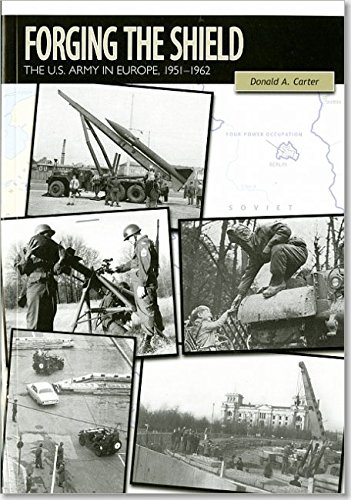
Forging the Shield : The U.S. Army in Europe, 1951-1962 / by Donald A. Carter.
Series U.S. Army in the Cold War series | CMH pub ; 45-3-1. | Army historical seriesEditor: Washington, D.C. : Center of Military History, United States Army, 2015Distribuidor: Washington, DC : For sale by the Superintendent of Documents, U.S. Government Publishing OfficeDescripción: xxi, 513 pages : illustrations, maps ; 25 cm Tipo de medio:- 9780160927546
- 0160927544
- 9780160927553
- 0160927552
- Forging the shield : the United States Army in Europe, 1951-1962
- United States Army in Europe, 1951-1962
- United States -- Armed Forces -- Europe -- History -- 20th century
- United States. Army, Europe and Seventh Army -- History -- 20th century
- Europe -- Military relations -- United States
- United States -- Military relations -- Europe
- United States. Army, Europe and Seventh Army
- Armed Forces
- Military relations
- Europe
- United States
- 1900-1999
- 355.0094/09045 23
- UA26.E9 C37 2015
No hay ítems correspondientes a este registro
Descripciones mejoradas de Syndetics:
This illustrated book that includes tables, charts, and maps primarily discusses the role of USAREUR acronym abbreviation for US Army Europe) in rearming and training the new German Army spans several years and is perhaps the Army s single greatest contribution toward maintaining security in Western Europe. Likewise, the relationship between American soldiers and
their French and West German hosts evolved over time and is a critical element in telling the story of the US Army in Europe."
Shipping list no.: 2015-0249-P.
CRDP Program record.
Includes bibliographical references (pages 471-485) and index.
Reseñas proporcionadas por Syndetics
CHOICE Review
In his in-depth analysis of the history of the US Army in Europe (USAREUR) during the early part of the Cold War, Carter examines the reactivation of the Seventh Army in Europe in 1950 and how this force served as the cornerstone of US military commitment to contain the Soviet Union on the Continent. As an official history of the USAREUR, the book covers a wide range of topics, including the evolution and development of the force's conventional and atomic doctrine, its relationship with its NATO allies, and the critical role it played during the 1961 Berlin Crisis. In addition to serving as a deterrent against Soviet aggression in Europe, the USAREUR was also instrumental in helping arm and train the newly created West German Army. The presence of so many US soldiers in France and Germany during this period helped strengthen the bonds between the US and its continental allies and contributed to the structural, economic, and spiritual recovery of Europe. Summing Up: Recommended. Upper-division undergraduates and above. --Christos G. Frentzos, Austin Peay State UniversityNotas de autor provistas por Syndetics
ABOUT THE AUTHOR
Donald A. Carter was born in Albany, New York, and grew up in Oneida,
New York. He graduated from the United States Military Academy in 1977
and served as a Field Artillery Officer until 1992. During that time, he received
a Ph.D. in history from the Ohio State University in 1985 and served as a
military history instructor, both at West Point and at the U.S. Army Field
Artillery School at Fort Sill, Oklahoma. After leaving the Army he joined
the U.S. Army Center of Military History as an archivist. In 1995 he left
CMH to serve with the Gulf War Declassification Project and the U.S. Army
Declassification Activity. He returned to CMH in 2003 as a historian. His
publications include Eisenhower Versus The Generals, in "Journal of Military"
"History "(October 2007); The U.S. Military Response to the 1960 1962 Berlin
Crisis, for a National Archives pamphlet commemorating the release of Cold
War records; and Wargames in Europe: The U.S. Army Experiments with
Atomic Doctrine, in "Blueprints for Battle "(University Press of Kentucky, 2012).
He is married with two children and lives in Dale City, Virginia"