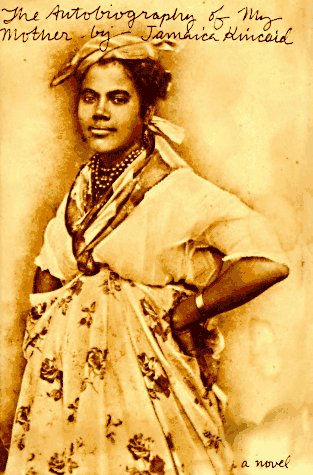
Imagen de Amazon.com

Portada de Syndetics
Imagen de OpenLibrary
The autobiography of my mother / Jamaica Kincaid.
Idioma: Español New York : Farrar, Straus, Giroux, ©1996Edición: 1st edDescripción: 228 pages : illustrations ; 21 cmISBN:- 0374107319
- 813 20
- PR9275.A583 K5636 1996
| Imagen de cubierta | Tipo de ítem | Biblioteca actual | Biblioteca de origen | Colección | Ubicación en estantería | Signatura topográfica | Materiales especificados | Info Vol | URL | Copia número | Estado | Notas | Fecha de vencimiento | Código de barras | Reserva de ítems | Prioridad de la cola de reserva de ejemplar | Reservas para cursos | |
|---|---|---|---|---|---|---|---|---|---|---|---|---|---|---|---|---|---|---|
| Libro | Biblioteca Encarnación Valdés Colección General bev | 813 K511a (Navegar estantería(Abre debajo)) | Disponible | 80000002577339 |
Total de reservas: 0
Descripciones mejoradas de Syndetics:
Jamaica Kincaid's new novel is the haunting, deeply charged story of a woman's life on the island of Dominica. Xuela Claudette Richardson, daughter of a Carib mother and a half-Scottish, half-African father, was delivered to his laundress as an infant, bundled up like his clothes. The Autobiography of My Mother is a story of love, fear, loss, and the forging of a character, an account of one woman's inexorable evolution evoked in startling and magical poetry.
Reseñas proporcionadas por Syndetics
Library Journal Review
In this fictional autobiography, Xuela Claudette Richardson, a 70-year-old West Indian woman, raises questions about family, race, gender, justice, and injustice as she reflects on the events in her life. Born of a mother who died at her birth, Xuela defines her life by that loss as she struggles to come to terms with a detached father who drifts in and out of her life and a marriage to a white man she does not love. A fiercely independent woman, she commands respect for maintaining her indomitable will despite a life of suffering. Xuela's defiance gives her the strength to face the injustices so common to a Caribbean people dominated by a colonial power. Author Kincaid, best known for Annie John (Audio Reviews, LJ 2/15/95), reads with power and clarity, capturing the cadences of the West Indian dialect. with its rich metaphors and intriguing paradoxes, this audiobook challenges as well as entertains. Highly recommended to all who value quality writing.Nancy R. Ives, SUNY at Geneseo (c) Copyright 2010. Library Journals LLC, a wholly owned subsidiary of Media Source, Inc. No redistribution permitted.Publishers Weekly Review
Kincaid's third novel (after Annie John) is presented as the mesmerizing, harrowing, richly metaphorical autobiography of 70-year-old Xuela Claudette Richardson. Earthy, intractably antisocial, acridly introspective, morbidly obsessed with history and identity, conquest and colonialism, language and silence, Xuela recounts her life on the island of Dominica in the West Indies. In Kincaid's characteristically lucid, singsong prose, Xuela traces her evolution from a young girl to an old woman while interrogating the mysteries of her hybrid cultural origins and her parents, who failed to be parents: her mother died during childbirth; her often absent father, a cruel and petty island official, cultivates a veneer of respectability (``another skin over his real skin''), rendering him unrecognizable to his daughter. At 14, Xuela undertakes an affair with one of her father's friends, becomes pregnant and aborts the child. Experiencing that trauma as a rebirth (``I was a new person then''), she inaugurates a life of deliberate infertility, eventually becoming the assistant to a European doctor, whom she later marries. Xuela's Dominica, two generations after slavery, is a ``false paradise'' of reckless fathers and barren matrilinear relations, of tropical ferment, fecundity, witchcraft and slums, whose denizens resemble the walking dead. With aphoristic solemnity at times evocative of Ecclesiastes, Kincaid explores the full paradoxes of this extraordinary story, which, Xuela concludes, is at once the testament of the mother she never knew, of the mother she never allowed herself to be and of the children she refused to have. 75,000 first printing; major ad/ promo; author tour; translation, first serial, dramatic rights: Wylie, Aitken & Stone. (Jan.) (c) Copyright PWxyz, LLC. All rights reservedBooklist Review
The rage of Kincaid's essay A Small Place (1988) is distilled here into a novel of contained fury. A Caribbean woman tells of her search for identity in a wasteland destroyed by conquest and slavery. Her mother was Carib, one of the last remnants of a vanishing people ("My mother had died when I was born, unable to protect herself in a world cruel beyond ordinary imagining, unable to protect me" ). Her father is part African, part Irish, corrupt and powerful; he doesn't love his daughter. She's without family, country, landscape, religion. Home is danger and treachery. History is defeat; it has left her people forever foreign, marginalized, other. And history cannot be overcome ("I then and now had and have no use for redemption" ). Alone, she's the archetypal hero whose search for her mother leads her to discover herself. She begins with her body, which she loves in all its sensuality, and she fuses the erotic with the deliberate conscious knowledge of who she is as an individual person, separate from any group or nation. Kincaid's language is stark, nearly monosyllabic, as the narrator makes herself in flesh and mind. The word not is used over and over like a beating echo for what is lost ("It was not nothing" ). Absence is palpable. The sentences twist and turn with surprise and bitterness. More argument than novel, it's the drama of the personal voice that makes it a spellbinding narrative. Not innocent, not reverential, this disturbing story is lyrical, brave, defiant. (Reviewed December 1, 1995)0374107327Hazel RochmanNotas de autor provistas por Syndetics
Jamaica Kincaid came to the United States in 1966 as a free-lance writer and is now on staff at the New Yorker. Her first volume of stories, At the Bottom of the River (1983), depicts men and women alienated from each other by conflict, physical separation, or death. The story "My Mother" vividly describes the painful separation between mother and daughter; and the stories in Annie John (1985) clearly reveal that the world of the past cannot be recaptured. Kincaid's poetic use of language and everyday images allows the reader to experience ordinary events with a new and heightened sensitivity. Kincaid is a relatively new writer whose works are beginning to receive critical attention.(Bowker Author Biography)