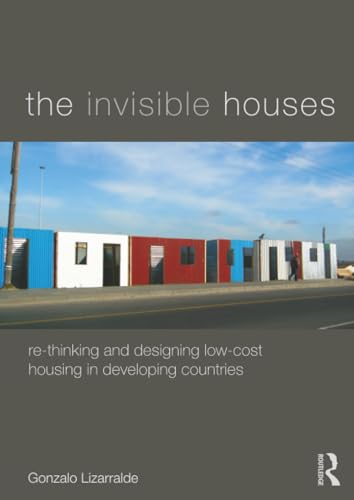

The invisible houses : rethinking and designing low-cost housing in developing countries. / Gonzalo Lizarralde. txt
Editor: New York : Routledge , 2015Edición: 1st editionDescripción: xviii, 232 p. ill.; 25 cmTipo de contenido:- text
- unmediaded
- volume
- 9780415840835 (paperback)
- 041584083X
- 9780415840828 (hardback)
- 728/.1091724 23
- NA7477 L59 2015
| Imagen de cubierta | Tipo de ítem | Biblioteca actual | Biblioteca de origen | Colección | Ubicación en estantería | Signatura topográfica | Materiales especificados | Info Vol | URL | Copia número | Estado | Notas | Fecha de vencimiento | Código de barras | Reserva de ítems | Prioridad de la cola de reserva de ejemplar | Reservas para cursos | |
|---|---|---|---|---|---|---|---|---|---|---|---|---|---|---|---|---|---|---|
| Libro | CARIBET Biblioteca Arquitectura Colección General CARIBET | General NA7477 L59 2015 (Navegar estantería(Abre debajo)) | 1 | Disponible | 91000000053157 |
Descripciones mejoradas de Syndetics:
Winner of the ACSA/AIA Housing Design Education Award!
There is an increased interest among architects, urban specialists and design professionals to contribute to solve "the housing problem" in developing countries. The Invisible Houses takes us on a journey through the slums and informal settlements of South Africa, India, Colombia, Honduras, El Salvador, Cuba, Haiti and many other countries of the Global South, revealing the challenges of, and opportunities for, improving the fate of millions of poor families. Stressing the limitations of current approaches to housing development, Gonzalo Lizarralde examines the short-, mid- and long-term consequences of housing intervention. The book covers - among others - the issues of planning, design, infrastructure and project management. It explains the different variables that need to be addressed and the causes of common failures and mistakes, while outlining successful strategies based on embracing a sustained engagement with the complexity of processes that are generally invisible.
Include index
Include Bibliography
Learning From the Poor: Most of What Architects, Urban Specialists, Policy Makers and Design Professionals Need to Know About Housing Can Be Learned from the Informal Sector --
Invisible Millions: The Multiple (and Contradictory) Faces of Poverty and Informality --
Invisible Markets: On Why to Buy a $60,000 House in a Slum, and Other Distortions in Housing Markets --
Invisible Land: About Houses Built on Distant, Wasted and Fragmented Land --
Invisible Informal Processes: About the Way Land is Occupied and Houses are Produced, Purchased, Installed and Enlarged --
Invisible Infrastructure: Housing is Not Actually About Delivering Houses, But About Developing Infrastructure, Collective Services and Economic Activities. But, Where? --
Visibly Vulnerable, Invisibly Resilient: On Why Disasters Are Not Strictly "Natural" and Reconstruction Projects Sometimes Represent a Different Type of Disaster --
Invisible Freedoms: On an Ethical Position Towards Housing in Developing Countries --
Invisible Power: On Who Does What, When and How—a New Framework for Understanding Low-Cost Housing in Developing Countries --
Rethinking and Designing Low-Cost Housing in Developing Countries: It is Not About Simplifying the Problem, but Rather Committing to Collective Sustained Effort and Embracing Complexity --
There is an increased interest among architects, urban specialists and design professionals to contribute to solve 'the housing problem' in developing countries. The Invisible Houses takes us on a journey through the slums and informal settlements of South Africa, India, Colombia, Honduras, El Salvador, Cuba, Haiti and many other countries of the global south, revealing the challenges of, and opportunities for, improving the fate of millions of poor families. Stressing the limitations of current approaches to housing development, Gonzalo Lizarralde examines the short, mid, and long term consequences of housing intervention. The book covers the issues of planning, design, infrastructure and project management, explaining the different variables that need to be addressed and the causes of common failures and mistakes, while outlining successful strategies based on embracing a sustained engagement with the complexity of processes that are generally invisible.
Tabla de contenidos provista por Syndetics
- Figures(p. ix)
- The Author(p. xiv)
- Acknowledgments(p. xv)
- Credits(p. xvii)
- 1 Learning From the Poor: Most of What Architects, Urban Specialists, Policy Makers and Design Professionals Need to Know About Housing Can Be Learned from the Informal Sector(p. 1)
- 2 Invisible Millions: The Multiple (and Contradictory) Faces of Poverty and Informality(p. 34)
- 3 Invisible Markets: On Why to Buy a $60,000 House in a Slum, and Other Distortions in Housing Markets(p. 56)
- 4 Invisible Land; About Houses Built on Distant, Wasted and Fragmented Land(p. 79)
- 5 Invisible Informal Processes: About the Way Land is Occupied and Houses are Produced, Purchased, Installed and Enlarged(p. 96)
- 6 Invisible Infrastructure: Housing is Not Actually About Delivering Houses, But About Developing Infrastructure, Collective Services and Economic Activities. But, Where?(p. 114)
- 7 Visibly Vulnerable, Invisibly Resilient: On Why Disasters Are Not Strictly "Natural" and Reconstruction Projects Sometimes Represent a Different Type of Disaster(p. 128)
- 8 Invisible Freedoms: On an Ethical Position Towards Housing in Developing Countries(p. 147)
- 9 Invisible Power: On Who Does What, When and How-a New Framework for Understanding Low-Cost Housing in Developing Countries(p. 167)
- 10 Rethinking and Designing Low-Cost Housing in Developing Countries: It is Not About Simplifying the Problem, but Rather Committing to Collective Sustained Effort and Embracing Complexity(p. 180)
- Bibliography(p. 213)
- Index(p. 222)