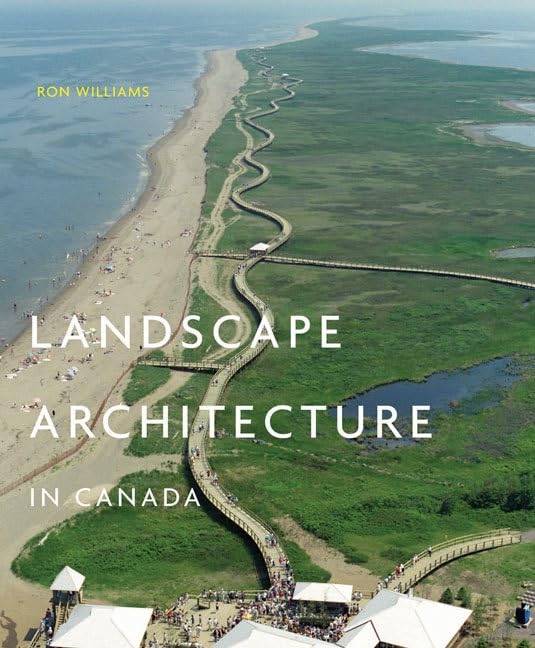

Landscape architecture in Canada / Ron Williams.
Editor: Montréal & Kingston : McGill-Queen's University Press, [2014]Fecha de copyright: ©2014Descripción: viii, 664 pages : illustrations (chiefly colour), maps (chiefly colour), portraits (some colour) ; 27 cmTipo de contenido:- text
- still image
- cartographic image
- unmediated
- volume
- 9780773542068
- 077354206X
- 712.0971 23
- SB470.55.C3 W55 2014
| Imagen de cubierta | Tipo de ítem | Biblioteca actual | Biblioteca de origen | Colección | Ubicación en estantería | Signatura topográfica | Materiales especificados | Info Vol | URL | Copia número | Estado | Notas | Fecha de vencimiento | Código de barras | Reserva de ítems | Prioridad de la cola de reserva de ejemplar | Reservas para cursos | |
|---|---|---|---|---|---|---|---|---|---|---|---|---|---|---|---|---|---|---|
| Libro | CARIBET Biblioteca Arquitectura Colección General CARIBET | SB470.55.C3 W55 2014 (Navegar estantería(Abre debajo)) | Disponible | Pres. 2016-2017 | 91000000059741 |
Descripciones mejoradas de Syndetics:
The largest and most pervasive of human artifacts, landscapes are both cultural expressions and environments that shape our actions. Playgrounds, cemeteries, memorials, historic sites, public squares, gardens, industrial rehabilitation sites, wild national parks, and manicured urban parks provide the settings for work, recreation, commerce, memorialization, and mourning and shape the experience and meaning of these activities in Canada. In the first critical history of designed landscapes in our country, Ron Williams approaches landscape architecture as a social art that creates places for people to use and as an environmental art through which practitioners act as stewards of the natural world.
Landscape Architecture in Canada provides a detailed panorama of the man-made landscapes that vary as widely as the country's geography. The book profiles the projects and people that defined landscape architecture, illuminating the motivations and aspirations that drove landscape architects and explaining the intellectual climate in which they worked. Williams casts a wide net and examines the varied traditions and impacts of Canada's first peoples, its early colonists, later immigrant communities, the remarkable landscape innovations of nineteenth-century industrial cities as well as agricultural landscapes and the protected natural environments of national parks. He also shows how stimulating new ideas from recent decades have expanded landscape architecture and opened the door to projects that embody a distinctive Canadian approach, reflecting the social and natural diversity of contemporary society and its responses to rapid change.
Thoroughly researched, practically oriented, and grounded in the country's many regions, Landscape Architecture in Canada is a richly illustrated and affecting narrative of the ways in which we have shaped our environment and an inimitable lens through which to view the story of Canada.
Includes bibliographical references (pages 585-651) and indexes.
Part Landscape heritage of the first nations and colonists -- The Oldest land in the world : the natural landscapes of canada -- Turtle Island : landscapes of Canada's first nations -- Maritime approaches : the first Europeans -- Sacred Land in the New World : the colonial heritage of new France -- Dreams of Empire : The British Colonial tradition -- Promised lands in the west
Part II The Nineteenth century : challenges of an urban and industrial landscape -- The Making of Canada's rural landscape -- The Greening of the urban landscape -- Public and private gardens of the nineteenth century -- Taming the industrial city : City Parks and Rural Cemeteries -- Taming the Industrial City : The great public parks -- Natural monuments : the creation of the national and provincial parks -- New ideals in urban design : Garden City and City Beautiful -- Landscapes of the "Belle Époque"
Part III Years of challenge, 1914-1945 : landscape innovations in times of war and depression -- Landscapes of memory : memorials of the First World War -- Private gardens of the Twenties and Thirties -- "The City Efficient" : changing currents of urban development -- Embers in the shadows : remarkable landscape projects of the 1930s
Part IV Birth of the modern landscape, from 1945 to the present day -- Brave new landscapes : the postwar era -- Urban renaissance -- Birth of an environmental conscience -- Beyond modernism : new currents in landscape, 1975-2000 -- Landscapes for a multicultural society -- The Twenty-first Century : Canadian landscapes in a time of rapid change -- Epilogue : the conservation of historic and significant landscapes -- Appendix : Glossary of plants mentioned in the text.
"The largest and most pervasive of human artifacts, landscapes are both cultural expressions and environments that shape our actions. Playgrounds, cemeteries, memorials, historic sites, public squares, gardens, industrial rehabilitation sites, wild national parks, and manicured urban parks provide the settings for work, recreation, commerce, memorialization, and mourning and shape the experience and meaning of these activities in Canada. In the first critical history of designed landscapes in our country, Ron Williams approaches landscape architecture as a social art that creates places for people to use and as an environmental art through which practitioners act as stewards of the natural world. Landscape Architecture in Canada provides a detailed panorama of the man-made landscapes that vary as widely as the country's geography."--book jacket.