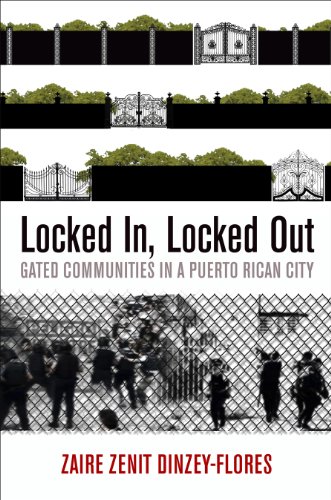

Locked in, locked out : gated communities in a Puerto Rican city. / Zaire Zenit Dinzey-Flores.
Series The City in the Twenty-First Century SerPhiladelphia : University of Pennsilvania Press , 2013Edición: 1st edDescripción: xiv, 220 p. ill. ; 24 cmTipo de contenido:- text
- unmediaded
- volume
- 9780812245134
- 307.77 23
- HT169.59.P9 D56 2013
| Imagen de cubierta | Tipo de ítem | Biblioteca actual | Biblioteca de origen | Colección | Ubicación en estantería | Signatura topográfica | Materiales especificados | Info Vol | URL | Copia número | Estado | Notas | Fecha de vencimiento | Código de barras | Reserva de ítems | Prioridad de la cola de reserva de ejemplar | Reservas para cursos | |
|---|---|---|---|---|---|---|---|---|---|---|---|---|---|---|---|---|---|---|
| Libro Col. Puerto Rico CARIBET | CARIBET Biblioteca Arquitectura Colección de Puerto Rico CARIBET | Puerto Rico HT169.59.P9 D56 2013 (Navegar estantería(Abre debajo)) | 1 | Disponible | Pres. 2016-2017 | 91000000052811 |
Descripciones mejoradas de Syndetics:
In November 1993, the largest public housing project in the Puerto Rican city of Ponce--the second largest public housing authority in the U.S. federal system--became a gated community. Once the exclusive privilege of the city's affluent residents, gates now not only locked "undesirables" out but also shut them in. Ubiquitous and inescapable, gates continue to dominate present-day Ponce, delineating space within government and commercial buildings, schools, prisons, housing developments, parks, and churches. In Locked In, Locked Out , Zaire Zenit Dinzey-Flores shows how such gates operate as physical and symbolic ways to distribute power, reroute movement, sustain social inequalities, and cement boundary lines of class and race across the city.
In its exploration of four communities in Ponce--two private subdivisions and two public housing projects-- Locked In, Locked Out offers one of the first ethnographic accounts of gated communities devised by and for the poor. Dinzey-Flores traces the proliferation of gates on the island from Spanish colonial fortresses to the New Deal reform movement of the 1940s and 1950s, demonstrating how urban planning practices have historically contributed to the current trend of community divisions, shrinking public city spaces, and privatizing gardens. Through interviews and participant observation, she argues that gates have transformed the twenty-first-century city by fostering isolation and promoting segregation, ultimately shaping the life chances of people from all economic backgrounds. Relevant and engaging, Locked In, Locked Out reveals how built environments can create a cartography of disadvantage--affecting those on both sides of the wall.
Include index
Includes Bibliography
PROLOGUE. THE NATIVE OUTSIDER 1 --
1. FORTRESS GATES OF THE RICH AND POOR: PAST AND PRESENT 9 --
2. CACHET FOR THE RICH AND CASHERÍOS FOR THE POOR: AN EXPERIMENT IN CLASS INTEGRATION 28 --
3. "PRECAUTION: SECURITY KNIVES IN THE GATES" 53 --
4. COMMUNITY: WHERE RIGHTS BEGIN AND END 73 --
5. THE SECRET GARDENS 98 --
6. NEIGHBORS MORE REMOTE THAN STRANGERS 123 --
Epilogue. The Gated Library --
Methodology --
Notes --
Index --
Acknowledgments --
In November 1993, the largest public housing project in the Puerto Rican city of Ponce-the second largest public housing authority in the U.S. federal system-became a gated community. Once the exclusive privilege of the city's affluent residents, gates now not only locked "undesirables" out but also shut them in. Ubiquitous and inescapable, gates continue to dominate present-day Ponce, delineating space within government and commercial buildings, schools, prisons, housing developments, parks, and churches. In Locked In, Locked Out, Zaire Zenit Dinzey Flores shows how such gates operate as physical and symbolic ways to distribute power, reroute movement, sustain social inequalities, and cement boundary lines of class and race across the city. In its exploration of four communities in Ponce-two private subdivisions and two public housing projects-Locked In, Locked Out offers one of the first ethnographic accounts of gated communities devised by and for the poor. Dinzey Flores traces the proliferation of gates on the island from Spanish colonial fortresses to the New Deal reform movement of the 1940s and 1950s, demonstrating how urban planning practices have historically contributed to the current trend of community divisions, shrinking public city spaces, and privatizing gardens. Through interviews and participant observation, she argues that gates have transformed the twenty-first-century city by fostering isolation and promoting segregation, ultimately shaping the life chances of people from all economic backgrounds. Relevant and engaging, Locked In, Locked Out reveals how built environments can create a cartography of disadvantage-affecting those on both sides of the wall --
Tabla de contenidos provista por Syndetics
- Preface(p. xi)
- Prologue. The Native Outsider(p. 1)
- 1 Fortress Gates of the Rich and Poor: Past and Present(p. 9)
- 2 Cachet for the Rich and Casheríos for the Poor: An Experiment in Class Integration(p. 28)
- 3 "Precaution: Security Knives in the Gates"(p. 53)
- 4 Community: Where Rights Begin and End(p. 73)
- 5 The Secret Gardens(p. 98)
- 6 Neighbors More Remote than Strangers(p. 123)
- Epilogue. The Gated Library(p. 142)
- Methodology(p. 153)
- Notes(p. 169)
- Index(p. 209)
- Acknowledgments(p. 217)