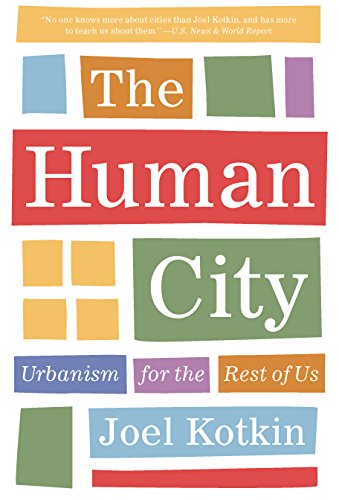

The Human City : urbanism for the rest of us. / Joel Kotkin. txt
Editor: Chicago : An Agate Imprint, B2 Books, [2016]Descripción: 312 p. 23 cmTipo de contenido:- text
- unmediaded
- volume
- 9781572841727 (hardback)
- 9781572842168
- 307.76 23
- HT361 K686 2016
| Imagen de cubierta | Tipo de ítem | Biblioteca actual | Biblioteca de origen | Colección | Ubicación en estantería | Signatura topográfica | Materiales especificados | Info Vol | URL | Copia número | Estado | Notas | Fecha de vencimiento | Código de barras | Reserva de ítems | Prioridad de la cola de reserva de ejemplar | Reservas para cursos | |
|---|---|---|---|---|---|---|---|---|---|---|---|---|---|---|---|---|---|---|
| Libro | CARIBET Biblioteca Arquitectura Colección General CARIBET | General HT361 K686 2016 (Navegar estantería(Abre debajo)) | 1 | Disponible | 91000000052506 |
Descripciones mejoradas de Syndetics:
" The Human City presents the most cogent, evidence-based and clear-headed exposition of the pro-suburban argument. . . . enriching our understanding of what cities are about and what they can and must become." -- Wall Street Journal
Around the globe, most new urban development has adhered to similar tenets: tall structures, small units, and high density. In The Human City , Joel Kotkin--called "America's uber-geographer" by David Brooks of the New York Times --questions these nearly ubiquitous practices, suggesting that they do not consider the needs and desires of the vast majority of people. Built environments, Kotkin argues, must reflect the preferences of most people--especially those of families--even if that means lower-density development.
The Human City ponders the purpose of the city and investigates the factors that drive most urban development today. Armed with his own astute research, a deep-seated knowledge of urban history, and a sound grasp of economic, political, and social trends, Kotkin pokes holes in what he calls the "retro-urbanist" ideology and offers a refreshing case for dispersion centered on human values.
This book is not anti-urban, but it does advocate a greater range of options for people to live the way they want at all stages of their lives.
Index
Contents:
Introduction 1 --
Chapter 1 What is a city for? 5 --
Chapter 2 The importance of Everyday life 19 --
Chapter 3 The problem with megacities 49 --
Chapter 4 Inside the “Glamour Zone” 79 --
Chapter 5 Post familial places 111 --
Chapter 6 The case for dispersion 141 --
Chapter 7 How should we live? 169 --
Acknowledgements 203 --
Bibliography 207 --
Endnotes 263 --
Index 297 --
"In The Human City, internationally recognized urbanist Joel Kotkin challenges the conventional urban-planning wisdom that favors high density, "pack-and-stack" strategies. By exploring the economic, social, and environmental benefits of decentralized, family friendly alternatives, Kotkin concludes that while the word "suburbs" may be outdated, the concept is certainly not dead. Aside from those wealthy enough to own spacious urban homes, people forced into high density development must accept crowded living conditions and limited privacy, thus degrading their quality of life. Dispersion, Kotkin argues, provides a chance to build a more sustainable, "human scale" urban environment. After pondering the purpose of a city and the social, political, economic, and aesthetic characteristics that are associated with urban living Kotkin explores the problematic realities of today's megacities and the importance of families, neighborhoods, and local communities, arguing that these considerations must guide the way we shape our urban landscapes. He then makes the case for dispersion and explores communities (dynamic small cities, redeveloped urban neighborhoods, and more) that are already providing viable, decentralized alternatives to ultra dense urban cores. The Human City lays out a vision of urbanism that is both family friendly and flexible. It describes a future where people, aided by technology, are freed from the constraints of small spaces and impossibly high real estate prices. While Kotkin does not call for low-density development per se, he does advocate for a greater range of options for people to live the way they want at various stages of their lives. We are building cities without thinking about the people who live in them, argues The Human City. It's time to change our approach to one that is centered on human values" --
"Urbanist Joel Kotkin challenges the conventional urban-planning wisdom that favors high-density strategies and instead advocates for "smart suburbs" that take advantage of new technologies, family-friendly policies, and sustainable planning" --
Reseñas proporcionadas por Syndetics
CHOICE Review
Hatfield versus McCoy, Yankees versus Red Sox, plastic versus paper. Into this world of passionate feuds jumps a well-known urban demographer and policy scholar with one more: city versus suburb. The conventional wisdom of activists often privileges a dense urban center, but Kotkin (urban studies, Chapman Univ.) enters this "yeah, but ..." debate with his own gauntlets, captured well in chapter titles--"What Is a City For?," "The Problem with Megacities," "The Case for Dispersion," and "How Should We Live?"--and in the volume's subtitle. He makes a persuasive case that lower densities and sprawl reflect the preferences and values of the vast majority of people, as well as offer an environment in which ordinary families can afford to live and work. The downside--not of the arguments, but with the book itself: 200 pages of prose, the vast majority of whose paragraphs conclude with an endnote, suggests disjointed, cut-and-paste notions rather an unbroken, logical train of thought. In addition, those endnotes take up 30 pages and number 1,080; coupled with more than 50 pages of bibliography, they constitute, in urban lingo, TMI, and detract significantly from the narrative. Summing Up: Recommended. All levels/libraries. --Allen R. Sanderson, University of ChicagoNotas de autor provistas por Syndetics
A senior fellow with the Davenport Institute for Public Policy at Pepperdine University, a research fellow in urban studies at the Reason Public Policy Institute, and a senior fellow with the Milken Institute. He writes a monthly column in The New York Times and has written four previous books. His work also appears in the Wall Street Journal, The Los Angeles Times, Forbes and The Washington Post. He lives in North Hollywood, California.(Bowker Author Biography)