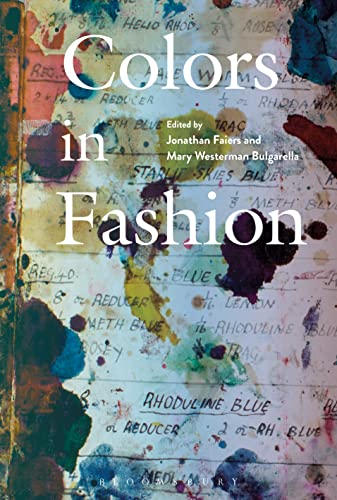

Colors in fashion / edited by Jonathan Faiers and Mary Westerman Bulgarella. [electronic resource]
Editor: London ; New York : Bloomsbury Academic, an imprint of Bloomsbury Publishing Plc, 2017Descripción: xvii, 227 pages : illustrations (chiefly color) ; 24 cmTipo de contenido:- text
- computer
- online resource
- 9781474273688 (hardcover)
- 746.9/2 23
- TT507 .C657 2017
| Imagen de cubierta | Tipo de ítem | Biblioteca actual | Biblioteca de origen | Colección | Ubicación en estantería | Signatura topográfica | Materiales especificados | Info Vol | URL | Copia número | Estado | Notas | Fecha de vencimiento | Código de barras | Reserva de ítems | Prioridad de la cola de reserva de ejemplar | Reservas para cursos | |
|---|---|---|---|---|---|---|---|---|---|---|---|---|---|---|---|---|---|---|
| Libro electrónico | Biblioteca de Mayagüez Acceso en línea | TT507 .C657 2017 (Navegar estantería(Abre debajo)) | c. 1 | Disponible | 50000003272829 | |||||||||||||
| Libro electrónico | Biblioteca Encarnación Valdés Acceso en línea | E-book (Navegar estantería(Abre debajo)) | Disponible | 8000ebookpev10 | ||||||||||||||
| Libro electrónico | Biblioteca Mons. Iñaki Mallona (Arecibo) Acceso en línea | 746.92 (Navegar estantería(Abre debajo)) | Ebooks | Disponible | 60000010177167 |
Descripciones mejoradas de Syndetics:
Color speaks a powerful cultural language, conveying political, sexual, and economic messages that, throughout history, have revealed how we relate to ourselves and our world. This ground-breaking compilation is the first to investigate how color in fashionable and ceremonial dress has played a significant social role, indicating acceptance and exclusion, convention and subversion.From the use of white in pioneering feminism to the penchant for black in post-war France, and from mystical scarlet broadcloth to the horrors of arsenic-laden green fashion, this publication demonstrates that color in dress is as mutable, nuanced, and varied as color itself. Divided into four thematic parts - solidarity, power, innovation, and desire - each section highlights the often violent, emotional histories of color in dress across geographical, temporal and cultural boundaries. Underlying today's relaxed attitude to color lies a chromatic complexity that speaks of wars, migrations and economics. While acknowledging the importance that technology has played in the development of new dyes, the chapters explore color as a catalyst for technical innovation that continues to inspire designers, artists, and performers. Bringing together cutting-edge contributions from leading scholars, it is essential reading for academics of fashion, textiles, design, cultural studies and art history.
Includes bibliographical references and index.
Introduction -- SECTION ONE COLOR AND SOLIDARITY -- 1. Color as Theme in the Ebony Fashion Fair -- 2. Purity and parity: the white dress of the suffrage movement in early twentieth-century britain -- 3. Birds of the Same “color” flock together: color as expression of identity and solidarity in aso-ebi cloth of the yoruba -- 4. contradictory colors: tricolor in vichy france’s fashion culture -- SECTION TWO COLOR AND POWER -- 5. Dress and color at the thai court -- 6. “gold and silver by night.” queen alexandra: a life in color -- 7. Lord boston’s court uniform: a story of color, politics, and the psychology of belonging -- 8. Yellow is the New Red, or Clothing the Recession and How the Shade of Shame Became Chic -- SECTION THREE COLOR AND INNOVATION -- 9. Color before technicolor: colorized fashion films of the silent era -- 10. Color as Concept: From international klein blue to viktor & rolf’s “bluescreen” -- 11. tainted love: oscar wilde’s toxic green carnation, queerness, and chromophobia -- 12. Starlit skies blue versus durindone blue -- SECTION FOUR COLOR AND DESIRE -- 13. Rough wolves in the sheepcote: the meanings of fashionable -- 14. “le noir étant la dominante de notre vêture …”: the many meanings of the color black in postwar paris -- 15. British scarlet broadcloth, the perfect red in eastern africa, c.1820–1885 -- 16. Lives lived: An archaeology of faded indigo -- Index.
Color speaks a powerful cultural language, conveying political, sexual, and economic messages that, throughout history, have revealed how we relate to ourselves and our world. This ground-breaking compilation is the first to investigate how color in fashionable and ceremonial dress has played a significant social role, indicating acceptance and exclusion, convention and subversion.From the use of white in pioneering feminism to the penchant for black in post-war France, and from mystical scarlet broadcloth to the horrors of arsenic-laden green fashion, this publication demonstrates that color in dress is as mutable, nuanced, and varied as color itself. Divided into four thematic parts - solidarity, power, innovation, and desire - each section highlights the often violent, emotional histories of color in dress across geographical, temporal and cultural boundaries. Underlying today's relaxed attitude to color lies a chromatic complexity that speaks of wars, migrations and economics. While acknowledging the importance that technology has played in the development of new dyes, the chapters explore color as a catalyst for technical innovation that continues to inspire designers, artists, and performers. Bringing together cutting-edge contributions from leading scholars, it is essential reading for academics of fashion, textiles, design, cultural studies and art history.
Tabla de contenidos provista por Syndetics
- List of illustrations(p. vii)
- List of Contributors(p. xiii)
- Acknowledgments(p. xviii)
- Introduction(p. 1)
- Section 1 Color and Solidarity(p. 11)
- 1 Color as Theme in the Ebony Fashion Fair(p. 13)
- 2 Purity and Parity: The White Dress of the Suffrage Movement in Early Twentieth-Century Britain(p. 21)
- 3 Birds of the Same "Color" Flock Together: Color as Expression of Identity and Solidarity in Aso-Ebi Cloth of the Yoruba(p. 35)
- 4 Contradictory Colors: Tricolor in Vichy France's Fashion Culture(p. 47)
- Section 2 Color and Power(p. 57)
- 5 Dress and Color at the Thai Court(p. 59)
- 6 "Gold and Silver by Night." Queen Alexandra: A Life in Color(p. 67)
- 7 Lord Boston's Court Uniform: A Story of Color, Politics, and the Psychology of Belonging(p. 81)
- 8 Yellow is the New Red, or Clothing the Recession and How the Shade of Shame Became Chic(p. 95)
- Section 3 Color and Innovation(p. 107)
- 9 Color before Technicolor: Colorized Fashion Films of the Silent Era(p. 109)
- 10 Color as Concept: From International Klein Blue to Viktor & Rolf's "Bluescreen"(p. 117)
- 11 Tainted Love: Oscar Wilde's Toxic Green Carnation, Queerness, and Chromophobia(p. 127)
- 12 Starlit Skies Blue versus Durindone Blue(p. 143)
- Section 4 Color and Desire(p. 153)
- 13 Rough Wolves in the Sheepcote: The Meanings of Fashionable Color, 1900-1914(p. 156)
- 14 "Le Noir Étant la Dominante de Notre Vêture...": The Many Meanings of the Color Black in Postwar Paris(p. 169)
- 15 British Scarlet Broadcloth, the Perfect Red in Eastern Africa, c.1820-1885(p. 187)
- 16 Lives Lived: An Archaeology of Faded Indigo(p. 199)
- Index(p. 210)
Reseñas proporcionadas por Syndetics
Library Journal Review
Why did the British suffragettes wear white? What color did Thailand's Queen Sirikit sport on Fridays? And why were dyed green carnations in the early 1800s so deadly? The role of color in the world of fashion, as readers will learn, is to inform, communicate, and even discriminate, as well as to illustrate political, economic, and sexual ideas. This book includes 16 of the best papers presented at the 2014 Costume Colloquium conference held in Florence, Italy, and they cover many shades of the rainbow to answer the questions above, as well as the meaning of black in postwar Paris, how fashion and color are used to show identity and belonging with the Yoruba in Nigeria, and how early colorized silent films employed high fashion to attract female viewers and blur the lines between upper- and lower-class forms of entertainment. VERDICT Readers of fashion, costume, and design, as well as anthropology, history, and art history will enjoy this accessible, fun title.-Melissa Aho, Univ. of Minnesota Bio-Medical Lib., Minneapolis © Copyright 2017. Library Journals LLC, a wholly owned subsidiary of Media Source, Inc. No redistribution permitted.Notas de autor provistas por Syndetics
Jonathan Faiers is Professor of Fashion, Thinking at Winchester School of Art, University of Southampton, UK, publishes internationally on fashion and textiles, and is editor of the journal Luxury: History, Culture, Consumption.Mary Westerman Bulgarella is a consultant in the conservation, research, and display of historic textiles and dress, based in Florence, Italy and in Chicago, Illinois. She has been the-Advisory Committee Coordinator of Costume Colloquium since its conception.