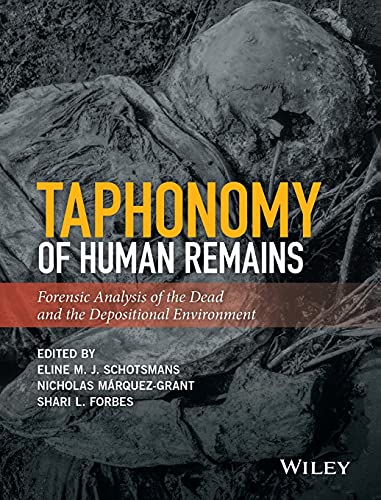

Taphonomy of human remains : forensic analysis of the dead and the depositional environment / edited by Eline M. Schotsmans, Dr. Nicholas Márquez-Grant, Professor Shari Forbes. [electronic resource]
Editor: Chichester, West Sussex ; Hoboken, NJ : John Wiley & Sons, Inc., 2017Descripción: Electronic text (xxxii, 509 pages) : illustrationsTipo de contenido:- text
- computer
- online resource
- 9781118953327 (cloth)
- 9781118953334
- 9781118953341 (Ebook)
- 614/.17 23
- RA1055 .T374 2017
- W 750
| Imagen de cubierta | Tipo de ítem | Biblioteca actual | Biblioteca de origen | Colección | Ubicación en estantería | Signatura topográfica | Materiales especificados | Info Vol | URL | Copia número | Estado | Notas | Fecha de vencimiento | Código de barras | Reserva de ítems | Prioridad de la cola de reserva de ejemplar | Reservas para cursos | |
|---|---|---|---|---|---|---|---|---|---|---|---|---|---|---|---|---|---|---|
| Libro electrónico | Biblioteca de Mayagüez Acceso en línea | RA1055 .T374 2017 (Navegar estantería(Abre debajo)) | c. 1 | Disponible | 50000003272787 | |||||||||||||
| Libro electrónico | Biblioteca Encarnación Valdés Acceso en línea | E-book (Navegar estantería(Abre debajo)) | Disponible | 8000ebookpev6 |
Descripciones mejoradas de Syndetics:
A truly interdisciplinary approach to this core subject within Forensic Science
Combines essential theory with practical crime scene work Includes case studies Applicable to all time periods so has relevance for conventional archaeology, prehistory and anthropology Combines points of view from both established practitioners and young researchers to ensure relevanceIncludes bibliographical references and index.
Introduction -- Part I: General Post-Mortem Processes: Degradation of Soft Tissue, Bone and Associated Materials -- Chapter 1: Gross Post-Mortem Changes in the Human Body -- Chapter 2: Microscopic Post-Mortem Changes: the Chemistry of Decomposition -- Chapter 3: Profiling Volatile Organic Compounds of Decomposition -- Chapter 4: Blood Degradation and Bloodstain Age Estimation -- Chapter 5: DNA Degradation: Current Knowledge and Progress in DNA Analysis -- Chapter 6: Taphonomic Alterations to Hair and Nail -- Chapter 7: Taphonomy of Teeth -- Chapter 8: The Taphonomy of Natural Mummies -- Chapter 9: Degradation of Clothing in Depositional Environments -- Chapter 10: Post-Mortem Interval Estimation: an Overview of Techniques -- Part II: The Depositional Environment -- Chapter 11: Relationships between Human Remains, Graves and the Depositional Environment -- Chapter 12: Bacterial Symbionts and Taphonomic Agents of Humans -- Chapter 13: Forensic Entomology and Funerary Archaeoentomology -- Chapter 14: Forensic Botany and Stomach Contents Analysis: Established Practice and Innovation -- Chapter 15: The Effects of Weathering on Bone Preservation -- Chapter 16: The Effects of Terrestrial Mammalian Scavenging and Avian Scavenging on the Body -- Chapter 17: Decomposition in Aquatic Environments -- Chapter 18: Post-Mortem Differential Preservation and its Utility in Interpreting Forensic and Archaeological Mass Burials -- Chapter 19: Reconstructing the Original Arrangement, Organisation and Architecture1 of Burials in Archaeology -- Part III: Anti-, Peri- and Post-Mortem Modifications to the Body -- Chapter 20: Forensic Toxicology of Decomposed Human Remains -- Chapter 21: Thermal Alteration to the Body -- Chapter 22: Concealing the Crime: the Effects of Chemicals on Human Tissues -- Chapter 23: Distinguishing between Peri- and Post-Mortem Trauma on Bone -- Chapter 24: Collection Care and Management of Human Remains -- Part IV: Case Studies -- Chapter 25: The Use of Volatile Fatty Acid Biomarkers to Estimate the Post-Mortem Interval -- Chapter 26: A Taphonomic Study Based on Observations of 196 Exhumations and 23 Clandestine Burials -- Chapter 27: Case Studies on Taphonomic Variation between Cemetery Burials -- Chapter 28: Forensic Entomology Case Studies from Mexico -- Chapter 29: Recovery of Skeletonised Human Remains and Textile Degradation: a Case Study -- Chapter 30: Saponified Brains of the Spanish Civil War -- Chapter 31: Analysis and Interpretation of Burned Human Remains from a Homicide -- Chapter 32: A Soldier's Story: Forensic Anthropology and Blast Injury -- Chapter 33: Decomposition in an Unusual Environment: Body Sealed in Concrete -- Chapter 34: A Case Study from Los Angeles: Baby in Concrete -- Part V: Past, Present and Future Considerations -- Chapter 35: History and Development of the First Anthropology Research Facility, Knoxville, Tennessee -- Chapter 36: Crime Scene Investigation, Archaeology and Taphonomy: Reconstructing Activities at Crime Scenes -- Index.
A truly interdisciplinary approach to this core subject within Forensic Science Combines essential theory with practical crime scene work Includes case studies Applicable to all time periods so has relevance for conventional archaeology, prehistory and anthropology Combines points of view from both established practitioners and young researchers to ensure relevance
Notas de autor provistas por Syndetics
Eline M. J. Schotsmans is a post-doctoral researcher in forensic archaeology and taphonomy at the Laboratory of Anthropology of Past and Present Populations (PACEA) at the University of Bordeaux, France, and an honorary fellow at the University of Bradford, UK. She has worked on various forensic cases and conducts research in taphonomy that lies at the interface between archaeo-anthropology and forensic sciences.
Nicholas Márquez-Grant is a Lecturer in Forensic Anthropology and Course Director MSc in Forensic Archaeology and Anthropology at Cranfield University, UK. He is also a Research Associate at the University of Oxford. He has analysed human remains from a number of countries and chronological periods and currently undertakes forensic casework in the UK.
Shari Forbes is a Professor and ARC Future Fellow in the Centre for Forensic Science at the University of Technology Sydney. She is also the Director of the Australian Facility for Taphonomic Experimental Research (AFTER), the first facility in Australia that allows scientists to study the decomposition of human cadavers. She is regularly consulted on forensic casework and assists police to search for and locate human remains using police dogs and geophysical equipment.