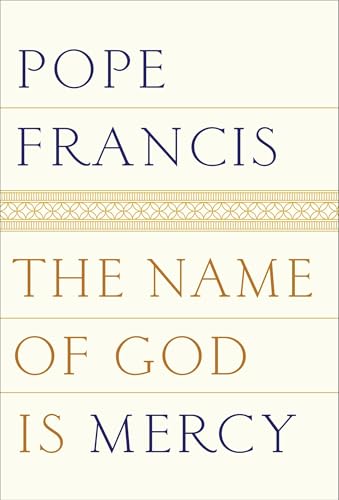
Imagen de portada de Amazon
Imagen de Amazon.com
Imagen de cubierta Syndetics
Portada de Syndetics
Imagen de OpenLibrary

El nombre de Dios es Misericordia : una conversación con Andrea Tornielli ; Papa Francisco ;traducción de M.ª Angeles Cabré.

Por: Colaborador(es): Idioma: Español Editor: New York : Random House, ©2016Edición: First editionDescripción: xx, 151 pages ; 23 cmTipo de contenido:
  • text
Tipo de medio:
  • unmediated
Tipo de soporte:
  • volume
ISBN:
  • 9780399588631
  • 0399588639
Otro título:
  • Papa Francisco [Título de cubierta]
Títulos uniformes: Tema(s): Clasificación CDD:
  • 282/.092 23
Clasificación LoC:
  • BV4647.M4 F73 2016
Contenidos:
"En su primer libro oficial como el Papa, y en celebración de su Jubileo de la Misericordia, el Papa Francisco se dirige a cada hombre y mujer del planeta un diálogo íntimo y personal. En el centro, se halla el tema que más le interesa --la misericordia--desde siempre eje fundamental de su fe y ahora de su pontificado. En cada página vibra el deseo de llegar a todas aquellas almas que buscan darle un sentido a...
Valoración
    Valoración media: 0.0 (0 votos)
Existencias
Imagen de cubierta Tipo de ítem Biblioteca actual Biblioteca de origen Colección Ubicación en estantería Signatura topográfica Materiales especificados Info Vol URL Copia número Estado Notas Fecha de vencimiento Código de barras Reserva de ítems Prioridad de la cola de reserva de ejemplar Reservas para cursos
Libro Biblioteca Encarnación Valdés Colección General bev 282.092 F8181n E (Navegar estantería(Abre debajo)) Disponible 80000002544792
Total de reservas: 0

Descripciones mejoradas de Syndetics:

NEW YORK TIMES BESTSELLER * Pope Francis invites all humanity to an intimate and personal dialogue on the subject closest to his heart: mercy.

"Moving . . . [Pope Francis] opens the sacred space of his conscience to explain how he came to center his ministry, and now his papacy, around mercy."--James Carroll, The New Yorker

"The name of God is mercy. There are no situations we cannot get out of, we are not condemned to sink into quicksand."--Pope Francis

In this conversation with Vatican reporter Andrea Tornielli, Francis explains--through memories from his youth and moving anecdotes from his experiences as a pastor--why "mercy is the first attribute of God." God "does not want anyone to be lost. His mercy is infinitely greater than our sins," he writes. As well, the Church cannot close the door on anyone, Francis asserts--on the contrary, its duty is to go out into the world to find its way into the consciousness of people so that they can assume responsibility for, and move away from, the bad things they have done.

Clear and profound, The Name of God Is Mercy resonates with this desire to reach all those who are looking for meaning in life, a road to peace and reconciliation, and the healing of physical and spiritual wounds.

Includes bibliographical references (pages 156-157).

"En su primer libro oficial como el Papa, y en celebración de su Jubileo de la Misericordia, el Papa Francisco se dirige a cada hombre y mujer del planeta un diálogo íntimo y personal. En el centro, se halla el tema que más le interesa --la misericordia--desde siempre eje fundamental de su fe y ahora de su pontificado. En cada página vibra el deseo de llegar a todas aquellas almas que buscan darle un sentido a...

Extracto provisto por Syndetics

I a Time for Mercy Holy Father, can you tell us how the desire to proclaim a Holy Year of Mercy was born? Where did the inspiration come from? There was no particular or defining moment. Things come to me by themselves, they are the ways of the Lord, and they are preserved in prayer. I am inclined never to trust my first reaction to an idea or to a proposal that is made to me. I never trust myself in part because my first reaction is usually wrong. I have learned to wait, to trust in the Lord, to ask for his help, so I can discern better and receive guidance. I can say that the centrality of mercy, which for me is Jesus' most important message, has slowly evolved over the years in my work as a priest, as a consequence of my experience as a confessor, and thanks to the many positive and beautiful stories that I have known. As early as July 2013, only a few months after being named Pope, when you were returning from Rio de Janeiro, where the World Day of Youth had been celebrated, you said that ours is a time of mercy. Yes, I believe that this is an age of mercy. The Church is showing her maternal side, her motherly face, to a humanity that is wounded. She does not wait for the wounded to knock on her doors, she looks for them on the streets, she gathers them in, she embraces them, she takes care of them, she makes them feel loved. And so, as I said, and I am ever more convinced of it, this is a kairós, our era is a kairós of mercy, an opportune time. When John XXIII solemnly opened the Second Vatican Ecumenical Council, he said, "The Bride of Christ prefers to use the medicine of mercy rather than arm herself with the weapons of rigor." In his meditation "Thoughts on Death," the blessed Paul VI revealed the essence of his spiritual life in the synthesis proposed by Saint Augustine: poverty and mercy. "My poverty--Pope Montini wrote--the mercy of God. That I may at least honor who you are, God of infinite bounty, invoking, accepting, and celebrating your sweet mercy." Saint John Paul II took the notion further with his encyclical Dives in Misericordia, in which he affirmed that the Church lives an authentic life when it professes and proclaims mercy, the most amazing attribute of the Creator and Redemptor, and when it leads humanity to the font of mercy. In addition, he instituted the festivity of Holy Mercy, endorsed the figure of Saint Faustina Kowalska, and focused on Jesus' words on mercy. Even Pope Benedict XVI also spoke of this in his teachings: "Mercy is in reality the core of the Gospel message; it is the name of God himself, the face with which he revealed himself in the Old Testament and fully in Jesus Christ, incarnation of Creative and Redemptive Love. This love of mercy also illuminates the face of the Church, and is manifested through via the Sacraments, in particular that of the Reconciliation, as well as in works of charity, both of community and individuals. Everything that the Church says and does shows that God has mercy for man." I also have many personal memories of other episodes related to the subject. For example, before coming here, when I was in Buenos Aires, I specifically recall a roundtable discussion with theologians. The topic was what the Pope could do to bring people closer together; we were faced with so many problems that there seemed to be no solution. One of the participants suggested "a Holy Year of forgiveness." This idea stayed with me. And therefore, to answer your question, I believe that the decision came through prayer, through reflection on the teachings and declarations of the Popes who preceded me, and by thinking of the Church as a field hospital, where treatment is given above all to those who are most wounded. A Church that warms people's hearts with its closeness and nearness. What is mercy for you? Etymologically, "mercy" derives from misericordis, which means opening one's heart to wretchedness. And immediately we go to the Lord: mercy is the divine which embraces attitude, it is God's giving himself to us, accepting us, and bowing to forgive. Jesus said he came not for those who were good but for the sinners. He did not come for the healthy, who do not need the doctor, but for the sick. For this reason, we can say that mercy is God's identity card. God of Mercy, merciful God. For me, this really is the Lord's identity. I was always impressed by the story of Jerusalem as it is told in chapter 16 of the Book of Ezekiel. The story compares Jerusalem to a little girl whose umbilical cord wasn't cut, who was left in her blood and was cast out. God saw her wallowing in blood, he washed the blood from her, he anointed her, he dressed her, and when she grew up he adorned her with silk and jewels. But she, infatuated with her own beauty, became a harlot, not for money but paying her lovers herself. God, however, will never forget his covenant and he will place her above her sisters so that Jerusalem will remember and be ashamed (Ezekiel 16:63), when she is forgiven for what she has done. For me this is one of the most important revelations: you will continue to be the chosen people and all your sins will be forgiven. So mercy is deeply connected to God's faithfulness. The Lord is faithful because he cannot deny himself. This is explained well by Saint Paul in the Second Letter to Timothy: "If we are faithless, he remains faithful, for he cannot deny himself." You can deny God, you can sin against him, but God cannot deny himself. He remains faithful. What place and meaning do mercy have in your heart, life, and personal history? Do you remember your first experience of mercy as a child? I can read my life in light of chapter 16 of the book of the prophet Ezekiel. I read those pages and I say: everything here seems written just for me. The prophet speaks of shame, and shame is a grace: when one feels the mercy of God, he feels a great shame for himself and for his sin. There is a beautiful essay by a great scholar of spirituality, Father Gaston Fessard, on the subject of shame in his book The Dialectic of the "Spiritual Exercises" of St. Ignatius of Loyola. Shame is one of the graces that Saint Ignatius asks for during his confession of his sins before Christ crucified. That text from Ezekiel teaches us to be ashamed, it shows us how to feel shame: with all our history of wretchedness and sin, God remains faithful and raises us up. I feel this. I don't have any particular memories of mercy as a young child. But I do as a young man. I think of Father Carlos Duarte Ibarra, the confessor I met in my parish church on September 21, 1953, the day the Church celebrated Saint Matthew the apostle and Evangelist. I was seventeen years old. On confessing to him, I felt welcomed by the mercy of God. Ibarra was originally from Corrientes but was in Buenos Aires to receive treatment for leukemia. He died the following year. I still remember how when I got home, after his funeral and burial, I felt as though I had been abandoned. And I cried a lot that night, really a lot, and hid in my room. Why? Because I had lost a person who helped me feel the mercy of God, a person who helped me understand the expression miserando atque eligendo, an expression I didn't know at the time but which I would eventually choose as my episcopal motto. I learned about it later, from the homilies of the English monk Venerable Bede. When describing the calling of Matthew, he writes: "Jesus saw the tax collector, and by having mercy chose him as an Apostle, saying to him, 'Follow me.' " This is the translation commonly given for the words of Saint Bede. I like to translate miserando with another gerund that doesn't exist: mercifying. So, "mercifying and choosing" describes the vision of Jesus, who gives the gift of mercy and chooses, and takes unto himself. Excerpted from The Name of God Is Mercy: A Conversation with Andrea Tornielli by Francis I All rights reserved by the original copyright owners. Excerpts are provided for display purposes only and may not be reproduced, reprinted or distributed without the written permission of the publisher.

Reseñas proporcionadas por Syndetics

Publishers Weekly Review

Pope Francis proclaimed 2016 "the extraordinary jubilee year of mercy"; in this small, persuasive book, he explains that "we need constantly to contemplate the mystery of mercy." The first two-thirds consists of questions posed by Andrea Tornielli, a Vatican journalist, and answered by Francis. Tornielli's questions range in tone from catechism ("Why are we sinners?") to eliciting Francis's personal and pastoral experiences, as well as questions that clarify his theology and vision for the Roman Catholic Church. Pope Francis quotes saints, Scripture, and his papal forefathers in the beautiful book, with endpapers that repeat the title in many languages. The pope briefly addresses homosexuality and the ecumenism of mercy throughout the world's religions; he more fully considers mercy in relation to compassion, scholarship, confession, and justice, juxtaposing mercy and corruption most profoundly. The last third of the book presents his proclamation about the year of mercy, delivered in March of 2015, in all its poetry, clarity, and appeal: "Let us live this jubilee intensely..." (Jan.) © Copyright PWxyz, LLC. All rights reserved.

Notas de autor provistas por Syndetics

Pope Francis was born in Buenos Aires on December 17, 1936, son of Italian migrants, the first of five children born in the working-class barrio of Flores. He qualified as a chemical technician, graduated in philosophy in 1963, became a priest in 1969, joined the provincial of the Jesuits of Argentina in 1973, was named auxiliary bishop in 1992, archbishop of Buenos Aires in 1998, created cardinal in 2001, and since March 13, 2013, Bishop of Rome and the 266th Pope of the Catholic Church.

Andrea Tornielli is a veteran Vatican reporter, correspondent for La Stampa, and director of the Vatican Insider website. He also writes for a variety of Italian and international magazines. His publications include the first biography of the Pope, Francis: Pope of a New World, which was translated into sixteen languages, and This Economy Kills: Pope Francis on Capitalism and Social Justice, which was translated into nine languages.
Compartir
logopucpr-y-vive

Contáctanos

¡Queremos saber de ti!

Tel. 787.841.2000 Ext. 1801

bibliotecavaldes@pucpr.edu

⁣Búscanos en las redes

© 2026 Desarrollado por Ignite Online • All Rights Reserved • Powered by Koha.