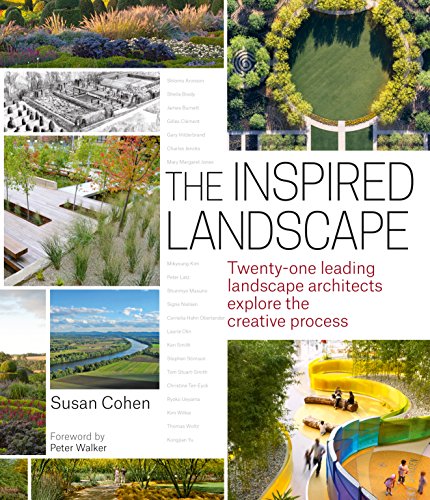
Imagen de portada de Amazon
Imagen de Amazon.com
Imagen de cubierta Syndetics
Portada de Syndetics
Imagen de OpenLibrary

The inspired landscape : twenty-one leading landscape architects explore the creative process / Susan Cohen ; foreword by Peter Walker.

Por: Idioma: Inglés Editor: Portland, Oregon : Timber Press, Inc., 2015Edición: First editionDescripción: 268 pages : illustrations, color ; 27 cmTipo de contenido:
  • text
  • still image
Tipo de medio:
  • unmediated
Tipo de soporte:
  • volume
ISBN:
  • 9781604694390
  • 1604694394
Otro título:
  • Twenty-one leading landscape architects explore the creative process
Tema(s): Clasificación CDD:
  • 712.092 23
Clasificación LoC:
  • SB469.37 .C64 2015
Contenidos:
Finding the muse : An introduction -- Shlomo Aronson : Kreitman Plaza at Ben-Guiron University of the Negev, Beersheba, Israel -- Sheila Brady : The Native Plant Garden at the New York Botanical Garden, Bronx, New York -- James Burnett : Sunnylands Center and Gardens, Rancho Mirage, California -- Gilles Clement : Garden at the Musee du quai Branly, Paris, France -- Gary Hilderbrand : Old Quarry Residence, Guilford, Connecticut -- Charles Jencks : Dividing Cells, Maggie's Cancer Caring Centre, Inverness, Scotland -- Mary Margaret Jones : Discovery Green, Houston, Texas -- Mikyoung Kim : Crown Sky Garden, Chicago, Illinois -- Peter Latz : Landscape Park Duisburg Nord, Duisburg, Germany -- Shunmyo Masuno : Gardens at Samukawa Shrine, Kanagawa Prefecture, Japan -- Signe Nielsen : Fulton Landing, Brooklyn, New York -- Cornelia Hahn Oberlander : VanDusen Botanical Garden Visitor Centre, Vancouver, Canada -- Laurie Olin : The American Academy in Rome Landscape Redesign, Rome, Italy -- Ken Smith : Museum of Modern Art Roof Garden, New York, New York -- Stephen Stimson : Southwest Concourse at the University of Massachusetts, Amherst, Massachusetts -- Tom Stuart-Smith : The walled garden at Broughton Grange, Northamptonshire, England -- Christine Ten Eyck : Capri Lounge Garden, Marfa, Texas -- Ryoko Ueyama : Kitamachi Shimashima Park, Saitama, Japan -- Kim Wilkie : Orpheus at Boughton House, Northamptonshire, England -- Thomas Woltz : Hither Hill Garden, Montauk, New York -- Kongjian Yu : Rice Campus, Shenyang Jianzhu University, Shenyang, China ; Red Ribbon Park, Qinhuangdoa, China.
Resumen: Featuring the work of 21 landscape architects from around the world, The Inspired Landscape traces each project from the initial spark of creativity through its stunning completion. Lushly illustrated with original sketches, plans, and photographs, this invaluable resource will embolden designers to delve into the myriad sources that fuel the creative process.--COVER.
Valoración
    Valoración media: 0.0 (0 votos)
Existencias
Imagen de cubierta Tipo de ítem Biblioteca actual Biblioteca de origen Colección Ubicación en estantería Signatura topográfica Materiales especificados Info Vol URL Copia número Estado Notas Fecha de vencimiento Código de barras Reserva de ítems Prioridad de la cola de reserva de ejemplar Reservas para cursos
Libro CARIBET Biblioteca Arquitectura Colección General CARIBET SB469.37.C64 2015 (Navegar estantería(Abre debajo)) Disponible 91000000052183
Total de reservas: 0

Descripciones mejoradas de Syndetics:

The Inspired Landscape explores the creative process of outstanding landscape architects through their most celebrated projects. Susan Cohen, the founder and director of the acclaimed Landscape Design Portfolio Series at New York Botanical Garden, illustrates the creative path taken by landscape architects like Mikyoung Kim, whose design for the Crown Sky Garden in Chicago was inspired by the interplay of music and nature. And Cornelia Oberlander, whose vision for the form of a Vancouver green roof was drawn from a Karl Blossfeld photograph of a gently undulating orchid leaf. With original sketches, plans, and photographs, this book is an extraordinary journey through the creative process.

Includes index.

Finding the muse : An introduction -- Shlomo Aronson : Kreitman Plaza at Ben-Guiron University of the Negev, Beersheba, Israel -- Sheila Brady : The Native Plant Garden at the New York Botanical Garden, Bronx, New York -- James Burnett : Sunnylands Center and Gardens, Rancho Mirage, California -- Gilles Clement : Garden at the Musee du quai Branly, Paris, France -- Gary Hilderbrand : Old Quarry Residence, Guilford, Connecticut -- Charles Jencks : Dividing Cells, Maggie's Cancer Caring Centre, Inverness, Scotland -- Mary Margaret Jones : Discovery Green, Houston, Texas -- Mikyoung Kim : Crown Sky Garden, Chicago, Illinois -- Peter Latz : Landscape Park Duisburg Nord, Duisburg, Germany -- Shunmyo Masuno : Gardens at Samukawa Shrine, Kanagawa Prefecture, Japan -- Signe Nielsen : Fulton Landing, Brooklyn, New York -- Cornelia Hahn Oberlander : VanDusen Botanical Garden Visitor Centre, Vancouver, Canada -- Laurie Olin : The American Academy in Rome Landscape Redesign, Rome, Italy -- Ken Smith : Museum of Modern Art Roof Garden, New York, New York -- Stephen Stimson : Southwest Concourse at the University of Massachusetts, Amherst, Massachusetts -- Tom Stuart-Smith : The walled garden at Broughton Grange, Northamptonshire, England -- Christine Ten Eyck : Capri Lounge Garden, Marfa, Texas -- Ryoko Ueyama : Kitamachi Shimashima Park, Saitama, Japan -- Kim Wilkie : Orpheus at Boughton House, Northamptonshire, England -- Thomas Woltz : Hither Hill Garden, Montauk, New York -- Kongjian Yu : Rice Campus, Shenyang Jianzhu University, Shenyang, China ; Red Ribbon Park, Qinhuangdoa, China.

Featuring the work of 21 landscape architects from around the world, The Inspired Landscape traces each project from the initial spark of creativity through its stunning completion. Lushly illustrated with original sketches, plans, and photographs, this invaluable resource will embolden designers to delve into the myriad sources that fuel the creative process.--COVER.

Extracto provisto por Syndetics

Finding the Muse: An Introduction Through training and experience, landscape architects have the ability to recognize the possibilities of a given site as well as its constraints. They know how the sun will move across the sky and where the shadows will fall, how the wind will blow, which plants will grow well, where the best views might be, and where people are most likely to walk or gather. They know how to analyze the existing soil and how to accommodate both natural conditions and the surrounding built environment. Most importantly, they understand how to meet the needs of people who will use the space.             However, like musicians, painters, poets, and sculptors, the best landscape architects are also artists. They use their skills, their imaginations, and the materials of their craft to create something new, works that move and change through time. And like all artists, they must begin with an idea; they must invoke their muses to create a singular landscape that is also a work of art. This book explores and illustrates the sources of these ideas in the work of twenty-one outstanding landscape architects in their successful projects in the United States, Canada, England, Scotland, Germany, France, Italy, Israel, China, and Japan. Although there are threads that link some of their thoughts and methods, each created landscape is unique, and all the landscape architects have a story to tell about how the spark of a design idea--inspiration--came to them.  It is no surprise that the inspirations and influences for their projects are as varied as the landscape architects who made them and the sites on which they worked. And yet many projects here resonate with each other. For instance, Signe Nielsen's Fulton Landing, a small urban park in Brooklyn, New York, is very different from Gary Hilderbrand's residential property in Guilford, Connecticut. But both landscape architects turned to the historical uses of their waterfront sites, drawing inspiration from the shoreline activities of centuries past. Nielsen's influences include the decorative patterns of Native Americans who once lived here, Walt Whitman's famous poem "Crossing Brooklyn Ferry," about the Fulton Ferry that departed from this location, and the magnificent Brooklyn Bridge adjacent to the site. Hilderbrand was struck by the extensive stone debris that littered his clients' property, remnants of the extensive old granite quarry that had provided the stone for the base of the Statue of Liberty in the nineteenth century. Instead of carting away tons of this abandoned stone, as many of the neighbors had done, Hilderbrand used it throughout the property in ways both practical and artful. In doing so, he felt he honored the work of the hundreds of experienced stonemasons, most of them immigrants from Europe, who had toiled here a hundred years earlier. By coincidence, two landscape architects were similarly inspired by a natural desert phenomenon: the streambeds that carry intermittent floodwaters in times of heavy rain. Desert wadis, as they are called in the Middle East, sparked Shlomo Aronson's design for a gathering place at Ben-Gurion University in Israel's Negev Desert. His evocative stone wadi at Kreitman Plaza, which runs continuously with burbling water, shares kinship with a winding garden creek that collects rainwater in Christine Ten Eyck's Capri Lounge garden in Marfa, Texas, where such desert washes are called arroyos. For others, a single work of art provided the spark of invention. While sketching design concepts for the Native Plant Garden at the New York Botanical Garden, Sheila Brady took time out to visit a museum and found, in a wood sculpture by Martin Puryear, her inspiration for the abstract shape of a large pond, the new garden's central feature. Similarly, Cornelia Oberlander, who has admired the pioneering work of the nineteenth-century photographer Karl Blossfeldt since her childhood days in Germany, found the vision for the form of a green roof in Vancouver in his photograph of a gently undulating orchid leaf. For the Sunnylands Center and Gardens, James Burnett was encouraged by Vincent Van Gogh's painting A Wheatfield with Cypresses to use drought-tolerant plants in large sweeps, creating an unexpectedly lush landscape in the southern California desert. All landscape architects study garden history as part of their training, and most are inveterate visitors to gardens old and new. So it is not surprising that they reach back to gardens of the past for ideas. Tom Stuart-Smith, invited by the owner of an English country estate to make a walled garden on a sloping piece of land not far from the manor house, created an imaginative terraced composition that references the famous seventeenth-century Villa Lante in Italy. While in Rome at the American Academy, Laurie Olin made countless visits to both ancient and Renaissance-period Italian gardens, which he studied, sketched, and photographed. He used several ideas and details from these gardens in his landscape redesign at the academy. For his roof design at the Museum of Modern Art in New York, Ken Smith cited as inspiration two gardens created in 1958: the patently synthetic garden in the film Mon Oncle and Isamu Noguchi's rooftop Peace Garden at the UNESCO headquarters in Paris. For Shunmyo Masuno, a landscape architect and Zen Buddhist priest, remembered landscapes are part of a centuries-old tradition of garden making in Japan. Some landscape architects find their muse in the site itself. In looking for the "memories of the land," landscape architect Ryoko Ueyama was thrilled to discover that her 4-acre site for a park north of Tokyo was located directly on the axis between two mountains, one of which is the iconic Mount Fuji. Calling this coincidence a "divine pronouncement," she emphasized this line in her design with a diagonal pattern of stripes that runs the length of the park. In Duisburg, Germany, Peter Latz was struck by the huge abandoned concrete and iron structures on his post-industrial site and found imaginative and useful ways to incorporate them into his plan for a new public park. Others find flashes of inspiration from childhood memories. For Kongjian Yu, the remembered landscape is his family's rice fields in rural China and the paths through which, as a boy, he led the village water buffalo to graze. Across the world, Stephen Stimson grew up on a dairy farm in Massachusetts. His strong bond with a five-generation agricultural past led him to use stone walls, orchard-like plantings of trees, and benches bracketed by heavy metal fastenings that recall farm implements in his project at the University of Massachusetts. Kim Wilkie's childhood in Iraq and Malaysia gave him an obsession with ziggurats and old Mesopotamian sites, as well as a fascination with all things sacred and mystical. These early interests inspired his Orpheus landform at Boughton House in Northamptonshire, England. Great landscape architects, like their counterparts in other arts, seem able to draw inspiration from diverse sources: a place, a poem, a painting, a remembered garden, a path taken in childhood, or the shape of a leaf. Judging from the work presented here, the ancient muses of invention are still among us, providing spirited inspiration to landscape architects practicing today.     Excerpted from The Inspired Landscape: Twenty-One Extraordinary Landscape Architects Explore the Creative Process by Susan Cohen All rights reserved by the original copyright owners. Excerpts are provided for display purposes only and may not be reproduced, reprinted or distributed without the written permission of the publisher.

Notas de autor provistas por Syndetics

Susan Cohen is a teacher, trainer, and author with tremendous commitment to, and expertise in, inquiry- and place-based education; strategies for engaging diverse learners; school gardens; and the intersection between environmental education and public schools. She is the education director of Life Lab and a lecturer at UC Santa Cruz.
Compartir
logopucpr-y-vive

Contáctanos

¡Queremos saber de ti!

Tel. 787.841.2000 Ext. 1801

bibliotecavaldes@pucpr.edu

⁣Búscanos en las redes

© 2026 Desarrollado por Ignite Online • All Rights Reserved • Powered by Koha.