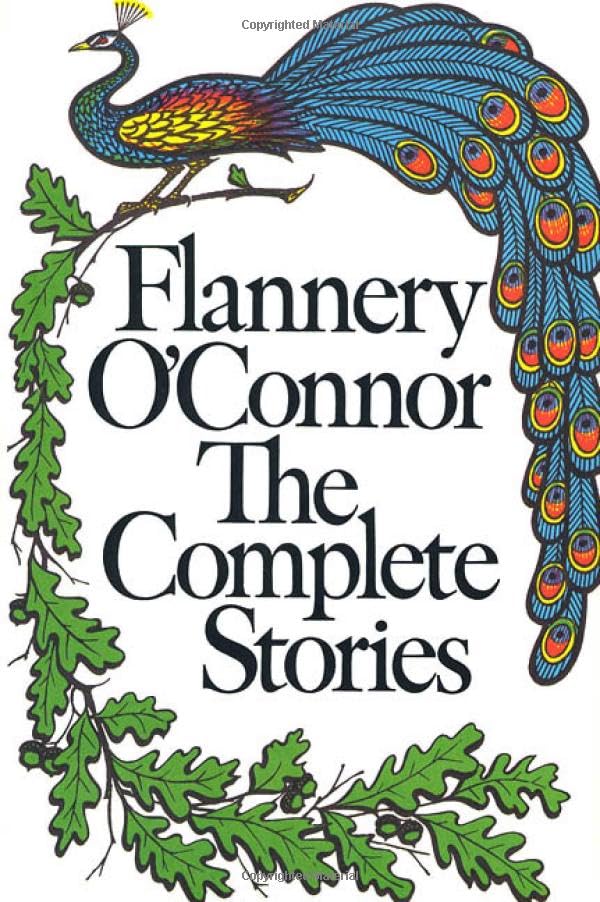

The complete stories.
Detalles de publicación: New York Farrar, Straus and Giroux [1971]Descripción: xvii, 555 pISBN:- 0374127522
- 813/.5/4
- PZ4.O183 Co
| Imagen de cubierta | Tipo de ítem | Biblioteca actual | Biblioteca de origen | Colección | Ubicación en estantería | Signatura topográfica | Materiales especificados | Info Vol | URL | Copia número | Estado | Notas | Fecha de vencimiento | Código de barras | Reserva de ítems | Prioridad de la cola de reserva de ejemplar | Reservas para cursos | |
|---|---|---|---|---|---|---|---|---|---|---|---|---|---|---|---|---|---|---|
| Libro | Biblioteca Encarnación Valdés Colección General bev | 813 O181c (Navegar estantería(Abre debajo)) | Disponible | 80000000840028 |
Descripciones mejoradas de Syndetics:
Winner of the National Book Award
The publication of this extraordinary volume firmly established Flannery O'Connor's monumental contribution to American fiction. There are thirty-one stories here in all, including twelve that do not appear in the only two story collections O'Connor put together in her short lifetime-- Everything That Rises Must Converge and A Good Man Is Hard to Find .
O'Connor published her first story, "The Geranium," in 1946, while she was working on her master's degree at the University of Iowa. Arranged chronologically, this collection shows that her last story, "Judgement Day"--sent to her publisher shortly before her death--is a brilliantly rewritten and transfigured version of "The Geranium." Taken together, these stories reveal a lively, penetrating talent that has given us some of the most powerful and disturbing fiction of the twentieth century. Also included is an introduction by O'Connor's longtime editor and friend, Robert Giroux.
Tabla de contenidos provista por Syndetics
- Introduction
- The Geranium The Barber Wildcat
- The Crop The Turkey
- The Train The Peeler
- The Heart of the Park
- A Stroke of Good Fortune Enoch and the Gorilla
- A Good Man Is Hard to Find
- A Late Encounter with the Enemy
- The Life You Save May Be Your Own The River
- A Circle in the Fire
- The Displaced Person
- A Temple of the Holy Ghost
- The Artificial Nigger Good Country People You Can't Be Any Poorer Than Dead Greenleaf
- A View of the Woods
- The Enduring Chill
- The Comforts of Home Everything
- That Rises Must Converge
- The Partridge Festival
- The Lame Shall Enter First Why Do the Heathen Rage?
- Revelation Parker's Back Judgement Day
Reseñas proporcionadas por Syndetics
Booklist Review
American. 1925-64. This Georgian's Catholic faith and interest in the woes of the social outsider resulted in stories both compassionate and darkly humorous.Notas de autor provistas por Syndetics
Flannery O'Connor was born in Savannah, Georgia. She had a quiet, bookish life as a child before attending Georgia State College for Women and going on tot he Writers Workshop at the State University of Iowa, where she earned a Master of Fine Arts degree. Her 1949 dissertation consisted of six short stories, one of which she developed into her first novel, Wise Blood (1952).Wise Blood is the story of a fanatical, wandering preacher who sets out to found a "church of truth without Jesus Christ crucified." The book introduces some of the religious themes that run throughout O'Connor's later work. Her second novel, The Violent Bear It Away (1960), is the story of murder involving a Tennessee backwoods preacher and a small boy. Once again, O'Connor explores unusual manifestation of religion and human eccentricities.
Although O'Connor produced only a small body of work during her relatively brief lifetime, she has received much critical attention. O'Connor suffered from lupus, an inherited disease, which crippled her and cut short her life, and so her creative work was largely compressed within a decade of the 1950's. Her father also dies of Lupus when she was 15 years old.
O'Connor is frequently praised as being the most creative and distinctive writer of this period. The two most notable aspects of her fiction are its religious themes and its commentary on the oppressive traditions of the mid-twentieth-century Deep South.
(Bowker Author Biography)