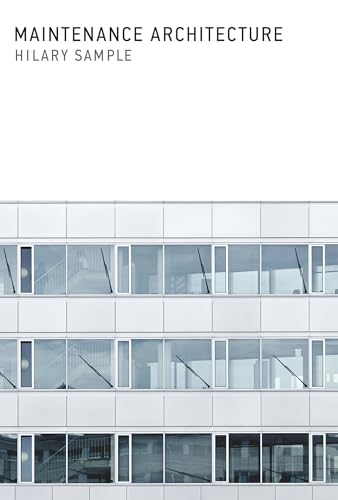

Maintenance architecture / Hilary Sample.
Editor: Cambridge, Massachusetts : The MIT Press, 2016Descripción: xi, 192 pages ; 24 cmTipo de contenido:- text
- unmediated
- volume
- 9780262034975 (hardcover : alk. paper)
- 720.28/8 23
- NA2542.4 .S26 2016
Descripciones mejoradas de Syndetics:
An inventive examination of a crucial but neglected aspect of architecture, by an architect writing to architects.
Maintenance plays a crucial role in the production and endurance of architecture, yet architects for the most part treat maintenance with indifference. The discipline of architecture values the image of the new over the lived-in, the photogenic empty and stark building over a messy and labored one. But the fact is: homes need to be cleaned and buildings and cities need to be maintained, and architecture no matter its form cannot escape from such realities. In Maintenance Architecture , Hilary Sample offers an inventive examination of the architectural significance of maintenance through a series of short texts and images about specific buildings, materials, and projects. Although architects have seldom choose to represent maintenance-imagining their work only from conception to realization-artists have long explored subjects of endurance and permanence in iconic architecture. Sample explores a range of art projects-by artists including Gordon Matta-Clark, Jeff Wall, and Mierle Laderman Ukeles-to recast the problem of maintenance for architecture. How might architectural design and discourse change as a building cycle expands to include "post-occupancy"?
Sample looks particularly at the private home, exhibition pavilion, and high-rise urban building, giving special attention to buildings constructed with novel and developing materials, technologies, and precise detailing in relation to endurance. These include Buckminster Fuller's Dymaxion House (1929), the Lever House (1952), the U.S. Steel Building (1971), and the O-14 (2010). She considers the iconography of skyscrapers; maintenance workforces, both public and private; labor-saving technology and devices; and contemporary architectural projects and preservation techniques that encompass the afterlife of buildings. A selection of artworks make the usually invisible aspects of maintenance visible, from Martha Rosler's Cleaning the Drapes to Inigo Manglano-Ovalle's The Kiss .
Includes index.
Tabla de contenidos provista por Syndetics
- Acknowledgments
- Introduction
- 1 Maintenance and the Urban Image
- Rockefeller Center, Raymond Hood, 1939
- Façade of Pharos Building, Vanessa van Dam, 2002
- Capturing Cleanliness
- Lever House, 50M, 1952
- Appliance House, Jennifer Bclande, 1998-1999
- La Notte, Michelangelo Antonioni, 1961
- Sears Tower, SOM, 1973
- Corporate Materiality and Self-Maintenance: Alcoa, U.S. Steel, and PPG
- Union Carbide Headquarters, Natalie de Blois/SOM, 1962
- The Louvre Pyramid, Pei Cobb Freed & Partners, 1989
- 2 Cleaning and the Politics of Labor
- "Manifesto for Maintenance Art," Mierle Laderman Ukeles, 1969 On Maintenance
- Crystal Palace, Sir Joseph Paxton, 1851
- White Wings, Department of Street Cleaning, New York, 1930
- Flats at Rue des Amiraux, Henri Sauvage, 1925
- Centre Pompidou Competition, Renzo Piano and Richard Rogers, 1977
- Neue Nationalgalerie, Ludwig Mies van der Robe, 1968
- Desire
- Le Baiser/The Kiss, Inigo Manglano-Ovalle, 1999
- 3 Visualizing Decay
- Koolhaas Houselife, Ila Bêka and Louise Lemoine, 2008
- Madeness
- Morning Cleaning, Jeff Wait, 1999
- Conical Intersect, Gordon Matta-Clark, 1975
- Cleaning the Rieiveld Pavilion, Job Kodewijn, 1992
- Cleaning the Drapes, Martha Rosier, 1967-1972
- Ethics of Dust, Jorge Otero-Pailos, 2009
- Dusty Relief, R&Sie(n), 2002
- Usus/Usures, Rolor, 2010
- 4 Modernizing Maintenance
- With Robots, Diego Trujillo Pisanty, 2010
- The Domestication or Cleanliness
- Befreites Wohnen, Sigfried Giedion, 1929
- Cité de Refuge, Le Corbusier, 1929
- The Dymaxion House, Buckminster Fuller, 1929
- House of the Future, Alison and Peter Smithson, 1955-1956
- The Squeegee, Ettre Steccone, 1936
- Window-Washing Chairs, Anna Dormitzer from 1878
- Self-Cleaning Glass, Pilkington Glass, 2001
- Beijing National Aquatics Center, PTW Architects, 2008
- GEKKO Facade and Clean Ant: Window-Washing Robots, 2009
- 5 Post-Occupancy and Alternate Architectural Futures
- AM/PM: Sarah Morris, 1999
- Endurance
- Loomis House, William Lescaze, 1938
- Unite d'Hahkaiion in Berlin, Le Corbusier, 1957
- Yale Center for British Art, Louis Kahn, 1974
- Toledo Museum of Art Glass Pavilion, SANAA, 2006
- Dutch Embassy in Berlin Pem koothaas/OMA, 2004
- O-14, Reiser + Umemoto, 2010
- I Feel Cold Today, Patrick Bermatchez 2007
- Notes
- Index