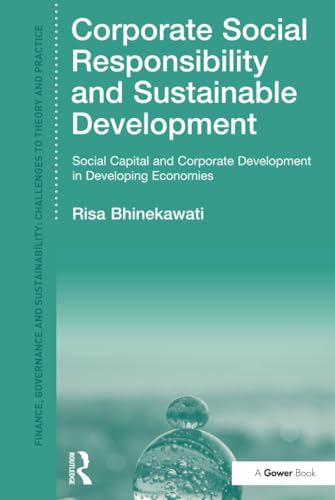

Corporate social responsibility and sustainable development : social capital and corporate development in developing economies / Risa Bhinekawati. [Electronic Resource]
Idioma: Español Detalles de publicación: London ; Routledge, c2017.Descripción: xxiii, 336 pages ; 24 cmTipo de contenido:- text
- computer
- online resource
- 9781138227583 (hardback)
- 338.9/27091724 23
- HD60.5.D44 B495 2017
| Imagen de cubierta | Tipo de ítem | Biblioteca actual | Biblioteca de origen | Colección | Ubicación en estantería | Signatura topográfica | Materiales especificados | Info Vol | URL | Copia número | Estado | Notas | Fecha de vencimiento | Código de barras | Reserva de ítems | Prioridad de la cola de reserva de ejemplar | Reservas para cursos | |
|---|---|---|---|---|---|---|---|---|---|---|---|---|---|---|---|---|---|---|
| Libro electrónico | Biblioteca de Mayagüez Acceso en línea | HD60.5.D44 B495 2017 (Navegar estantería(Abre debajo)) | Ebook | Disponible | 50000003268033 |
Descripciones mejoradas de Syndetics:
Many different companies can significantly contribute to the integrated goals and targets of the United Nations¿ sustainable development goals, such as poverty reduction by 2030. Poverty is not only about people living on less than $1.25 per day, but more fundamentally, it is their lack of capabilities and access to participate in productive economic activities. If companies can contribute in order to provide access and the necessary skills, then individuals will have the capabilities to achieve their aspirations, including earning a higher income.
Corporate Social Responsibility and Sustainable Development supports Sen¿s assertions that poverty can be alleviated if the capability of individuals is improved. Beyond that, this book shows that sustainable development goals can be achieved when the company¿s CSR programs and social capital development in improving people¿s capabilities are combined with necessary finance access and market access for the poor. The theoretical model developed from the journey of Astra International, one of the largest public-listed companies in Indonesia, is replicable for other companies aspiring to be sustainable in developing countries. The model shows a virtuous cycle between the corporate aim, CSR programs, social capital and corporate sustainability.
This volume is of great value to academics, practitioners and policy makers interested in the themes of CSR, social capital and sustainable development of developing countries. It also appeals to professionals in industry associations, development agencies and international organizations, as well as NGOs that are concerned with the achievement of sustainable development goals by 2030.
Includes bibliographical references and index.
Foreword -- Acknowledgements -- List of acronyms and abbreviations -- 1. Introduction: corporations and sustainable development goals -- 2. Corporate social responsibility and sustainable development in developing countries -- 3. Social capital and corporate sustainability in developing countries -- 4. Theoretical linkages between sustainable development, corporate social responsibility, social capital and corporate sustainability -- 5. Research approach -- 6. Indonesia, a very large developing country -- 7. Astra, one of the largest companies in Indonesia -- 8. Empowering micro and small enterprises to build supply chain and prosperity -- 9. Developing vocational education to secure skilled workers -- 10. Eradicating poverty by empowering smallholder farmers -- 11. Building theory on corporate social responsibility and sustainable development -- 12. Conclusion: a replicable model for corporate social responsibility and sustainable development -- Appendix: notes to contributors -- Index.
any different companies can significantly contribute to the integrated goals and targets of the United Nations'sustainable development goals, such as poverty reduction by 2030. Poverty is not only about people living on less than $1.25 per day, but more fundamentally, it is their lack of capabilities and access to participate in productive economic activities. If companies can contribute in order to provide access and the necessary skills, then individuals will have the capabilities to achieve their aspirations, including earning a higher income. Corporate Social Responsibility and Sustainable Development supports Sen's assertions that poverty can be alleviated if the capability of individuals is improved. Beyond that, this book shows that sustainable development goals can be achieved when the company's CSR programs and social capital development in improving people's capabilities are combined with necessary finance access and market access for the poor. The theoretical model developed from the journey of Astra International, one of the largest public-listed companies in Indonesia, is replicable for other companies aspiring to be sustainable in developing countries. The model shows a virtuous cycle between the corporate aim, CSR programs, social capital and corporate sustainability. This volume is of great value to academics, practitioners and policy makers interested in the themes of CSR, social capital and sustainable development of developing countries. It also appeals to professionals in industry associations, development agencies and international organizations, as well as NGOs that are concerned with the achievement of sustainable development goals by 2030.
Notas de autor provistas por Syndetics
Risa Bhinekawati is a corporate sustainability advisor and a lecturer who is very passionate about improving sustainable development in developing countries. She is now a lecturer at Podomoro University, Indonesia, and also serves as an Advisory Board Member of Women in Global Business, Indonesian Chapter.