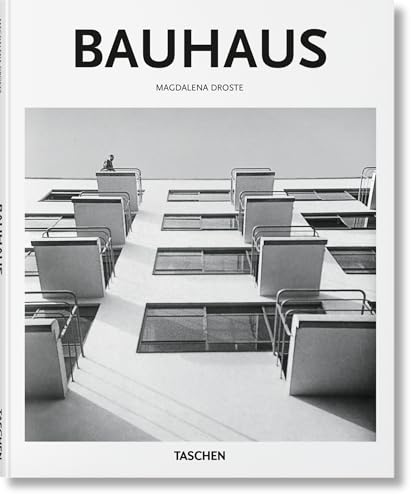

La Bauhaus, 1919-1933 : Reforma y vanguardia Droste, Magdalena txt
Series Basic Art 2.0Koln : Taschen, 2016Descripción: 96 pages: illustrations; 27 cmTipo de contenido:- text
- unmediaded
- Volume
- 9783836560122
- N332.G33 D76 2015
| Imagen de cubierta | Tipo de ítem | Biblioteca actual | Biblioteca de origen | Colección | Ubicación en estantería | Signatura topográfica | Materiales especificados | Info Vol | URL | Copia número | Estado | Notas | Fecha de vencimiento | Código de barras | Reserva de ítems | Prioridad de la cola de reserva de ejemplar | Reservas para cursos | |
|---|---|---|---|---|---|---|---|---|---|---|---|---|---|---|---|---|---|---|
| Libro | CARIBET Biblioteca Arquitectura Colección General CARIBET | General N332.G33 D76 2015 (Navegar estantería(Abre debajo)) | 1 | Disponible | 91000000050286 |
Descripciones mejoradas de Syndetics:
In a fleeting fourteen year period, sandwiched between two world wars, Germany's Bauhaus school of art and design changed the face of modernity. With utopian ideals for the future, the school developed a pioneering fusion of fine art, craftsmanship, and technology to be applied across painting, sculpture, design, architecture, film, photography, textiles, ceramics, theatre, and installation.
As much an intense personal community as a publicly minded collective, the Bauhaus was first founded by Walter Gropius (1883-1969), and counted Josef and Anni Albers, Wassily Kandinsky, Paul Klee, Oskar Schlemmer, Gunta Stölzl, Marianne Brandt and Ludwig Mies van der Rohe among its members. Between its three successive locations in Weimar, Dessau and Berlin, the school fostered charismatic and creative exchange between teachers and students, all varied in their artistic styles and preferences, but united in their idealism and their interest in a "total" work of art across different practices and media.
This book celebrates the adventurous innovation of the Bauhaus movement, both as a trailblazer in the development of modernism, and as a paradigm of art education, where an all-encompassing freedom of creative expression and cutting-edge ideas led to functional and beautiful creations.
Índice:
Prólogo: tres directores 6 --
Walter Gropius y su trayectoria hacia la Bauhaus 8 --
Los orígenes de la radicalidad artística 12 --
El manifiesto de la Bauhaus de (1919) 14 --
El curso preliminar 16 --
La formación del maestro artesano y el diploma 18 --
Los talleres 19 --
La teoría de la forma; la teoría del trabajo en el taller 22 --
Maestros y jóvenes maestros 24 --
Mujeres, hombres y parejas 28 --
Del expresionismo al constructivismo 30 --
Teorías de diseño 34 --
Ideas para la construcción de viviendas 40 --
La oficina del director en Weimar (1924) 42 --
La oficina de la Bauhaus en Dessau (1925-1926) 44 --
Las casas de los maestros en Dessau (1925-1926) 48 --
La colonia Dessau Törten (1926-1928) 52 --
Nuevo habitar 54 --
Reforma y vanguardia en el mandato de Gropius 58 --
El mandato de Hannes Meyer (1928-1930) 62 --
Cambios en la rueda de maestros 66 --
Diseño científico 68 --
Productos estándar como meta 72 --
La escuela federal de Bernau (1928-1930) 74 --
Priorizar los requerimientos populares y no el lujo 78 --
Despido de meyer en (1930) 80 --
El mandato de Mies Van Der Rohe (1930-1933) 82 --
Tensiones políticas 84 --
Nuevas estructuras 86 --
Enseñanza de la arquitectura bajo la dirección de Mies Van Der Rohe 88 --
Reforma y vanguardia en el mandato de Mies Van Der Rohe 90 --
La hostilidad nazi contra la Bauhaus 92 --
Epílogo: El mito Bauhaus 94 --
Bibliografía / créditos fotográficos / agradecimiento 96 --