Imagen de portada de Amazon
Imagen de Amazon.com
Imagen de cubierta Syndetics
Portada de Syndetics
Imagen de OpenLibrary

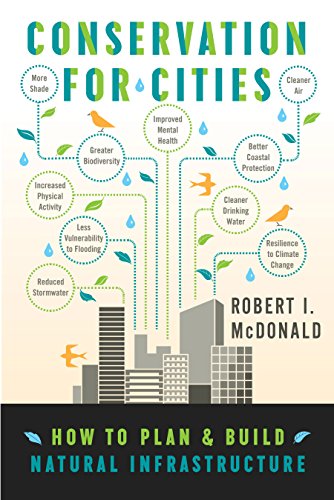
Conservation For Cities : how to plan and build natural infrastructure. / Robert I. McDonald.

Por: Editor: Washington, DC : Island Press, [2015]Fecha de copyright: ♭2015Descripción: 268 pages : ill. ; maps ; 24 cmTipo de contenido:
  • text
Tipo de medio:
  • unmediaded
Tipo de soporte:
  • volume
ISBN:
  • 9781610915212
  • 1610915216
  • 9781610915229 (paperback)
  • 1610915224 (paperback)
Tema(s): Clasificación LoC:
  • HT166 .M393 2015
Contenidos:
Contents: Chapter 1 Nature in an urban world -- Chapter 2 Figuring out what matters -- Chapter 3 Drinking water protection -- Chapter 4 Stormwater -- Chapter 5 Floodwater -- Chapter 6 Coastal protection -- Chapter 7 Shade -- Chapter 8 Air purification -- Chapter 9 Aesthetic value -- Chapter 10 Recreation value and physical health -- Chapter 11 Parks and mental health -- Chapter 12 The value of biodiversity in cities -- Chapter 13 Putting it all together -- References -- Index --
Valoración
    Valoración media: 0.0 (0 votos)
Existencias
Imagen de cubierta Tipo de ítem Biblioteca actual Biblioteca de origen Colección Ubicación en estantería Signatura topográfica Materiales especificados Info Vol URL Copia número Estado Notas Fecha de vencimiento Código de barras Reserva de ítems Prioridad de la cola de reserva de ejemplar Reservas para cursos
Libro CARIBET Biblioteca Arquitectura Colección General CARIBET General HT166 M393 2015 (Navegar estantería(Abre debajo)) 1 Disponible 91000000049965
Total de reservas: 0

Descripciones mejoradas de Syndetics:

Urban growth and climate change are reshaping the way cities function--and how they must adapt. As traditional infrastructure struggles to keep pace, forward-thinking planners, engineers, and conservationists are turning to natural systems to help meet urban demands for clean air, safe water, flood protection, and livable neighborhoods.


Conservation for Cities lays out a practical roadmap for weaving nature into the urban fabric. Robert McDonald, a leading scientist at The Nature Conservancy, shows how cities can harness ecosystem services by integrating green and grey infrastructure--from restoring wetlands to cooling heat islands with tree canopy. Through real-world examples, he explains how to identify the most valuable ecosystem services for a given place, weigh tradeoffs, and design cost-effective solutions that work with nature rather than against it.


Each chapter tackles a specific service--stormwater management, water quality, climate regulation, biodiversity, and more--offering insights into policy tools, funding mechanisms, and implementation strategies. For urban planners, landscape architects, engineers, and conservation professionals, Conservation for Cities serves as a clear, actionable guide to building resilient cities with nature at the core.

Includes bibliographical references (pages 245-258) and index.

Contents:
Chapter 1 Nature in an urban world --
Chapter 2 Figuring out what matters --
Chapter 3 Drinking water protection --
Chapter 4 Stormwater --
Chapter 5 Floodwater --
Chapter 6 Coastal protection --
Chapter 7 Shade --
Chapter 8 Air purification --
Chapter 9 Aesthetic value --
Chapter 10 Recreation value and physical health --
Chapter 11 Parks and mental health --
Chapter 12 The value of biodiversity in cities --
Chapter 13 Putting it all together --
References --
Index --

Tabla de contenidos provista por Syndetics

  • Acknowledgments
  • Chapter 1 Nature in an Urban World
  • Chapter 2 Figuring Out What Matters
  • Chapter 3 Drinking Water Protection
  • Chapter 4 Stormwater
  • Chapter 5 Floodwater
  • Chapter 6 Coastal Protection
  • Chapter 7 Shade
  • Chapter 8 Air Purification
  • Chapter 9 Aesthetic Value
  • Chapter 10 Recreation and Health
  • Chapter 11 Parks and Mental Health
  • Chapter 12 The Value of Biodiversity in Cities
  • Chapter 13 Putting It All Together
  • References
  • Index

Reseñas proporcionadas por Syndetics

Library Journal Review

Urban areas have been constantly expanding in modern times-some steadily, while others have seen rapid explosions in growth. More people mean increased strain on natural resources and infrastructure, and the impact has not always been adequately planned for or well understood. -McDonald, a senior scientist for sustainable land use at the Nature Conservancy, shows the importantance of interrelations between people, urban centers, and natural and man-made environments, connecting research and case studies from around the world to argue for thoughtful urban planning. For example, city parks can provide not only shade and increased property values but opportunities for increased physical activity and improved mental well-being. McDonald also demonstrates how an understanding of current research about these interrelations can provide for more deliberate design and planning that will improve human conditions while creating sustainable natural environments. VERDICT For city planners, landscape architects, and ecologists, this book is a solid research overview; also appropriate for a general audience.-Marianne Stowell Bracke, Purdue Univ. Lib., West Lafayette, IN © Copyright 2015. Library Journals LLC, a wholly owned subsidiary of Media Source, Inc. No redistribution permitted.

CHOICE Review

McDonald (urban sustainability specialist, The Nature Conservancy) endeavors to develop a unified set of axioms for supplanting various human technologies with alternatives that are founded in the technique of conserving natural environments within the urban realm. These axioms are utilized in a variety of planning processes designed to meet broad needs of urban citizens. The services the author chose to describe lend themselves well to the results of implementing conservation policies. One hundred years after the wonderful efficacy of the "City Beautiful" philosophy, McDonald makes a valiant attempt at the rationalization of urban greening within the context of city planning as potentially a systematic science. The amazing statistical efforts to justify planting shade trees in traditionally heat island city environs are astounding. The author returns to the roots of his concerns in his conclusion, stating idealistically that "we can have another more beautiful and humane world." A valuable resource for academic, professional, and large public libraries. Summing Up: Recommended. All readership levels. --Daniel E. Cleary, York College

Notas de autor provistas por Syndetics

Dr. Robert McDonald is Senior Scientist for Sustainable Land Use at The Nature Conservancy, where he is lead scientist for the organization's efforts to figure out how to make cities more sustainable. He holds a PhD in Ecology from Duke University and has published more than 30 peer-reviewed publications, many of them on the science of how cities impact and depend on the environment. He blogs for The Nature Conservancy's Cool Green Science blog and has published two recent essays on urban/environment interactions in a collection called Taking Sides: Clashing Views in Global Issues (McGraw-Hill) and in The Chronicle of Higher Education .

Compartir
logopucpr-y-vive

Contáctanos

¡Queremos saber de ti!

Tel. 787.841.2000 Ext. 1801

bibliotecavaldes@pucpr.edu

⁣Búscanos en las redes

© 2026 Desarrollado por Ignite Online • All Rights Reserved • Powered by Koha.