Imagen de Amazon.com

Portada de Syndetics
Imagen de OpenLibrary
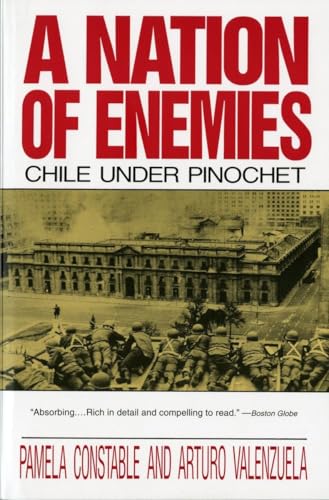
A nation of enemies : Chile under Pinochet / Pamela Constable and Arturo Valenzuela.
Idioma: Español Detalles de publicación: New York : Norton, 1993, c1991.Edición: Norton pbk. 1993Descripción: 367 p. : ill. ; 25 cmISBN:- 0393309851 (pbk.)
- F3100.C64 1991
Contenidos:
The war -- The soldiers -- The dictator -- Army of the shadows -- The law -- The culture of fear -- The technocrats -- The rich -- The poor -- Children of dictatorship -- The politicians -- Rebirth of a nation.
| Imagen de cubierta | Tipo de ítem | Biblioteca actual | Biblioteca de origen | Colección | Ubicación en estantería | Signatura topográfica | Materiales especificados | Info Vol | URL | Copia número | Estado | Notas | Fecha de vencimiento | Código de barras | Reserva de ítems | Prioridad de la cola de reserva de ejemplar | Reservas para cursos | |
|---|---|---|---|---|---|---|---|---|---|---|---|---|---|---|---|---|---|---|
| Libro | Biblioteca Encarnación Valdés Colección General bev | 983.065 C756n (Navegar estantería(Abre debajo)) | Disponible | 80000002566639 |
Total de reservas: 0
Descripciones mejoradas de Syndetics:
How Chile, once South America's most stable democracy, gave way to a culture of fear. The authors explain and illuminate the rift in Chilean society that widened dramatically during the Pinochet era.
Includes bibliographical references (p. [321]-356) and index.
The war -- The soldiers -- The dictator -- Army of the shadows -- The law -- The culture of fear -- The technocrats -- The rich -- The poor -- Children of dictatorship -- The politicians -- Rebirth of a nation.
Tabla de contenidos provista por Syndetics
- Acknowledgments(p. 7)
- Preface(p. 9)
- Chapter 1 The War(p. 15)
- Chapter 2 The Soldiers(p. 40)
- Chapter 3 The Dictator(p. 64)
- Chapter 4 Army of the Shadows(p. 90)
- Chapter 5 The Law(p. 115)
- Chapter 6 The Culture of Fear(p. 140)
- Chapter 7 The Technocrats(p. 166)
- Chapter 8 The Rich(p. 199)
- Chapter 9 The Poor(p. 222)
- Chapter 10 Children of Dictatorship(p. 247)
- Chapter 11 The Politicians(p. 271)
- Chapter 12 Rebirth of a Nation(p. 296)
- Notes(p. 321)
- Index(p. 357)
Reseñas proporcionadas por Syndetics
Library Journal Review
Veteran journalist Constable and distinguished academic Valenzuela re-create life for most ordinary Chileans during the past 20 years when ``they were dubious spectators caught in a system that they had not chosen.'' Chile had a 150-year-old tradition of stable democracy and civilian rule. Yet from the coup that ousted President Allende in September 1973 until March 1990 when Patricio Alywin was inaugurated as President of Chile, General Augusto Pinochet and the military completely dominated Chilean life. Based on broad sources, including many interviews, this book chronicles without ideological bias the lengthy struggles for the reemergence of democracy in Chile and concludes that after two decades Chileans grew tired of hating each other and have regained ``new appreciation for the values of moderation and compromise.'' Written for both general and academic audiences, this will stand as the definitive work on Chile under Pinochet for many years to come. It belongs in all public and academic libraries.-- James Rhodes, Luther Coll., Decorah, Ia. (c) Copyright 2010. Library Journals LLC, a wholly owned subsidiary of Media Source, Inc. No redistribution permitted.Publishers Weekly Review
In this rigorous study, based on hundreds of interviews with Chileans, the authors chronicle the divisive dictatorship of Augusto Pinochet. (May) (c) Copyright PWxyz, LLC. All rights reservedCHOICE Review
A welcome book about a pivotal period in recent Chilean history (1973-90). The Pinochet era attracted global attention and played a key role in US-Latin American relations. Although many publications are available covering the preceding Marxist Allende government (1970-73), books in English on the rightist Pinochet years are still scarce and lack comprehensiveness. The authors of this detailed study are a journalist and a scholar who are experts on Chile. The first chapter sets the scene for 1973 to 1990 and sketches the Chilean military traditions and Pinochet's personality from his cadet years. Although the book is basically a study of the political dimensions, the economic aspect is also covered. The presentation is lucid and written in good prose. The authors are quite critical of this harsh, autocratic government but also strive to be balanced. Among the Latin American nations Chile had a record of stability and respect for democratic rights. The authors attempt to explain why Chile under Pinochet became a government of fear and repression, but also detail how democracy eventually reemerged peacefully. No bibliography but it does have footnotes. Readers at all levels.-C. W. Arnade, University of South FloridaBooklist Review
By a foreign correspondent for the Boston Globe teamed with the director of the center for Latin American Studies at Georgetown University, a vigorously comprehensive but very approachable examination of the 17 years (1973-90) General Augusto Pinochet ruled Chile with an iron fist. The story of this repressive military regime in a country that, unusual for South America, had a time-honored democratic tradition, actually began in 1970 with the advent into the presidential office of Salvador Allende, the first freely elected Marxist head of state in the world. Dissent from the Right burgeoned into open rebellion, and in a lightning coup, Allende was displaced by Pinochet, whose intention was to recast Chilean institutions and values in his own efficient but narrow mold. Responsibly, Constable and Valenzuela track the record of Pinochet's dictatorship, and in the process, they reveal all details of Pinochet's self-aggrandizing way of government, identifying who benefited from authoritarianism and who did not, asserting that Chile under him was a society divided nearly in two by fear and hostility. Answers to how and why an advanced nation succumbed to military rule are explained both expansively and accessibly. ~--Brad HooperNotas de autor provistas por Syndetics
Pamela Constable is a Deputy Foreign Editor at The Washington Post .Arturo Valenzuela is the United States Assistant Secretary of State for Western Hemisphere Affairs. He was formerly a professor of government and the Director of the Center for Latin American Studies in the Edmund A. Walsh School of Foreign Service at Georgetown University.