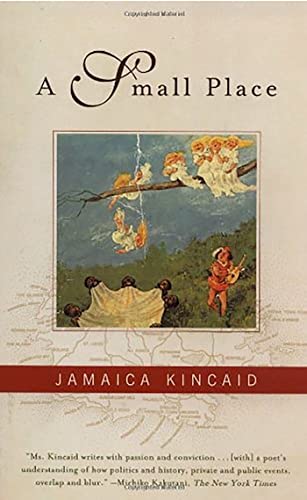

A small place / Jamaica Kincaid.
Idioma: Español New York : Farrar, Straus and Giroux, ©1988Descripción: 81 pages : illustrations ; 21 cmISBN:- 0374527075
- F2035 .K56 1988
| Imagen de cubierta | Tipo de ítem | Biblioteca actual | Biblioteca de origen | Colección | Ubicación en estantería | Signatura topográfica | Materiales especificados | Info Vol | URL | Copia número | Estado | Notas | Fecha de vencimiento | Código de barras | Reserva de ítems | Prioridad de la cola de reserva de ejemplar | Reservas para cursos | |
|---|---|---|---|---|---|---|---|---|---|---|---|---|---|---|---|---|---|---|
| Libro | Biblioteca Encarnación Valdés Colección General bev | 972.974 K511s (Navegar estantería(Abre debajo)) | Disponible | 80000002567991 | ||||||||||||||
| Libro | Biblioteca Encarnación Valdés Colección General bev | 972.974 K511s (Navegar estantería(Abre debajo)) | c.2 | Disponible | 80000002609108 |
Descripciones mejoradas de Syndetics:
A brilliant look at colonialism and its effects in Antigua--by the author of Annie John
"If you go to Antigua as a tourist, this is what you will see. If you come by aeroplane, you will land at the V. C. Bird International Airport. Vere Cornwall (V. C.) Bird is the Prime Minister of Antigua. You may be the sort of tourist who would wonder why a Prime Minister would want an airport named after him--why not a school, why not a hospital, why not some great public monument. You are a tourist and you have not yet seen . . ."
So begins Jamaica Kincaid's expansive essay, which shows us what we have not yet seen of the ten-by-twelve-mile island in the British West Indies where she grew up.
Lyrical, sardonic, and forthright by turns, in a Swiftian mode, A Small Place cannot help but amplify our vision of one small place and all that it signifies.
Extracto provisto por Syndetics
Reseñas proporcionadas por Syndetics
Library Journal Review
Kincaid here examines the geography and history of Antigua, where she was raised. We first see the island through the eyes of the typical North American tourist, who aims to exchange his or her own ``everydayness'' for that of someone without the same privilege. But rather than interpret Antiguan experience for outsiders, Kincaid lays bare the limits of her own understanding. She asks us to grasp the crime of empire in a new way, stressing that it can be understood only from a post-colonial point of view: surveying 20 years of a corrupt ``free'' government, she finds the inheritance of colonialism to be a commercial and governmental enterprise that serves individual interests. Antiguans, she effectively demonstrates, are ordinary people saddled with an unthinkable but unbreachable past. Mollie Brodsky, Rutgers Univ., New Brunswick, N.J. (c) Copyright 2010. Library Journals LLC, a wholly owned subsidiary of Media Source, Inc. No redistribution permitted.Booklist Review
A vivid polemic addresses the grim conditions on the Caribbean island of Antigua as emotions seethe beneath the tropical tourist scene. [BKL Je 15 88]Notas de autor provistas por Syndetics
Jamaica Kincaid came to the United States in 1966 as a free-lance writer and is now on staff at the New Yorker. Her first volume of stories, At the Bottom of the River (1983), depicts men and women alienated from each other by conflict, physical separation, or death. The story "My Mother" vividly describes the painful separation between mother and daughter; and the stories in Annie John (1985) clearly reveal that the world of the past cannot be recaptured. Kincaid's poetic use of language and everyday images allows the reader to experience ordinary events with a new and heightened sensitivity. Kincaid is a relatively new writer whose works are beginning to receive critical attention.(Bowker Author Biography)