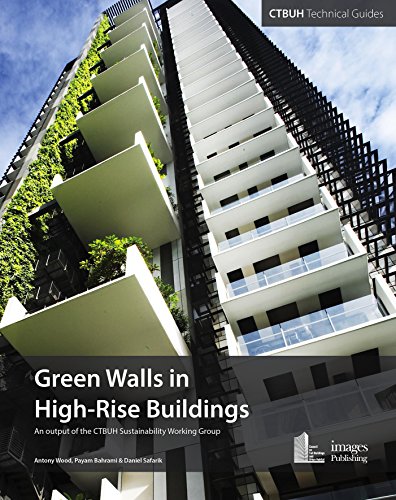

Green walls in high-rise buildings : an output of the CTBUH Sustainability Working Group / Antony Wood, Payam Bahrami & Daniel Safarik. txt
Series CTBUH technical guidesEditor: Mulgrave, Victoria : The Images Publishing Group Pty Ltd, 2014Fecha de copyright: 2014Descripción: 240 pages : color illustrations, plans ; 28 cmTipo de contenido:- text
- still image
- unmediated
- volume
- 9781864705935
- 9781864705935
- Plants in architecture
- Vertical gardening
- Tall buildings -- Environmental aspects
- Tall buildings -- Design and construction
- Sustainable architecture
- Sustainable buildings
- Hochhaus
- Fassadenbegr�unung
- Plants in architecture
- Sustainable architecture
- Sustainable buildings
- Tall buildings -- Design and construction
- Tall buildings -- Environmental aspects
- Vertical gardening
- 720.483 23
- NA6230 W66 2014
| Imagen de cubierta | Tipo de ítem | Biblioteca actual | Biblioteca de origen | Colección | Ubicación en estantería | Signatura topográfica | Materiales especificados | Info Vol | URL | Copia número | Estado | Notas | Fecha de vencimiento | Código de barras | Reserva de ítems | Prioridad de la cola de reserva de ejemplar | Reservas para cursos | |
|---|---|---|---|---|---|---|---|---|---|---|---|---|---|---|---|---|---|---|
| Libro | CARIBET Biblioteca Arquitectura Colección General CARIBET | General NA6230 W66 2014 (Navegar estantería(Abre debajo)) | 1 | Disponible | 91000000049569 |
Descripciones mejoradas de Syndetics:
This technical guide offers an extensive overview of the use of vertical vegetation in high-rise buildings, an indepth analysis of green walls, definitions and typology, including standards, policies and incentives. The Council on Tall Buildings and Urban Habitat has produced four Technical Guides to date, since the series launched in late 2012. Each of these guides is the product of a CTBUH Working Group committees formed specifically to address focused topical subjects in the industry. The intention of each guide is the same to provide working knowledge to the typical building owner or professional who wants a better understanding of available options for improving tall buildings, and what affects their design. The object of the series is to provide a tool-kit for the creation of better-performing tall buildings, and to spread the understanding of the considerations that need to be made in designing tall. The CTBUH is the world's leading resource for professionals focused on the design, construction, and operation of tall buildings and future cities. A not-for-profit organisation based at the Illinois Institute of Technology, Chicago, the group facilitates the exchange of the latest knowledge available on tall buildings around the world. AUTHOR: Antony Wood has been Executive Director of the Council on Tall Buildings and Urban Habitat since 2006. He is chair of the CTBUH Tall Buildings and Sustainability Working Group. SELLING POINTS: - An output by the CTBUH, the world's leading resource for professionals focused on the design and construction of tall buildings and future cities - A technical guide offering comprehensive case studies from around the globe (including experimental-based studies, simulation-based studies and a CTBUH study on energy savings), climate data, information on structural support systems and plant selections - Richly illustrated text, with detailed statistical infographics and full-colour images 220 col.
Includes bibliographical references (pages 226-229) and index.
Introduction and background -- Case studies -- Design considertions and limitations -- Recommenations and future research -- Appendix: Green walls and energy efficiency.
"Cities are facing unprecedented expansion through population growth and urbanization in the coming decades, and the horizontal-suburban model of urban development is increasingly being discredited on sustainability grounds. With less available land to build on, the logical solution is to build upwards. However, a major human need -- access to greenery -- must be addressed by any viable plan for increased height and density. This guide thus sets out recommendations for selecting, implementing and maintaining green walls in high-rise buildings, including local climatic factors that need to be taken into account, and the risks of adopting different wall types. Recommendations are based on the analysis of 18 case studies and research undertaken by the Council on Tall Buildings and Urban Habitat. These detailed and richly-illustrated case studies represent the cutting edge in green wall design around the globe -- embracing 11 cities, 9 climate zones, and green walls up to 69 stories in height"--Provided by publisher.