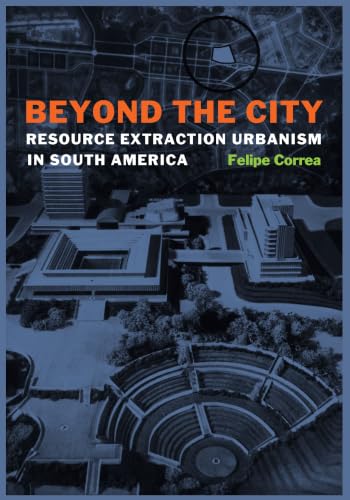

Beyond the City : resource extraction urbanism in South America. / Felipe Correa. txt
Idioma: Español Editor: Austin : University of Texas Press, 2016Edición: First editionDescripción: x, 166 p. ill. ; maps ; 26 cmTipo de contenido:- text
- unmediaded
- volume
- 9781477309414 (cloth : alk. paper)
- 307.760 23
- HT384.S63 C67 2016
| Imagen de cubierta | Tipo de ítem | Biblioteca actual | Biblioteca de origen | Colección | Ubicación en estantería | Signatura topográfica | Materiales especificados | Info Vol | URL | Copia número | Estado | Notas | Fecha de vencimiento | Código de barras | Reserva de ítems | Prioridad de la cola de reserva de ejemplar | Reservas para cursos | |
|---|---|---|---|---|---|---|---|---|---|---|---|---|---|---|---|---|---|---|
| Libro | CARIBET Biblioteca Arquitectura Colección General CARIBET | General HT384.S63 C67 2016 (Navegar estantería(Abre debajo)) | 1 | Disponible | 91000000049528 |
Descripciones mejoradas de Syndetics:
During the last decade, the South American continent has seen a strong push for transnational integration, initiated by the former Brazilian president Fernando Henrique Cardoso, who (with the endorsement of eleven other nations) spearheaded the Initiative for the Integration of Regional Infrastructure in South America (IIRSA), a comprehensive energy, transport, and communications network. The most aggressive transcontinental integration project ever planned for South America, the initiative systematically deploys ten east-west infrastructural corridors, enhancing economic development but raising important questions about the polarizing effect of pitting regional needs against the colossal processes of resource extraction. Providing much-needed historical contextualization to IIRSA's agenda, Beyond the City ties together a series of spatial models and offers a survey of regional strategies in five case studies of often overlooked sites built outside the traditional South American urban constructs.
Implementing the term "resource extraction urbanism," the architect and urbanist Felipe Correa takes us from Brazil's nineteenth-century regional capital city of Belo Horizonte to the experimental, circular, "temporary" city of Vila Piloto in Três Lagoas. In Chile, he surveys the mining town of María Elena. In Venezuela, he explores petrochemical encampments at Judibana and El Tablazo, as well as new industrial frontiers at Ciudad Guayana. The result is both a cautionary tale, bringing to light a history of societies that were "inscribed" and administered, and a perceptive examination of the agency of architecture and urban planning in shaping South American lives.
Index.
Bibliography.
Contents:
Introduction : shaping resource extraction 1 --
Chapter 1 A regional capital : Belo Horizonte 13 --
Chapter 2 A mining town constellation : María Elena 39 --
Chapter 3 Petrol encampments : Judibana and El Tablazo 65 --
Chapter 4 A new industrial frontier : Ciudad Guayana 89 --
Chapter 5 Pioneering modernity : Vila Piloto 111 --
Epilogue : the legacy of resource extraction urbanism and the future of the South American Hinterland 137 --
Notes 145 --
Bibliography 155 --
Index 163 --
During the last decade, the South American continent has seen a strong push for transnational integration, initiated by the former Brazilian president Fernando Henrique Cardoso, who (with the endorsement of eleven other nations) spearheaded the Initiative for the Integration of Regional Infrastructure in South America (IIRSA), a comprehensive energy, transport, and communications network. The most aggressive transcontinental integration project ever planned for South America, the initiative systematically deploys ten east-west infrastructural corridors, enhancing economic development but raising important questions about the polarizing effect of pitting regional needs against the colossal processes of resource extraction. Providing much-needed historical contextualization to IIRSA’s agenda, Beyond the City ties together a series of spatial models and offers a survey of regional strategies in five case studies of often overlooked sites built outside the traditional South American urban constructs. Implementing the term “resource extraction urbanism,” the architect and urbanist Felipe Correa takes us from Brazil’s nineteenth-century regional capital city of Belo Horizonte to the experimental, circular, “temporary” city of Vila Piloto in Três Lagoas. In Chile, he surveys the mining town of María Elena. In Venezuela, he explores petrochemical encampments at Judibana and El Tablazo, as well as new industrial frontiers at Ciudad Guayana. The result is both a cautionary tale, bringing to light a history of societies that were “inscribed” and administered, and a perceptive examination of the agency of architecture and urban planning in shaping South American lives --
Tabla de contenidos provista por Syndetics
- Acknowledgments(p. ix)
- Introduction: Shaping Resource Extraction(p. 1)
- Chapter 1 A Regional Capital: Belo Horizonte(p. 13)
- Chapter 2 A Mining Town Constellation: María Elena(p. 39)
- Chapter 3 Petrol Encampments: Judibana and El Tablazo(p. 65)
- Chapter 4 A New Industrial Frontier: Ciudad Guayana(p. 89)
- Chapter 5 Pioneering Modernity: Vila Piloto(p. 111)
- Epilogue: The Legacy of Resource Extraction Urbanism and the Future of the South American Hinterland(p. 137)
- Notes(p. 145)
- Bibliography(p. 155)
- Index(p. 163)
Notas de autor provistas por Syndetics
Felipe Correa is an associate professor of urban design and Director of the Urban Design Program at the Harvard University Graduate School of Design. His previous books are Mexico City: Between Geometry and Geography and A Line in the Andes , which won first prize in the Architecture, Landscape, and Urbanism Category at the 2014 Pan American Architecture Biennale.