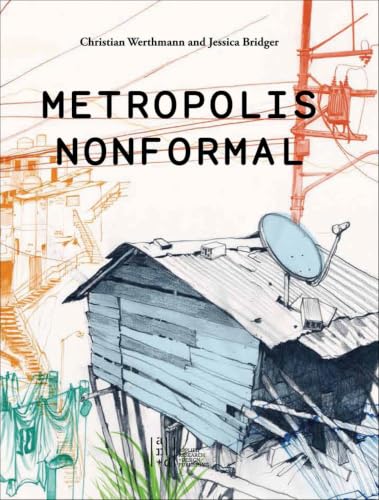

Metropolis nonformal / edited by Christian Werthmann and Jessica Bridger.
Editor: [Novato, CA] : Applied Research and Design Publishing, 2015Fecha de copyright: ©2015Edición: First EditionDescripción: 238 pages : illustrations (chiefly color), color maps, plans, portraits (chiefly color) ; 25 cmTipo de contenido:- text
- still image
- unmediated
- volume
- 9781940743141
- 1940743141
- NA9053.H76 B75 2015
| Imagen de cubierta | Tipo de ítem | Biblioteca actual | Biblioteca de origen | Colección | Ubicación en estantería | Signatura topográfica | Materiales especificados | Info Vol | URL | Copia número | Estado | Notas | Fecha de vencimiento | Código de barras | Reserva de ítems | Prioridad de la cola de reserva de ejemplar | Reservas para cursos | |
|---|---|---|---|---|---|---|---|---|---|---|---|---|---|---|---|---|---|---|
| Libro | CARIBET Biblioteca Arquitectura Colección General CARIBET | General NA9053.H76 B75 2015 (Navegar estantería(Abre debajo)) | 1 | Disponible | 91000000049049 |
Descripciones mejoradas de Syndetics:
Almost one billion people live in conditions that UN-Habitat classifies as slum households, out of almost four billion people who live in cities today. If the UN numbers hold true, approximately two and a half billion urban dwellers will be added by 2050 with a total estimated urban population of six-plus billion. We have come to understand that the majority of this increased urbanization will not result in perfect shining cities set in pastoral landscapes. Rather it is much to the contrary; if UN-Habitat predictions turn out to be correct, over two thirds of the new urban population, some two billion, may fall under UN-Habitat's category of a slum household, deprived of at least one out of five basic living conditions. Many of what UN-Habitat considers slum households are part of self-built neighborhoods, the result of informal occupation and construction. If two-thirds of our new urbanization will be largely the result of people building their own homes and neighborhoods outside of formal planning and processes, and close to one billion people live in these urban situations now this is not a fringe phenomenon of urbanization. It is mainstream urbanization, quickly becoming the majority - and thus the chosen title for this collection is Metropolis Nonformal.
Includes extensive illustrations and syntheses of presentations given at the Metropolis Nonformal symposia, held at the Technical University in Munich in 2011 and 2013.
METROPOLIS NONFORMAL/ Christian Werthmann and Jessica Bridger -
WORLD POPULATION MAP-
How THIS BOOK WAS MADE -
PHOTO STRETCH -
TALK TEXTS / By Jessica Bridger in collaboration with symposia participants -
READING THE NONFORMAL /
Rahul Mehrotra / Kinetic City , Ephemeral City INDIA -
Rainer Hehl / Mass Housing versus Popular Architecture BRAZIL-
Jörg Rekittke / Permanent Residence Aboard a Sinking Ship INDONESIA-
Anuradha Mathur / Intensive Landscapes INDIA -
Cynthia E . Smith / Design Exchange UNITED STATES -
Marcos L . Rosa/ Handmade Urbanism BRAZIL-
Michael Hooper / Public Participation : Simple Conceir versus Complex Realities TANZANIA -
Phillip Thompson /Where Flowers Bloom , So Does Hope Engagement in the Dark Side of Modernity UNITED STATES -
Janice Perlman /Urban Informality in Rio de Janairo : Marginal or Mainstream ? BRAZIL -
REACTING TO THE NONFORMAL /
Hubert Klumpner / Constructing Cities VENEZUELA-
Fernando de Mello Franco / Sao Paulo : Where Water and City Collide BRAZIL Flavio Janches Whose City Is It ? Design Strategies for Marginalized Communities in Buenos Aires ARGENTINA -
Arthur Adeya Productive Public Space in Kibera , Nairobi KENYA -
Adriana de Araujo Larangeira Informal Settlements in Latin America BRAZIL -
Solange Carvalho / Managing Growth in Rio ' s Favelas BRAZIL -
Maria Teresa Diniz/ Design Guidelines BRAZIL -
Sahar Attia / Towards More Resilient Communities : Coordinated Strategies and Interventions EGYPT -
Gabriel Duarte / Integrating the Informal City : Past Experiences and New Strategies BRAZIL -
Anna Heringer/ Handmade Architecture – a Catalyst for Development BANGLADESH -
ANTICIPATING THE NONFORMAL -
Claudio Acioly / Critical Issues about Informal Urbanization and the Future of Cities KENYA -
Martim Smolka/ From the Tree ( Curative ) to the Forest (Preventive) – Revisiting Policies Towards Informality LATIN AMERICA-
Alejandro Echeverri Managing Informal Growth in the Hills of Medellin COLOMBIA
Undine Giseke/ Fragmented Cities - Linking the Urban and the Rural MOROCCO -
Reinhard Goethert Sites and Services of the 21 " Century : We Have Been There Before . . . Is It Different Now ? UNITED STATES -
Edgar Pieterse / Reflections on the Nonformal SOUTH AFRICA -
FOUR QUESTIONS/ All Symposium Participants
AFTERWORD /Regine Keller-
"Almost one billion people today live in conditions that UN-Habitat classifies as slum households, out of approximately 3.9 billion people who live in cities. If the UN's estimates are accurate, approximately 2.5 billion more people will be living in cities by 2050--and not in perfect shining skyscrapers set in pastoral landscapes. Instead, over two thirds of this new urban population, some two billion people, are projected to fall under UN-Habitat's category of slum households, deprived of at least one of five basic living conditions. Many of what UN-Habitat considers slum households are part of self-built neighbourhoods, the result of informal occupation and construction. If two-thirds of our new urbanization will largely be the result of people building their own homes and neighborhoods outside of formal planning and processes, and with close to a billion people living in such situations already, this is not a fringe phenomenon. It is part of the mainstream, and it is on its way to becoming the majority of future urbanization--and thus the title for this collection: Metropolis nonformal."--Page 9.