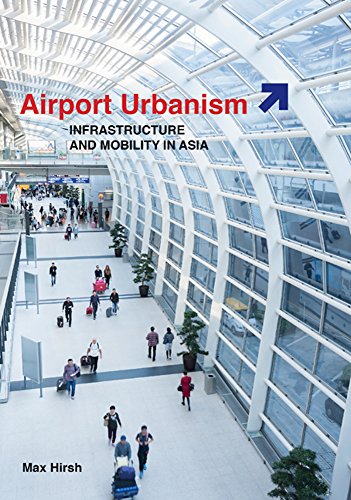

Airport urbanism : infrastructure and mobility in Asia / Max Hirsh. txt
Editor: Minneapolis ; London : University of Minnesota Press , 2016Descripción: x, 201 pag, 12 unnumbered pages of plates : illustrations (some color), maps ; 26 cmTipo de contenido:- text
- unmediated
- volume
- 9780816696093
- 9780816696109
- HT169.A78 H57 2016
| Imagen de cubierta | Tipo de ítem | Biblioteca actual | Biblioteca de origen | Colección | Ubicación en estantería | Signatura topográfica | Materiales especificados | Info Vol | URL | Copia número | Estado | Notas | Fecha de vencimiento | Código de barras | Reserva de ítems | Prioridad de la cola de reserva de ejemplar | Reservas para cursos | |
|---|---|---|---|---|---|---|---|---|---|---|---|---|---|---|---|---|---|---|
| Libro | CARIBET Biblioteca Arquitectura Colección General CARIBET | General HT169.A78 H57 2016 (Navegar estantería(Abre debajo)) | 1 | Disponible | 91000000049122 |
Descripciones mejoradas de Syndetics:
Thirty years ago, few residents of Asian cities had ever been on a plane, much less outside their home countries. Today, flying, and flying abroad, is commonplace. How has this leap in cross-border mobility affected the design and use of such cities? And how is it accelerating broader socioeconomic and political changes in Asian societies?
In Airport Urbanism, Max Hirsh undertakes an unprecedented study of airport infrastructure in five Asian cities--Bangkok, Hong Kong, Shenzhen, Kuala Lumpur, and Singapore. Through this lens he examines the exponential increase in international air traffic and its implications for the planning and design of the contemporary city. By investigating the low-cost, informal, and transborder transport systems used by new members of the flying public--such as migrant workers, retirees, and Asia's emerging middle class--he uncovers an architecture of incipient global mobility that has been inconspicuously inserted into places not typically associated with the infrastructure of international air travel.
Drawing on material gathered in restricted zones of airports and border control facilities, Hirsh provides a fascinating, up-close view of the mechanics of cross-border mobility. Moreover, his personal experience of growing up and living on three continents inflects his analyses with unique insight into the practicalities of international migration and into the mindset of people on the move.
Includes bibliographical references and index.
Introduction: what is airport urbanism? -- Parallel lines -- Transborder infrastructure -- Special zones -- Cheap tickets -- Conclusion: mobility, migration, and the future Asian city.
"A really smart & accessible look at how everyday practices play out in the architecture of and around airports in Asia. Looks at how the recent rise of air mobility is fueled by and also fuels the current Asia economic boom. Not just looking at airports but also the informal, chaotic-seeming transportation systems that have evolved to service them"-- Provided by publisher.
Tabla de contenidos provista por Syndetics
- Preface
- Introduction: What Is Airport Urbanism?
- 1 Parallel Lines
- 2 Transborder Infrastructure
- 3 Special Zones
- 4 Cheap Tickets
- Conclusion: Mobility, Migration, and the Future Asian City
- Acknowledgments
- Notes
- Index
Reseñas proporcionadas por Syndetics
CHOICE Review
An expert on airports, mobility, and urban infrastructure, Hirsh (Institute for the Humanities and Social Sciences, Univ. of Hong Kong) has a PhD in architecture and urban planning and here investigates the rapidly growing/evolving air-travel market in Southeast Asia. He describes an industry constrained by government regulations and international business practices, constraints that place undue burdens on less-affluent travelers, a growing constituency. The author describes various makeshift facilities and strategies that allow travelers to secure more-convenient, less-costly access to air travel. He describes the unique challenges of accessing the Hong Kong airport for less-affluent travelers from Hong Kong and travelers from other parts of China, particularly from China's special economic zones (for example, Shenzhen). Hirsh goes on to discuss an informal network of curiously located remote ticket agents serving airports in Thailand and Malaysia. Finally, he uses his own experiences as an expatriate working in Singapore to generalize the issues related to accommodating both a fluid transient population and a stable native population. The author argues that the challenges of a dysfunctional air travel system, and the somewhat countercultural responses to the challenges, reveal the condition of Southeast Asian cities. This is a fascinating, well-documented story of a world in transition. Summing Up: Essential. All readers. --David Sachs, Kansas State UniversityNotas de autor provistas por Syndetics
Max Hirsh is a research assistant professor at the Institute for the Humanities and Social Sciences at the University of Hong Kong.