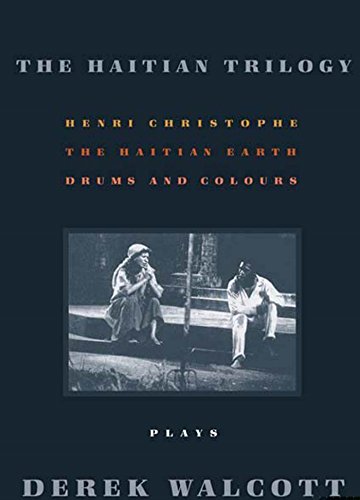

The Haitian trilogy / Derek Walcott.
Idioma: Español New York : Farrar, Straus and Giroux, 2002Edición: 1st edDescripción: viii, 434 p. : port., ; 21 cmISBN:- 0374528136 (alk. paper)
- 812/.54 21
- PR9272.9.W3 H35 2001
| Imagen de cubierta | Tipo de ítem | Biblioteca actual | Biblioteca de origen | Colección | Ubicación en estantería | Signatura topográfica | Materiales especificados | Info Vol | URL | Copia número | Estado | Notas | Fecha de vencimiento | Código de barras | Reserva de ítems | Prioridad de la cola de reserva de ejemplar | Reservas para cursos | |
|---|---|---|---|---|---|---|---|---|---|---|---|---|---|---|---|---|---|---|
| Libro | Biblioteca Encarnación Valdés Colección General bev | 812.54 W156h (Navegar estantería(Abre debajo)) | Disponible | 80000002556911 |
Descripciones mejoradas de Syndetics:
Three plays by the Nobel-laureate Derek Walcott, brought together for the first time in The Haitian Trilogy
In the history plays that comprise The Haitian Trilogy -- Henri Christophe, Drums and Colours and The Haytian Earth --Derek Walcott, recipient of the Nobel Prize in Literature, uses verse to tell the story of his native West Indies as a four-hundred-year cycle of war, conquest and rebellion.
In Henri Christophe and The Haytian Earth, Walcott re-casts the legacy of Haiti's violent revolutionaries--led by Toussaint L'Ouverture, Jean Jacques Dessalines and Henri Christophe--whose rebellion established the first black state in the Americas, but whose cruelty becomes a parable of racial pride and corruption. Drums and Colours, commissioned in 1958 to celebrate the first parliament in Trinidad, is a grand pageant linking the lives of complex, ambiguous heroes: Columbus and Raleigh; Toussaint; and George William Gordon, a martyr of the constitutional era.
From Henri Christophe's high style to the bracing vernacular of The Haytian Earth, to the epic scale and scope of Drums and Colours, in these plays Walcott, one of our most celebrated poets, carved a place in the modern theater for the history of the West Indies, and a sounding room for his own maturing voice.
Henri Christophe -- Drums and colours -- The Haitian earth.
Reseñas proporcionadas por Syndetics
Library Journal Review
These three early theater experiments by Nobel prize-winning poet and playwright Walcott (Omeros) center around three historical characters: Christoff, Dessaline, and Toussaint L'Ouverture. Moving freely through the history of the West Indies, these verse plays are the work of a powerful imagination struggling to find a language to realize its vision on stage. The first play, "Henri Christophe," is a Shakespearean meditation on the corrupting influence of power, while the second, "Drums and Colours," is a pageant of history from the age of discovery with Columbus to 1833 with Toussaint L'Ouverture. "The Haytian Earth" is a long historical drama of the slavery, rebellion, murder, greed, and power struggles that have fertilized the Haitian earth with blood. Unfortunately, while occasionally brilliant, these plays are too often clumsy and unsure. Stuffed with historical characters, they are too large in scope and too unwieldy in structure to fit on the stage, and the language is more argumentative than dramatic. Recommended for specialists. Thomas E. Luddy, Salem State Coll., MA (c) Copyright 2010. Library Journals LLC, a wholly owned subsidiary of Media Source, Inc. No redistribution permitted.Booklist Review
Uneven but filled with passages of startling poetry, this loose trilogy of plays, early work by the future Nobel laureate, is noteworthy more because of who Walcott became than because of its merits. Even in his late teens and twenties, Walcott was ambitious. Henri Christophe recasts the power struggle between the early Haitian leaders Jean Jacques Dessalines and Henri Christophe, both followers of the liberator Toussaint L'Ouverture, as a Shakespearean history play, complete with soliloquies and court intrigues. Drums and Colours daringly packs 400 years of West Indian history into one epic drama; it sprawls too much to be good theater, but on the page, there is something thrilling about a play that starts with Columbus' difficult third voyage to the New World and ends 182 pages later in the nineteenth century. The Haitian Earth is more Brechtian in scope and feeling as it dramatizes in a series of laconic scenes the bloody slave revolt that created the first black-run country in the Western Hemisphere. Throughout the trilogy, Walcott's ear for dialect is remarkable. --Jack HelbigNotas de autor provistas por Syndetics
Derek Alton Walcott was born in Castries, St. Lucia on January 23, 1930. He received a bachelor's degree in French, Latin, and Spanish at the University of the West Indies in 1953. He also began writing plays. His first play, about the revolutionary Haitian leader Henri Christophe, was produced in St. Lucia in 1950.He taught at schools in St. Lucia, Grenada and Jamaica while continuing to write and stage plays. His plays included Lone, Sea at Dauphin, Ti-Jean and His Brothers, Malcochon, and Dream on Monkey Mountain. He later wrote the book and collaborated with the singer and songwriter Paul Simon on the lyrics for The Capeman, a musical about a Puerto Rican gang member who murdered three people in Manhattan in 1959. He was a professor at Boston University from 1981 until retiring in 2007.
His metaphorical poetry captured the physical beauty of the Caribbean, the harsh legacy of colonialism, and the complexities of living and writing in two cultural worlds His collections of poetry included In a Green Night, Selected Poems, The Castaway, The Gulf, Sea Grapes, Another Life, Omeros, Tiepolo's Hound, and The Prodigal. He received the Queens Medal for Poetry, the Nobel Prize for Literature in 1992, and the T. S. Eliot Prize for his poetry collection, White Egrets, in 2011. He died on March 17, 2017 at the age of 87.
(Bowker Author Biography)