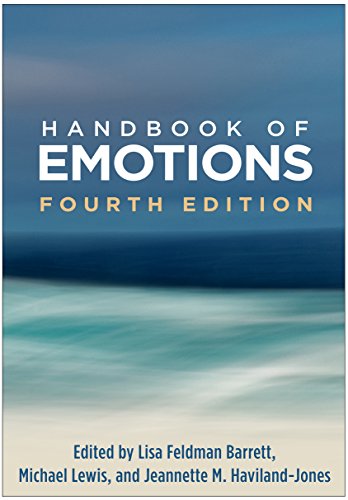

Handbook of emotions / edited by Lisa Feldman Barrett, Michael Lewis, Jeannette M. Haviland-Jones.
Idioma: Inglés New York : Guilford Press, ©2016Edición: Fourth editionDescripción: xvi, 928 pages : illustrations ; 27 cmTipo de contenido:- text
- unmediated
- volume
- 9781462525348 (hardcover : alk. paper)
- 152.4 23
- BF561 .H35 2016
| Imagen de cubierta | Tipo de ítem | Biblioteca actual | Biblioteca de origen | Colección | Ubicación en estantería | Signatura topográfica | Materiales especificados | Info Vol | URL | Copia número | Estado | Notas | Fecha de vencimiento | Código de barras | Reserva de ítems | Prioridad de la cola de reserva de ejemplar | Reservas para cursos | |
|---|---|---|---|---|---|---|---|---|---|---|---|---|---|---|---|---|---|---|
| Libro | Biblioteca Encarnación Valdés Sala de Referencia bev | 152.4 H2361 2016 (Navegar estantería(Abre debajo)) | c.1 | Disponible | 80000002556895 |
Descripciones mejoradas de Syndetics:
Recognized as the definitive reference, this handbook brings together leading experts from multiple psychological subdisciplines to examine one of today's most dynamic areas of research. Coverage encompasses the biological and neuroscientific underpinnings of emotions, as well as developmental, social and personality, cognitive, and clinical perspectives. The volume probes how people understand, experience, express, and perceive affective phenomena and explores connections to behavior and health across the lifespan. Concluding chapters present cutting-edge work on a range of specific emotions. Illustrations include 10 color plates.
New to This Edition
*Chapters on the mechanisms, processes, and influences that contribute to emotions (such as genetics, the brain, neuroendocrine processes, language, the senses of taste and smell).
*Chapters on emotion in adolescence and older age, and in neurodegenerative dementias.
*Chapters on facial expressions and emotional body language.
*Chapters on stress, health, gratitude, love, and empathy.
*Many new authors and topics; extensively revised with the latest theoretical and methodological innovations.
A Choice Outstanding Academic Title
Includes bibliographical references and index.
Tabla de contenidos provista por Syndetics
- Part I Interdisciplinary Perspectives
- 1 The Philosophy of Emotions and Its Impact on Affective Science(p. 3)
- 2 The History of Emotions(p. 49)
- 3 The Sociology of Emotion(p. 66)
- 4 Emotions in Music, Literature, and Film(p. 82)
- 5 Affect in Economic Decision Making(p. 98)
- 6 Computational Models of Emotion as Psychological Tools(p. 113)
- Part II Biological Perspectives
- 7 From Pleasure to Happiness: "Liking" and "Wanting" in Mind and Brain(p. 133)
- 8 Neural Fingerprinting: Mera-Analysis, Variation, and the Search for Brain-Based Essences in the Science of Emotion(p. 146)
- 9 Emotion and the Autonomic Nervous System(p. 166)
- 10 Genetic Contributions to Affect and Emotion(p. 182)
- 11 Olfaction: Explicit and Implicit Emotional Processing(p. 199)
- 12 Interoception and Emotion: A Neuroanatomical Perspective(p. 215)
- 13 The Affect of Taste and Olfaction: The Key to Survival(p. 235)
- Part III Developmental Perspectives
- 14 The Development of Facial Expressions; Current Perspectives on Infant Emotions(p. 255)
- 15 The Emergence of Human Emotions(p. 272)
- 16 Understanding Emotion(p. 293)
- 17 The Development of Children's Concepts of Emotion(p. 307)
- 18 Emotion and Aging(p. 319)
- 19 The Interplay of Motivation and Emotion: View from Adulthood and Old Age(p. 336)
- 20 Emotional Development in Adolescence(p. 350)
- Part IV Social and Personality Perspectives
- 21 Gender and Emotion: Theory, Findings, and Context(p. 369)
- 22 The Cultural Psychology of Emotions(p. 393)
- 23 Intergroup Emotions(p. 412)
- 24 Social Functions of Emotion and Emotion Regulation(p. 424)
- 25 Social Pain and Social Pleasure: Two Overlooked but Fundamental Mammalian Emotions?(p. 440)
- 26 Emotion Regulation: A Valuation Perspective(p. 453)
- 27 Expression of Emotion(p. 467)
- 28 Emotional Body Perception in the Wild(p. 483)
- 29 Form and Function in Facial Expressive Behavior(p. 495)
- Part V Cognitive Perspectives
- 30 Emotional Intelligence(p. 513)
- 31 New Light on the Affect-Cognition Connection(p. 532)
- 32 A Fundamental Role for Conceptual Processing in Emotion(p. 547)
- 33 Memory and Emotion(p. 564)
- 34 Language and Emotion: Putting Words into Feelings and Feelings into Words(p. 579)
- 35 Emotion and Attention(p. 595)
- Part VI Health-Related Perspectives
- 36 Emotions and Health(p. 613)
- 37 Neuroendocrine and Neuroimmunological Mechanisms of Emotion(p. 634)
- 38 Emotion Disturbances as Transdiagnostic Processes in Psychopathology(p. 653)
- 39 The Clinical Application of Emotion in Psychotherapy(p. 670)
- 40 Eat, Drink, and Be Sedentary: A Review of Health Behaviors' Effects on Emotions and Affective States, and Implications for Interventions(p. 685)
- 41 Stress and Emotion: Embodied, in Context, and across the Lifespan(p. 707)
- 42 Emotion-Related Symptoms of Neurodegenerative Dementias(p. 736)
- Part VII Specific Emotions
- 43 Fear and Anxiety(p. 751)
- 44 Anger(p. 774)
- 45 Self-Conscious Emotions: Embarrassment, Pride, Shame, Guilt, and Hubris(p. 792)
- 46 Disgust(p. 815)
- 47 Gratitude and Compassion(p. 835)
- 48 Love: Positivity Resonance as a Fresh, Evidence-Based Perspective on an Age-Old Topic(p. 847)
- 49 Sadness and Depression(p. 859)
- 50 Empathy(p. 871)
- Author Index(p. 885)
- Subject Index(p. 917)
Reseñas proporcionadas por Syndetics
CHOICE Review
The editors of the fourth edition of this handbook have surpassed their outstanding third edition (CH, Mar'09, 46-4136) to produce a work that provides not only a snapshot of the state-of-the-art aspects of emotion science, but also a credible and revealing vision of the future of the field. Of course, the editors are leaders in their respective areas of study; in addition, they have a rich and comprehensive understanding of the field of emotion science as a whole, especially its expanding borders. In the eight years since the last edition was published, the field has grown enormously; the new edition reflects that growth and more. Most of the 50 chapters are new or have been revised (some extensively), and the contributors again include seasoned pros or younger scientists conducting cutting-edge research. Noteworthy in this regard is the inclusion of chapters that incorporate some of the new methodologies and approaches that are changing the ways in which individuals think about emotions, as well as the expansion of the final section of the book, "Specific Emotions." There is no other handbook of this quality and scope. This text is absolutely essential. Summing Up: Essential. Upper-division undergraduates and above; faculty and professionals. --Randolph R. Cornelius, Vassar CollegeNotas de autor provistas por Syndetics
Lisa Feldman Barrett, PhD, is University Distinguished Professor of Psychology and Director of the Interdisciplinary Affective Science Laboratory at Northeastern University, with research appointments at Harvard Medical School and Massachusetts General Hospital (MGH), and is a faculty member at the MGH Center for Law, Brain and Behavior. Dr. Barrett's research focuses on the nature of emotion from both psychological and neuroscience perspectives, and incorporates insights from anthropology, philosophy, linguistics, and the history of psychology. She is the recipient of a Pioneer Award from the National Institutes of Health, among numerous other awards, and is a Fellow of the Royal Society of Canada, the American Association for the Advancement of Science, and the Association for Psychological Science. She was a founding Editor-in-Chief of the journal Emotion Review and cofounder of the Society for Affective Science. Dr. Barrett has published more than 170 papers and book chapters.Michael Lewis, PhD, is University Distinguished Professor of Pediatrics and Psychiatry and Director of the Institute for the Study of Child Development at Rutgers Robert Wood Johnson Medical School. He is also Professor of Psychology, Education, Cognitive Science, Biomedical Engineering, and Social Work at Rutgers, The State University of New Jersey, where he serves on the Executive Committee of the Center for Cognitive Science and is an Associate of the Center for Mathematics, Science and Computer Education. Dr. Lewis is a Fellow of the New York Academy of Sciences, the American Psychological Association (APA), the American Association for the Advancement of Science, and the Japan Society for the Promotion of Science, and is currently in the top 1.5% of scientists referenced in the Social Science Index. He is a recipient of the Bronfenbrenner Award for Lifetime Contribution to Developmental Psychology in the Service of Science and Society from the APA, the Hedi Levenback Pioneer Award from the New York Zero-to-Three Network, and the Distinguished Scientific Contributions to Child Development Award from the Society for Research in Child Development. Dr. Lewis has published over 450 journal articles and book chapters and 35 books, including The Rise of Consciousness and the Development of Emotional Life, which won the William James Book Award from APA Division 1 (Society for General Psychology), Social Cognition and the Acquisition of Self , Children's Emotions and Moods , Shame: The Exposed Self , and Altering Fate .
Jeannette M. Haviland-Jones, PhD, is Professor Emerita of Psychology at Rutgers, The State University of New Jersey, where she is Codirector of the Center for Sensory Science and Innovation and former Director of the Human Emotions Lab. Dr. Haviland-Jones has written extensively about emotional development for over 25 years. She is coauthor of The Hidden Genius of Emotion: Lifespan Transformations of Personality and has published over 60 articles, chapters, and books on emotion and related issues. Her long-time research interests have included lifespan changes in displays of emotion, gender differences in emotions, and the organizing effects of emotion on cognition and personality. Recently she has initiated research on the chemosensory aspects of emotion communication, called "olfactics."