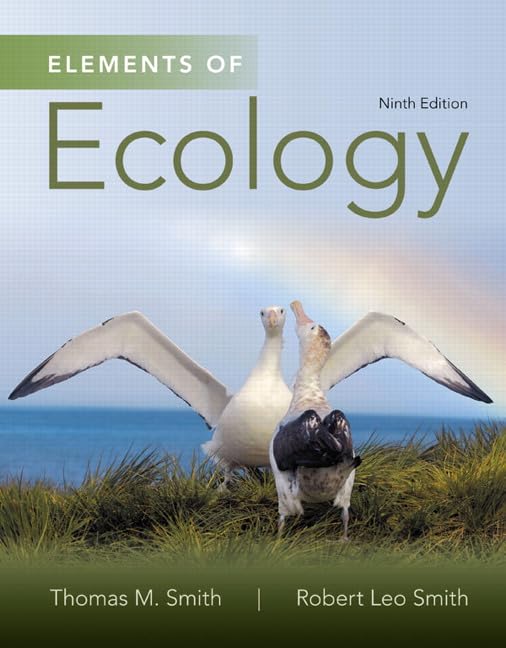

Elements of ecology / Thomas M. Smith, University of Virginia ; Robert Leo Smith, West Virginia University, Emeritus .
Idioma: Español Editor: Boston : Pearson, [2015]Edición: 9th editionDescripción: 1 varoius paging : illustrations (some color) ; 28 cm Tipo de medio:- 9780321934185
- 577 23
- QH541 .S624 2015
| Imagen de cubierta | Tipo de ítem | Biblioteca actual | Biblioteca de origen | Colección | Ubicación en estantería | Signatura topográfica | Materiales especificados | Info Vol | URL | Copia número | Estado | Notas | Fecha de vencimiento | Código de barras | Reserva de ítems | Prioridad de la cola de reserva de ejemplar | Reservas para cursos | |
|---|---|---|---|---|---|---|---|---|---|---|---|---|---|---|---|---|---|---|
| Libro | Biblioteca de Mayagüez Colección General mb | QH541 .S624 2015 (Navegar estantería(Abre debajo)) | c. 1 | Disponible | 50000003241758 |
Descripciones mejoradas de Syndetics:
&> Elements of Ecology, Ninth Edition continues to explain ecological processes clearly and concisely, with a greater emphasis on the relevance of ecology to everyday life and the human impact on ecosystems. This dramatically revised edition discusses issues of human ecology throughout the text and provides a greater variety of opportunities for students to learn, practice, and develop quantitative and analytical skills. Current research examples and other content updates are supported by more than 200 redesigned, full-color illustrations, graphs, and tables.
Also available with MasteringBiology®
This title is also available with MasteringBiology, an online homework, tutorial, and assessment program that improves results by helping students quickly master concepts both in and outside the classroom. The book and MasteringBiology work together to create a classroom experience that enables students to succeed in biology and ecology courses.
Note: You are purchasing a standalone product; MasteringBiology does not come packaged with this content. If you would like to purchase both the physical text and MasteringBiology search for ISBN-10: 0321934172/ISBN-13: 9780321934178. That package includes ISBN-10: 0321934180/ISBN-13: 9780321934185 and ISBN-10: 0321976010/ISBN-13: 9780321976017. MasteringBiology should only be purchased when required by an instructor.
The nature of ecology -- Climate -- The aquatic environment -- The terrestrial environment -- Adaptation and natural selection -- Plant adaptations to the environment -- Animal adaptations to the environment -- Properties of populations -- Population growth -- Life history -- Intraspecific population regulation -- Species interactions, population dynamics, and natural selection -- Interspecific competition -- Predation -- Parasitism and mutualism -- Community structure -- Factors influencing the structure of communities -- Community dynamics -- Landscape dynamics -- Ecosystem energetics -- Decomposition and nutrient cycling -- Biogeochemical cycles -- Terrestrial ecosystems -- Aquatic ecosystems -- Coastal and wetland ecosystems -- Large-scale patterns of biological diversity -- The ecology of climate change.
An introductory textbook for college students.
Notas de autor provistas por Syndetics
Thomas M. Smith, Associate Professor in Environmental Sciences at the University of Virginia, received his Ph.D. in ecology from the University of Tennessee in 1982. The main focus of his research over the past two decades has been to develop an individual based theory of community and ecosystems dynamics. As part of this work he has served on numerous national and international panels that have addressed the potential influence of human activities on the global environment. He has authored over 70 publications based on his research, and he has been recognized as one of the most cited scientists in the field of global change research.
Thomas's work has taken him to over 70 countries and 6 continents. He has served on the faculty of the University of Witwatersrand (Johannesburg, South Africa), Australian National University (Canberra, Australia), as well as the University of Virginia (Charlottesville, VA, USA). In addition, he has held research scientist positions at both Oak Ridge National Laboratory (Oak Ridge, TN, USA) and the Institute for Applied Systems Analysis (Laxenburg, Austria). His has over 20 years of experience teaching the science of ecology to both science and non-science majors.
Robert L. Smith holds a Ph.D. in Wildlife Biology from Cornell University. He is Professor Emeritus of Ecology at West Virginia University. He has spent over 30 years teaching Ecology and conducting field research throughout the world.
His teaching responsibilities have involved mostly undergraduate courses in general ecology and graduate courses in population ecology and wildlife management. His research has included forest-fire related problems in southern West Virginia, vegetational development and succession on abandoned and reclaimed surface mines, the relation between forest vegetational structure and the forest bird community, and forest habitat assessment and habitat evaluation procedures based on vegetational structure.
Smith has served as a consultant to congressional committees, workshops on environmental education and energy and environmental problems, the National Landmarks program of the U.S. Department of Interior, National Research Council Task Forces on wildlife and fisheries issues and ecological classification systems for implementing environmental quality evaluation procedures.