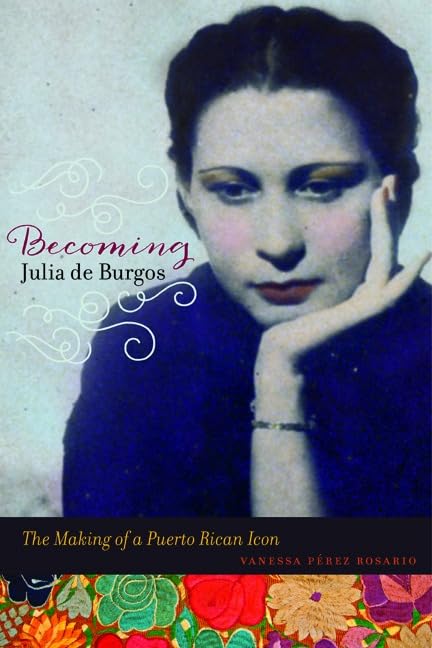

Becoming Julia de Burgos the making of a Puerto Rican icon Vanessa Pérez Rosario.
Detalles de publicación: Urbana University of Illinois Press ©2014.Descripción: xvi, 192 pages, 8 unnumbered pages of plates illustrations (some color) 24 cmTipo de contenido:- 9780252080609 (paperback : acid-free paper)
- 0252080602 (paperback : acid-free paper)
- 861/.62 23
- PQ7439.B9 Z756 2014
| Imagen de cubierta | Tipo de ítem | Biblioteca actual | Biblioteca de origen | Colección | Ubicación en estantería | Signatura topográfica | Materiales especificados | Info Vol | URL | Copia número | Estado | Notas | Fecha de vencimiento | Código de barras | Reserva de ítems | Prioridad de la cola de reserva de ejemplar | Reservas para cursos | |
|---|---|---|---|---|---|---|---|---|---|---|---|---|---|---|---|---|---|---|
| Libro | Biblioteca Encarnación Valdés Colección de Puerto Rico | PR 861.62 P9449b (Navegar estantería(Abre debajo)) | Disponible | 80000002558123 |
Descripciones mejoradas de Syndetics:
While it is rare for a poet to become a cultural icon, Julia de Burgos has evoked feelings of bonding and identification in Puerto Ricans and Latinos in the United States for over half a century.
nbsp;
In the first book-length study written in English, Vanessa Pérez-Rosario examines poet and political activist Julia de Burgos's development as a writer, her experience of migration, and her legacy in New York City, the poet's home after 1940. Pérez-Rosario situates Julia de Burgos as part of a transitional generation that helps to bridge the historical divide between Puerto Rican nationalist writers of the 1930s and the Nuyorican writers of the 1970s. Becoming Julia de Burgos departs from the prevailing emphasis on the poet and intellectual as a nationalist writer to focus on her contributions to New York Latino/a literary and visual culture. It moves beyond the standard tragedy-centered narratives of de Burgos's life to place her within a nuanced historical understanding of Puerto Rico's peoples and culture to consider more carefully the complex history of the island and the diaspora. Pérez-Rosario unravels the cultural and political dynamics at work when contemporary Latina/o writers and artists in New York revise, reinvent, and riff off of Julia de Burgos as they imagine new possibilities for themselves and their communities.
nbsp;
Includes bibliographical references (pages 167-181) and index.
Writing the nation: feminism, anti-imperialism, and the generación del treinta -- Nadie es profeta en su tierra: exile, migration, and hemispheric identity -- Más allá del mar: journalism as Puerto Rican cultural and political transnational practice -- Multiple legacies: Julia de Burgos and Caribbean Latino diaspora writers -- Remebering Julia de Burgos: cultural icon, community, belonging -- Conclusion: Creating Latinidad.
Tabla de contenidos provista por Syndetics
- List of Illustrations(p. xiii)
- Acknowledgments(p. xv)
- Introduction(p. 1)
- 1 Writing the Nation: Feminism, Anti-Imperialism, and the Generación del Treinta(p. 15)
- 2 Nadie es profeta en su tierra: Exile, Migration, and Hemispheric Identity(p. 46)
- 3 Más allá del mar: Journalism as Puerto Rican Cultural and Political Transnational Practice(p. 69)
- 4 Multiple Legacies: Julia de Burgos and Caribbean Latino Diaspora Writers(p. 94)
- 5 Remembering Julia de Burgos: Cultural Icon, Community, Belonging(p. 123)
- Conclusion: Creating Latinidad(p. 147)
- Notes(p. 151)
- Bibliography(p. 167)
- Index(p. 183)