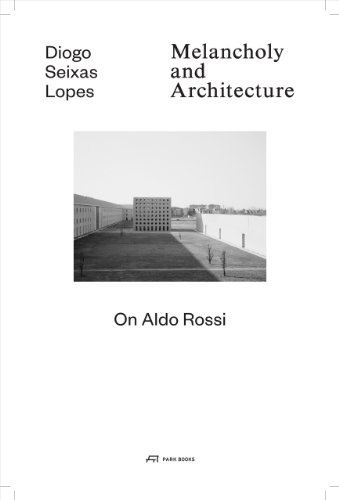

Melanchloly and architecture ; on Aldo Rossi : txt
Idioma: Inglés Switzerland : Park Book, 2015Descripción: 231 p. ill. (some col.) ; 24 cmTipo de contenido:- text
- unmediaded
- volume
- 9783906027470
- NA1123.R67 L67 2015
| Imagen de cubierta | Tipo de ítem | Biblioteca actual | Biblioteca de origen | Colección | Ubicación en estantería | Signatura topográfica | Materiales especificados | Info Vol | URL | Copia número | Estado | Notas | Fecha de vencimiento | Código de barras | Reserva de ítems | Prioridad de la cola de reserva de ejemplar | Reservas para cursos | |
|---|---|---|---|---|---|---|---|---|---|---|---|---|---|---|---|---|---|---|
| Libro Col. General CARIBET | CARIBET Biblioteca Arquitectura Colección General CARIBET | General NA1123.R67 L67 2015 (Navegar estantería(Abre debajo)) | 1 | Disponible | 91000000048496 |
Descripciones mejoradas de Syndetics:
Italian architect Aldo Rossi (1931-97) is a crucial figure in twentieth-century architecture, his work highly influential in both theory and practice. Working in Italy and throughout Europe after World War II, he disputed the then-dominant credos of the modernists--and even went so far as to question the very status of his profession. Discarding utopian pretenses, his work claimed the autonomy of architecture with formal restraint.
In Melancholy and Architecture , Diogo Seixas Lopes looks at Rossi's work through the lens of a term often used to describe Rossi's work: melancholy. While the influence of melancholy on literature and the visual arts has been extensively studied, its presence in architecture has been largely overlooked. Exploring Rossi's entire career, Lopes traces out the oscillation between enthusiasm and disenchantment that marks Rossi's work. Through a close exploration of one of Rossi's landmark works, the Cemetery of San Cataldo in Modena, he shows how this brilliant, innovative architect reinterpreted a typology of the past to help us come to terms with representations of death and the deep sadness that inevitably accompanies it.
Beautifully illustrated, Melancholy and Architecture both illuminates the career of a key postwar architect and offers a new perspective on the long cultural history of melancholy.
Contents:
11 Introduction --
12 Now this is lost --
22 Our usual feeling of imperfection --
Part 1 31 Melancholy and architecture --
32 Modernity, disquiet, and space --
38 Aesthetics of the sublime --
50 Metropolis and spleen --
59 The lost center --
69 Downcast architecture --
Part 2 75 The case of Aldo Rossi --
76 Postwar years --
82 A realist education --
88 Continuity or crisis? --
95 Architecture as choice --
101 Architecture as memory --
114 Architecture as autobiography --
120 Politics and poetics --
Part 3 125 The cemetery of San Cataldo --
126 A sign of culture --
132 First stage of competition --
144 Second stage of competition --
149 Planning and construction --
162 The city of the dead --
170 The abandoned house --
176 The form of the skeleton --
181 The architecture of shadows --
188 Memento mori --
195 Conclusion --
196 An architecture of optimism? --
206 Culture and crisis --
216 Final remarks --