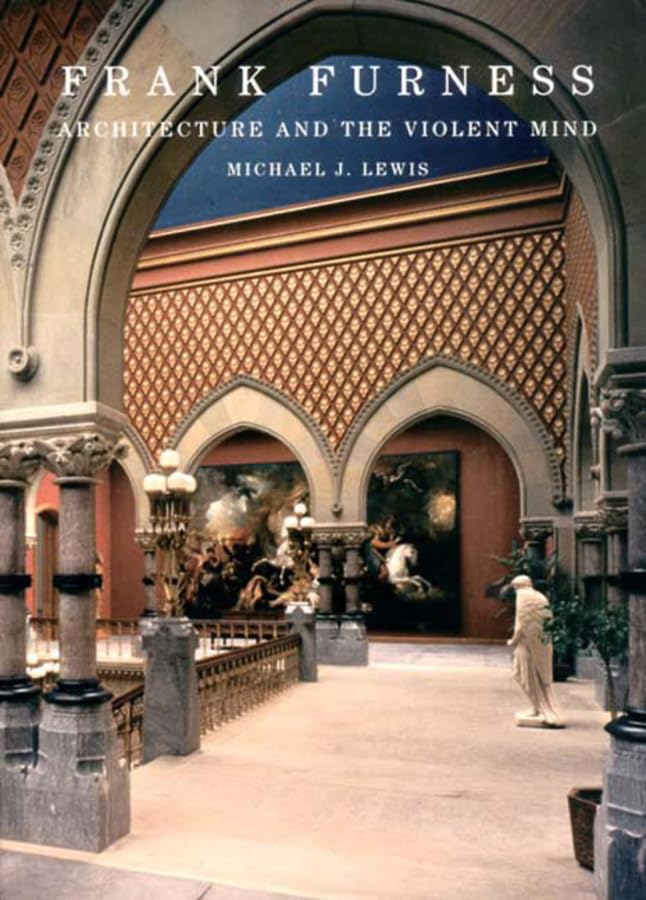

Frank Furness : architecture and the violent mind. / Michael J. Lewis. txt
New York : Norton , 2001Edición: 1st editionDescripción: x, 273 p. ill. ;plans. ;photo. ; 29 cmTipo de contenido:- text
- unmediaded
- volume
- 9780393730630
- 0393730638
- 720.92 21
- NA737.F84 L49 2001
| Imagen de cubierta | Tipo de ítem | Biblioteca actual | Biblioteca de origen | Colección | Ubicación en estantería | Signatura topográfica | Materiales especificados | Info Vol | URL | Copia número | Estado | Notas | Fecha de vencimiento | Código de barras | Reserva de ítems | Prioridad de la cola de reserva de ejemplar | Reservas para cursos | |
|---|---|---|---|---|---|---|---|---|---|---|---|---|---|---|---|---|---|---|
| Libro | CARIBET Biblioteca Arquitectura Colección General CARIBET | General NA737.F84 L49 2001 (Navegar estantería(Abre debajo)) | 1 | Disponible | 91000000048629 |
Descripciones mejoradas de Syndetics:
Frank Furness' energy, confidence, brashness, vulgarity, and full-throated love of life vibrate in his architecture.
This first biography details his abolitionist upbringing in staid Philadelphia, the horror of war and its translation into aggressive architecture--train stations, banks, and libraries--and illuminates his influence on his century and the world.
200 black & white illustrations
Include index
Include Bibliography
Introduction --
Abolition & architecture --
Frank Furness's war --
Late to the feast --
Fortune favors the bold --
The dog man --
Brave dreams --
Talkers are no great doers --
The white city & the red station --
To purchase oblivion --
The bravest of the brave --
Frank Furness' energy, confidence, brashness, vulgarity, and full-throated love of life vibrate in his architecture.
This first biography details his abolitionist upbringing in staid Philadelphia, the horror of war and its translation into aggressive architecture - train stations, banks, and libraries - and illuminates his influence on his century and the world.
"Philadelphia architect Frank Furness (1839-1912) produced the most aggressive and eye-catching buildings ever seen in the United States, merging French classicism, English medievalism, and New England transcendentalism. His energy, confidence, brashness, vulgarity, and full-throated love of life vibrate in his architecture.""This first biography of the flamboyant personality whom Louis Sullivan dubbed "the dog man" shows Furness a man of his age, immersed in its most powerful currents and forces. It details his abolitionist upbringing in staid Philadelphia, the transformative experience of the Civil War (in which he served as a cavalry officer and earned a Congressional Medal of Honor), and its translation into swaggering architecture that met the needs for vivid commercial imagery in the Gilded Age. It recounts how Furness's rip-roaring professional style brought him success when he served a generation of veterans but helped make him a pariah in the transformed culture of America at the turn of the twentieth century.""Michael J. Lewis's lively narrative draws on military records, unpublished family papers, interviews with family members, and contemporary documents, enriched by over 200 illustrations, including archival views of demolished masterpieces and contemporary photographs of Furness buildings that still stand today. Among these are the Pennsylvania Academy of the Fine Arts, the library of the University of Pennsylvania, churches, banks, a railroad station, and numerous row houses and mansions."--Jacket.
Tabla de contenidos provista por Syndetics
- Acknowledgments(p. ix)
- Introduction(p. 1)
- 1 Abolition and Architecture(p. 7)
- 2 Frank Furness's War(p. 29)
- 3 Late to the Feast(p. 53)
- 4 Fortune Favors the Bold(p. 83)
- 5 The Dog Man(p. 115)
- 6 Brave Dreams(p. 141)
- 7 Talkers Are No Great Doers(p. 175)
- 8 The White City and the Red Station(p. 195)
- 9 To Purchase Oblivion(p. 221)
- Epilogue: The Bravest of the Brave(p. 245)
- Notes(p. 255)
- Index(p. 267)