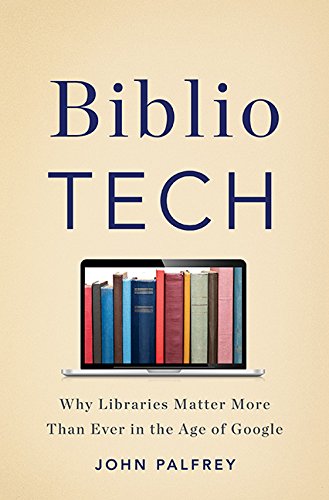
Imagen de portada de Amazon
Imagen de Amazon.com
Imagen de cubierta Syndetics
Portada de Syndetics
Imagen de OpenLibrary

BiblioTech [electronic resource] why libraries matter more than ever in the age of Google John Palfrey.

Por: Colaborador(es): Editor: New York Basic Books, A Member of the Perseus Books Group [2015]Descripción: one online resource (vii, 280 pages) 22 cmTipo de contenido:
Tipo de medio:
Tipo de soporte:
ISBN:
  • 9780465040605 (e-book)
Tema(s): Género/Forma: Clasificación CDD:
  • 020.285/4678 23
Clasificación LoC:
  • Z674.75.I58 P38 2015eb
Otra clasificación:
  • LAN025000
Contenidos:
Crisis : a perfect storm -- Customers : how we use libraries -- Spaces : the connection between the virtual and the physical -- Platforms : what cloud computing means for libraries -- Hacking : how to build the future -- Networks : the human network of librarians -- Preservation : collaboration, not competition, to preserve culture -- Education : libraries and connected learners -- Law : why copyright and privacy matter so much -- Conclusion : what's at stake.
Resumen: "Libraries today are more important than ever. More than just book repositories, libraries can become bulwarks against some of the most crucial challenges of our age: unequal access to education, jobs, and information. In BiblioTech, educator and technology expert John Palfrey argues that anyone seeking to participate in the 21st century needs to understand how to find and use the vast stores of information available online. And libraries, which play a crucial role in making these skills and information available, are at risk. In order to survive our rapidly modernizing world and dwindling government funding, libraries must make the transition to a digital future as soon as possible-by digitizing print material and ensuring that born-digital material is publicly available online. Not all of these changes will be easy for libraries to implement. But as Palfrey boldly argues, these modifications are vital if we hope to save libraries and, through them, the American democratic ideal. "--Resumen: "We live in a world of complex and seemingly infinite information. The ways in which people of all ages use and obtain that information has changed drastically in recent years: e-book readership has increased, Wikipedia has largely supplanted encyclopedias and reference books, and many people now consume news and media through their smartphones, tablets, and laptops. With digital culture ascendant, it seems counterintuitive to argue that libraries, of all things, are more important than ever. But that is exactly what library expert John Palfrey does in BiblioTech, a stirring call to arms that explains how libraries can become bulwarks against the creeping problems of our times: unequal access to education, jobs, and information. Yet the fate of the local library is by no means secure; these institutions are struggling to adapt to our rapidly modernizing world, and often rely on dwindling funding from state and local governments to do so. In order to survive, libraries will need to dramatically shift their focus from maintaining and building up their collections to serving their communities. Print and analog formats will never disappear, Palfrey assures us, but libraries must make the transition to a digital future as soon as possible--by digitizing print material, ensuring that born-digital material (from data sets to blog posts to sound recordings) is accessible to researchers, and making all of this digital information publicly available online. Not all of these changes will be easy for libraries to implement and the process of digitizing collections and training librarians will be complicated and costly. But as Palfrey boldly argues, these modifications are vital if we hope to save libraries and, through them, the American democratic ideal"-- Provided by publisher.
Valoración
    Valoración media: 0.0 (0 votos)
Existencias
Imagen de cubierta Tipo de ítem Biblioteca actual Biblioteca de origen Colección Ubicación en estantería Signatura topográfica Materiales especificados Info Vol URL Copia número Estado Notas Fecha de vencimiento Código de barras Reserva de ítems Prioridad de la cola de reserva de ejemplar Reservas para cursos
Libro electrónico Biblioteca de Mayagüez Acceso en línea Z674.75.I58 P38 2015eb (Navegar estantería(Abre debajo)) Disponible 50000003265781
Libro electrónico Biblioteca Mons. Iñaki Mallona (Arecibo) Acceso en línea 020.285 (Navegar estantería(Abre debajo)) Ebook Disponible 60000010173398
Total de reservas: 0

Descripciones mejoradas de Syndetics:

Libraries today are more important than ever. More than just book repositories, libraries can become bulwarks against some of the most crucial challenges of our age: unequal access to education, jobs, and information.

In BiblioTech , educator and technology expert John Palfrey argues that anyone seeking to participate in the 21st century needs to understand how to find and use the vast stores of information available online. And libraries, which play a crucial role in making these skills and information available, are at risk. In order to survive our rapidly modernizing world and dwindling government funding, libraries must make the transition to a digital future as soon as possible -- by digitizing print material and ensuring that born-digital material is publicly available online.

Not all of these changes will be easy for libraries to implement. But as Palfrey boldly argues, these modifications are vital if we hope to save libraries and, through them, the American democratic ideal.

Instrucciones de uso: Recurso electrónico favor presionar sobre el URL disponible en la parte inferior. En caso de dudas favor consulte al Bibliotecario.

"Libraries today are more important than ever. More than just book repositories, libraries can become bulwarks against some of the most crucial challenges of our age: unequal access to education, jobs, and information. In BiblioTech, educator and technology expert John Palfrey argues that anyone seeking to participate in the 21st century needs to understand how to find and use the vast stores of information available online. And libraries, which play a crucial role in making these skills and information available, are at risk. In order to survive our rapidly modernizing world and dwindling government funding, libraries must make the transition to a digital future as soon as possible-by digitizing print material and ensuring that born-digital material is publicly available online. Not all of these changes will be easy for libraries to implement. But as Palfrey boldly argues, these modifications are vital if we hope to save libraries and, through them, the American democratic ideal. "-- Provided by publisher.

"We live in a world of complex and seemingly infinite information. The ways in which people of all ages use and obtain that information has changed drastically in recent years: e-book readership has increased, Wikipedia has largely supplanted encyclopedias and reference books, and many people now consume news and media through their smartphones, tablets, and laptops. With digital culture ascendant, it seems counterintuitive to argue that libraries, of all things, are more important than ever. But that is exactly what library expert John Palfrey does in BiblioTech, a stirring call to arms that explains how libraries can become bulwarks against the creeping problems of our times: unequal access to education, jobs, and information. Yet the fate of the local library is by no means secure; these institutions are struggling to adapt to our rapidly modernizing world, and often rely on dwindling funding from state and local governments to do so. In order to survive, libraries will need to dramatically shift their focus from maintaining and building up their collections to serving their communities. Print and analog formats will never disappear, Palfrey assures us, but libraries must make the transition to a digital future as soon as possible--by digitizing print material, ensuring that born-digital material (from data sets to blog posts to sound recordings) is accessible to researchers, and making all of this digital information publicly available online. Not all of these changes will be easy for libraries to implement and the process of digitizing collections and training librarians will be complicated and costly. But as Palfrey boldly argues, these modifications are vital if we hope to save libraries and, through them, the American democratic ideal"-- Provided by publisher.

Includes bibliographical references (pages 261-270) and index.

Crisis : a perfect storm -- Customers : how we use libraries -- Spaces : the connection between the virtual and the physical -- Platforms : what cloud computing means for libraries -- Hacking : how to build the future -- Networks : the human network of librarians -- Preservation : collaboration, not competition, to preserve culture -- Education : libraries and connected learners -- Law : why copyright and privacy matter so much -- Conclusion : what's at stake.

eigm 02/2016

Reseñas proporcionadas por Syndetics

Library Journal Review

In his latest book, Palfrey (head, Phillips Andover Academy; board of directors, Digital P.L. of America; Born Digital) offers a celebration of libraries as well as a dose of tough love. The author believes that libraries are critical to the future of American democracy, social justice, and cultural preservation, but they must be willing to adapt and innovate in order to remain relevant as society transitions from preferring mostly analog to mostly digital. He argues that libraries' primary focus should no longer be information access and collections, although these will remain important, but they will need to focus on knowledge creation, collaboration, and dissemination. This book is a starting point for thinking about libraries' role in an increasingly digital and connected society, but there is still a lot more work that could and should be done to extend Palfrey's arguments. Chapters are arranged thematically and can be read in any order. VERDICT -Palfrey's intended audience is non-librarians, and library advocates will find this approach to be useful for thinking about the future without resorting to nostalgia. While it's not specifically written for them, this work should be required reading for librarians, particularly those who are looking to lead their libraries into the future.-Amanda Folk, Univ. of Pittsburgh Lib., Greensburg © Copyright 2015. Library Journals LLC, a wholly owned subsidiary of Media Source, Inc. No redistribution permitted.

Publishers Weekly Review

Reviewed by Annie Coreno. The future of libraries is filled with potential, according to Palfrey, the former director of the Harvard Law School Library and founding chair of the Digital Public Library of America. His new book carves out a strong and exciting vision for libraries in the 21st century, one that maintains the core activities of librarianship ("ensuring access to and preservation of information"), by combining the virtues of the library as a public space situated in a community with the vast networking capabilities afforded by the digital era. Palfrey, a passionate advocate for libraries, underlines their importance-but make no mistake, his book is not so much an ode to libraries as a stark wake-up call. The question that looms throughout is whether libraries will even continue to exist. To that end, he paints a harsh reality of the crisis currently facing libraries as they "awkwardly" straddle the analog and digital spheres: "on the one hand, the public sentiment that the digital era has made libraries less relevant, and on the other, the growing number of expectations we have for libraries, stemming in no small part from the very digitalization that the public assumes is making them obsolete." It's no revelation that libraries are underfunded and librarians are overworked, but Palfrey believes that in order to solve that dilemma, one must look back to the roots of the library system, when philanthropists endowed them for the public good. "We've forgotten how essential [libraries] are," he writes. "The knowledge that libraries offer and the help that librarians provide are the lifeblood of an informed, engaged republic." Palfrey argues convincingly that libraries matter even more in today's vast information environment than they did in the past. For those unfamiliar with the foundations of librarianship (say, anyone who thinks a librarian's primary job is putting books on a shelf), Palfrey's argument helps to move readers beyond the simplistic nostalgia for browsing the library stacks: "The powerful core idea is to focus less on books per se and more on knowledge transfer within a community." This is far less radical than it sounds-libraries have always facilitated "knowledge transfer" through the books they lend and the collections they build. Palfrey urges readers to shift their understanding of libraries from the physical materials they hold to the activities that those materials promote. This shift paves the way for Palfrey's vision of libraries in the future. He illustrates the path forward with examples of the ways community libraries are working with the DPLA to became local hubs in a larger network of knowledge intuitions. His enthusiasm for these projects is contagious. The question that remains is where the money for them will come from, but Palfrey leaves this in the hands of his readers. Above all else, Palfrey's book serves as a strong reminder that readers and librarians alike have a stake in the future of libraries. Whether this is enough to motivate readers to pay it forward remains to be seen. Annie Coreno is a reviews editor at PW. She holds a master's degree in library and information science from the University of Toronto. © Copyright PWxyz, LLC. All rights reserved.

CHOICE Review

Palfrey (Phillips Andover Academy), coauthor of Born Digital (CH, Aug'09, 46-7115), makes an impassioned, well-written case for the continued relevance of libraries in the digital age. In his view, this reality will require that libraries transition from being storehouses of information to becoming what he terms "platforms" networked together, collaborating via shared access to collections (print and digital) and managing both preservation and storage responsibilities. To fulfill this vision, libraries will need to do certain things well: become much more innovative; invest more heavily in research, development, and professional development; and create scalable, open-source/open-access digital projects shared among a variety of libraries. In his view, libraries and library staff who fail to transition in this manner risk becoming irrelevant, ceding the information-access field to for-profit companies such as Google, with a potentially deleterious effect on American democracy. Some readers will question the viability of Palfrey's call for greater public investment in libraries, and his argument that print collections still have a role in libraries would be stronger if it addressed the available evidence that print reading and digital reading differ in important respects. Overall, a useful addition to the current debate on the future of libraries and their role in learning more generally. Summing Up: Recommended. All readers; all types of libraries. --David M. Durant, East Carolina University

Notas de autor provistas por Syndetics

John Palfrey is president of the John D. and Catherine T. MacArthur Foundation and a former faculty director of the Berkman Klein Center for Internet and Society at Harvard University. He previously served as head of school at Phillips Academy in Andover, Massachusetts. He lives in Chicago, Illinois.
Compartir
logopucpr-y-vive

Contáctanos

¡Queremos saber de ti!

Tel. 787.841.2000 Ext. 1801

bibliotecavaldes@pucpr.edu

⁣Búscanos en las redes

© 2026 Desarrollado por Ignite Online • All Rights Reserved • Powered by Koha.