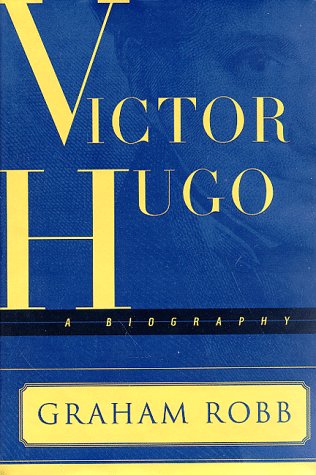

Victor Hugo Graham Robb.
Detalles de publicación: New York W.W. Norton & Co. c1997.Descripción: xix, 682 p. ill. 24 cmISBN:- 0393045781
- 848/.709 B 21
- PQ2293 .R54 1997
| Imagen de cubierta | Tipo de ítem | Biblioteca actual | Biblioteca de origen | Colección | Ubicación en estantería | Signatura topográfica | Materiales especificados | Info Vol | URL | Copia número | Estado | Notas | Fecha de vencimiento | Código de barras | Reserva de ítems | Prioridad de la cola de reserva de ejemplar | Reservas para cursos | |
|---|---|---|---|---|---|---|---|---|---|---|---|---|---|---|---|---|---|---|
| Libro | Biblioteca de Mayagüez Colección General mb | PQ2293 .R54 1997 (Navegar estantería(Abre debajo)) | Disponible | 50000003265310 |
Descripciones mejoradas de Syndetics:
The life of a writer whose books were such powerful social and political statements that he lived in exile from both France and England.Victor Hugo was the most important writer of the nineteenth century in France: founder and destroyer of the Romantic movement, revolutionary playwright, seminal poet, epic novelist, author of the last universally accessible masterpieces in the European tradition, among them Les Miserables and The Hunchback of Notre Dame. He was also a radical political thinker (and eventual exile); a gifted painter and architect; a visionary and mystic who conversed with Virgil, Shakespeare, and Jesus Christ -- in short, a tantalizing, protean personality who dominated, distracted, and maddened his contemporaries.Attempts to explain Hugo's bewildering complexity have generated a literature of memorable paradoxes. If there were a being higher than God, wrote Ford Madox Ford, one would have to say that it was Victor Hugo. Andre Gide, asked who the greatest French poet was, replied, Victor Hugo, alas And Jean Cocteau famously defined Victor Hugo as a madman who thought he was Victor Hugo.
Includes bibliographical references (p. 621-650) and indexes.
Reseñas proporcionadas por Syndetics
Library Journal Review
A highly praised biographer (Balzac, LJ 7/94) takes on the protean Hugo. (c) Copyright 2010. Library Journals LLC, a wholly owned subsidiary of Media Source, Inc. No redistribution permitted.Publishers Weekly Review
Acclaimed biographer Robb (Balzac, 1994) has produced an intensely dramatic biography of Victor Hugo laced with devastating wit and irony, which brings the great Romantic author down to earth from his Olympian heights without reducing him either to a megalomaniac opportunist or to a sheer force of nature. As a National Assembly deputy, Hugo (1802-1885) led assaults on workers' barricades in the revolution of 1848, during which untold numbers of insurgents died. Three years later, as a self-proclaimed revolutionary socialist opponent of dictator Louis-Napoleon, he went into exile, first to Brussels and then to England's Channel Islands, where he completed Les Misérables, which Robb considers "the most lucid, humane, and entertaining moral diagnosis" of modern society's corrupt institutions. Returning to France in 1870, Hugo mostly occupied himself with casual sex during the Prussian siege of Paris but also turned out inspirational political poems and pleaded for convicted Communards. A conservative who espoused liberal causes, an upholder of bourgeois values with one foot in the avant-garde, Hugo was full of contradictions, and Robb plumbs the messy reality of his life, illuminating many facets of his personality scarcely known outside France. He gives us Hugo the visionary poet and painter who held séances to commune with the spirits of Shakespeare, Jesus and Socrates; Hugo the sex addict and voyeuristic dandy; Hugo the guilt-ridden father of a schizophrenic daughter; Hugo the apostle of an incoherent new world religion; and Hugo the anarchist playwright, forerunner of Brecht and Beckett. Son of a brutish, philandering Napoleonic general and an erratic mother who dragged her brood into Spanish exile, Hugo, by age 16, saw his family fall apart and a whole society destroy itself. From this wreckage, Robb suggests, he produced prescient novels about the gradual suicides of civilizations, making him a prophet of modernism. In addition to presenting an absorbing account of Hugo's life and a critical appraisal of Hugo's work, Robb enriches his entrancing biography with his own unvarnished, unrhymed, highly effective translations of Hugo's verses. Photos. (Feb.) (c) Copyright PWxyz, LLC. All rights reservedCHOICE Review
Today many people believe that some 19th-century French writers were better than Victor Hugo, but no one disputes that he was the most important. As a teenager Hugo published with mature, successful poets and rapidly became the leader in the Romantic revolution that was to shake French letters to the core. His poetry, sometimes empty but always lovely, was read by the educated world and the whole of reading France. His novels marked several generations of readers and writers. Wherever he went he met adulation, which he graciously accepted, for he and everyone else knew that he was the greatest living writer and perhaps the greatest living man. At his death in 1885, all of Paris either watched or followed the pauper's hearse carrying his body. Robb, the talented author of the best biography of Balzac (Balzac, CH, Feb'95), has now written the best biography of Hugo. His awesome control of the enormous bibliography by and surrounding the writer results in a much better understanding of the personal and public complexities that created Victor Hugo. An excellent book for the general reader, student, and specialist alike. A. H. Pasco; University of KansasBooklist Review
Taking the measure of Victor Hugo requires such a range of talents--literary, psychological, scholarly, philosophical--that readers have had to wait more than a century for what Robb has finally produced: a balanced and complete critical biography. From Hugo's conception atop the Vosges Mountains to his interment near Rousseau in the Place de Pantheon, Robb unravels a tangled thread of genius--and self-contradiction. Neither the hagiography of Hugo's idolaters nor the slander of his rivals distracts Robb, who has scoured previously unavailable documents, correspondence, and journals (including an encrypted private journal tracking a frenetic sex life) to expose the inner tensions that made Hugo's private life painful, his politics perplexing, and his poetry powerful. Robb confronts the duplicities in Hugo's marital and family life and the inconsistencies in his political career with unflinching honesty. But it is in his treatment of Hugo's poetry, fiction, and drama that Robb most excels, as he penetrates the process through which imagination transforms the confusions of life into the radiance of art. Any public library with shelf space for Les Miserables and The Hunchback of Notre Dame should make room for this marvelous biography as well. --Bryce ChristensenNotas de autor provistas por Syndetics
Graham Robb's two previous books, "Victor Hugo" & "Balzac," were "New York Times" Notable Books. He lives in Oxford, England.(Bowker Author Biography)