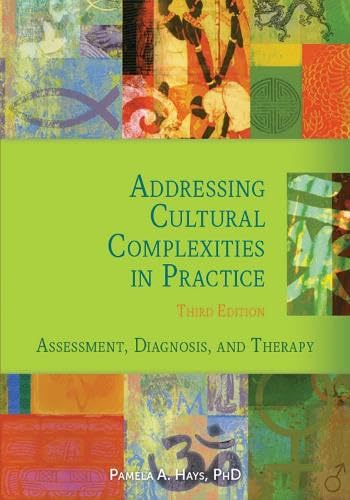

Addressing cultural complexities in practice assessment, diagnosis, and therapy Pamela A. Hays.
Detalles de publicación: Washington, DC American Psychological Association ©2016.Edición: Third EditionDescripción: vii, 355 pages 26 cm Tipo de medio:- 9781433821448
- 1433821443
- 158.3 23
- BF636.7.C76 H39 2016
| Imagen de cubierta | Tipo de ítem | Biblioteca actual | Biblioteca de origen | Colección | Ubicación en estantería | Signatura topográfica | Materiales especificados | Info Vol | URL | Copia número | Estado | Notas | Fecha de vencimiento | Código de barras | Reserva de ítems | Prioridad de la cola de reserva de ejemplar | Reservas para cursos | |
|---|---|---|---|---|---|---|---|---|---|---|---|---|---|---|---|---|---|---|
| Libro | Biblioteca Encarnación Valdés Colección General bev | 158.3 H425a3 (Navegar estantería(Abre debajo)) | Disponible | 80000002557570 |
Descripciones mejoradas de Syndetics:
In an increasingly diverse society, psychotherapists must be able to work effectively with a wide variety of clients. Hays' popular bestseller invites readers to move beyond a one-dimensional view of identity to a nuanced understanding of the overlapping cultural influences that affect us all. Her ADDRESSING framework encompasses Age and generational influences, Developmental or other Disability, Religion and spirituality, Ethnic and racial identity, Socioeconomic status, Sexual orientation, Indigenous heritage, National origin, and Gender. This third edition is richly illustrated with case material and includes up-to-date information on the DSM-5, ICD-10, and upcoming ICD-11, plus new sections on working with people in poverty, children, and transgender people; and trauma-informed care. Each chapter includes a Key Ideas summary and practice exercises, making it ideal for personal education or group use.
Revised edition of the author's Addressing cultural complexities in practice, 2008.
Includes bibliographical references and index.
Becoming a culturally responsive therapist -- The new reality: diversity and complexity -- Essential therapist qualities and essential knowledge -- Doing your own cultural self-assessment -- Making meaningful connections -- Let's talk : finding the right words -- Understanding clients' identities and contexts -- Creating a positive therapeutic relationship -- Sorting things out -- Conducting a culturally responsive assessment -- Using standardized tests in a culturally responsive way -- Making a culturally responsive diagnosis -- Beyond the treatment manuals -- Culturally responsive therapy : an integrative approach -- Indigenous, traditional, and other diverse interventions -- Pulling it all together : a complex case -- Conclusion.
Tabla de contenidos provista por Syndetics
- Acknowledgements(p. vii)
- I Becoming a Culturally Responsive Therapist(p. 1)
- 1 The New Reality; Diversity and Complexity(p. 3)
- 2 Essential Therapist Knowledge and Qualities(p. 19)
- 3 Doing Your Own Cultural Self-Assessment(p. 39)
- II Making Meaningful Connections(p. 61)
- 4 Let's Talk: Finding the Right Words(p. 63)
- 5 Understanding Clients' Identities and Contexts(p. 79)
- 6 Creating a Positive Therapeutic Alliance(p. 101)
- III Sorting Things Out(p. 125)
- 7 Conducting a Culturally Responsive Assessment(p. 127)
- 8 Using Standardized Tests in a Culturally Responsive Way(p. 161)
- 9 Making a Culturally Responsive Diagnosis(p. 195)
- IV Beyond the Treatment Manuals(p. 225)
- 10 Culturally Responsive Therapy: An Integrative Approach(p. 227)
- 11 Indigenous, Traditional, and Other Diverse Interventions(p. 257)
- 12 Pulling It All Together: A Complex Case Example(p. 283)
- 13 Conclusion: Looking to the Future(p. 299)
- References(p. 305)
- Index(p. 347)
- About the author(p. 355)
Notas de autor provistas por Syndetics
Pamela A. Hays, PhD, received her doctorate in clinical psychology from the University of Hawaii and completed a National Institute of Mental Health postdoctoral fellowship at the University of Rochester School of Medicine.She was on the graduate psychology faculty of Antioch University in Seattle, Washington, for 11 years, and in 2000, returned to her hometown on the Kenai Peninsula in Alaska, where she has worked in community mental health for the Kenaitze Tribe's Dena'ina Wellness Center, in private practice, and served on the Board of the Alaska State Psychological Association.
Her research has included work with Tunisian women in North Africa and with Vietnamese, Lao, and Cambodian people in the U.S.
She is the author of Connecting Across Cultures: The Helper's Toolkit and Creating Well-Being: Four Steps to a Happier, Healthier Life ; coeditor of the book Culturally Responsive Cognitive-Behavioral Therapy: Assessment, Practice, and Supervision ; and coauthor of the forthcoming book (with vidoe series) Cognitive Behavioral Therapy Techniques and Strategies .
Dr. Hays's work with clients is featured in several APA-produced DVDs, and she provides consultation and teaches workshops internationally.
For more information on Dr. Hays's clinical practice, publications, videos, and workshops, visit https://www.drpamelahays.com.