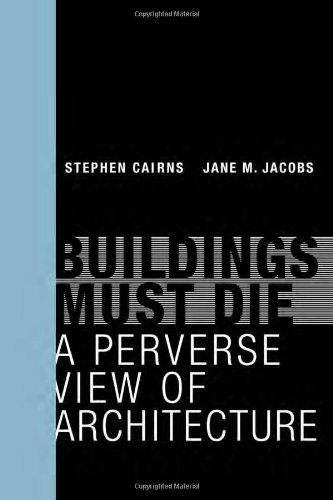

Buildings must die a perverse view of architecture Stephen Cairns, Jane M. Jacobs. txt
Idioma: Inglés Editor: Cambridge, Massachusetts The MIT Press [2014]Descripción: 298 p. ill. 23 cmTipo de contenido:- text
- unmediaded
- volume
- 9780262026932 (hardcover : alk. paper)
- 720.1 23
- NA2540 C32 2014
| Imagen de cubierta | Tipo de ítem | Biblioteca actual | Biblioteca de origen | Colección | Ubicación en estantería | Signatura topográfica | Materiales especificados | Info Vol | URL | Copia número | Estado | Notas | Fecha de vencimiento | Código de barras | Reserva de ítems | Prioridad de la cola de reserva de ejemplar | Reservas para cursos | |
|---|---|---|---|---|---|---|---|---|---|---|---|---|---|---|---|---|---|---|
| Libro | CARIBET Biblioteca Arquitectura Colección General CARIBET | General NA2540 C32 2014 (Navegar estantería(Abre debajo)) | 1 | Disponible | 91000000047761 |
Descripciones mejoradas de Syndetics:
Part memento mori for architecture, and part invocation to reimagine the design values that lay at the heart of its creative purpose.
Buildings, although inanimate, are often assumed to have "life." And the architect, through the act of design, is assumed to be their conceiver and creator. But what of the "death" of buildings? What of the decay, deterioration, and destruction to which they are inevitably subject? And what might such endings mean for architecture's sense of itself? In Buildings Must Die , Stephen Cairns and Jane Jacobs look awry at core architectural concerns. They examine spalling concrete and creeping rust, contemplate ruins old and new, and pick through the rubble of earthquake-shattered churches, imploded housing projects, and demolished Brutalist office buildings. Their investigation of the death of buildings reorders architectural notions of creativity, reshapes architecture's preoccupation with good form, loosens its vanities of durability, and expands its sense of value. It does so not to kill off architecture as we know it, but to rethink its agency and its capacity to make worlds differently.
Cairns and Jacobs offer an original contemplation of architecture that draws on theories of waste and value. Their richly illustrated case studies of building "deaths" include the planned and the unintended, the lamented and the celebrated. They take us from Moline to Christchurch, from London to Bangkok, from Tokyo to Paris. And they feature the work of such architects as Eero Saarinen, Carlo Scarpa, Cedric Price, Arata Isozaki, Rem Koolhaas and François Roche.
Buildings Must Die is both a memento mori for architecture and a call to to reimagine the design values that lay at the heart of its creative purpose.
Include index.
Includes bibliographical references (pages 247-286) and index.
Introduction: a feeling for the inert -- Design, creativity and architecture's natalism -- Terminal literacy: dross, rust and other architectural junk -- Towards a general economy of architecture -- Decay -- Obsolescence -- Disaster -- Ruin -- Demolition -- Ecological horizons.
Reseñas proporcionadas por Syndetics
CHOICE Review
This book explores the relationship between architecture and the adage memento mori (remember all things must die). Cairns (Singapore-ETH Centre) and Jacobs (Yale-NUS College, Singapore) hope to find both theoretical and practical value in the exercise. Early chapters bring together borrowed musings on the ways that the inevitability of death informs various disciplines and may help shed light on architecture. The coverage is thorough and reliable, though the application to architecture is not always clear. As evidenced by their titles ("Decay," "Obsolescence," "Disaster," "Ruin," and "Demolition"), five chapters examine architectural projects that have met different fates and ways different manners of demise affect one's appreciation of an architectural offering. The final chapter uses ideas from William McDonough and Michael Braungart's Cradle to Cradle: Remaking the Way We Make Things (CH, Oct'02, 40-0914) to justify a focus on the demise of buildings as a way of advancing architecture. Included are a few helpful illustrations, extensive notes, and a thorough bibliography. This is a good book with a narrow (and admittedly curious) focus that may find a limited audience. Those with considerable prior understanding of the field of architecture and/or issues of mortality likely will appreciate it most. --David Sachs, Kansas State UniversityNotas de autor provistas por Syndetics
Stephen Cairns is Scientific Director of the Future Cities Laboratory at the Singapore-ETH Centre. Jane M. Jacobs is Professor of Urban Studies at Yale-NUS College, Singapore.